

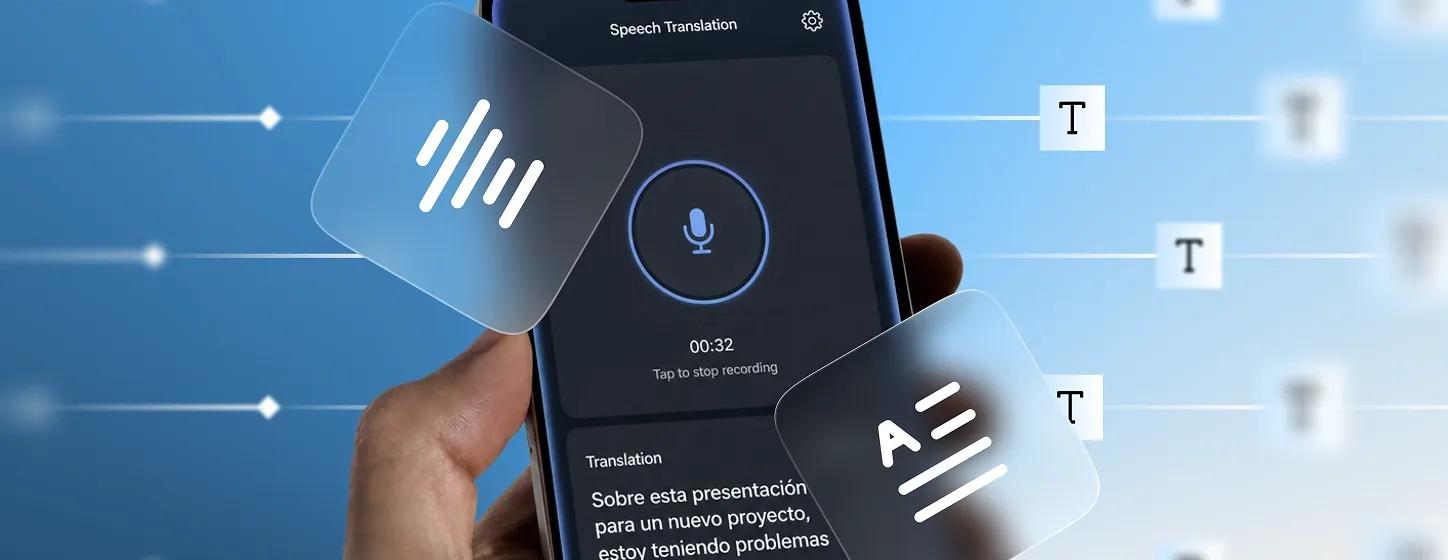
Think about the last time you used your phone's keyboard while driving. You didn't – you spoke. Somewhere between that moment and the message appearing on screen, a system made a series of decisions about sound that most people never think about, and got them right in under a second.
That system is speech-to-text. And while it shows up in places that feel mundane – meeting notes, customer service logs, voice search – what's running underneath is anything but simple.
This article breaks down how the technology actually works, which platforms handle it differently, and what the trade-offs look like when you're deciding whether to build with it.
What is speech-to-text?
Speech-to-text (also written as STT, or called Automatic Speech Recognition – ASR) is the technology that converts spoken words into written text. It works in real time as someone speaks, or it processes a recorded audio file after the fact. The naming can be confusing. Speech-to-text, speech recognition, and ASR all refer to the same conversion process. Voice recognition is different – that technology identifies who is speaking, not what they said. If you’ve heard these terms used as if they mean the same thing, now you have a reason to push back.
A short history in three eras
The technology didn’t arrive fully formed. It evolved through three distinct generations:
- 1952–1990s: Bell Labs built AUDREY in 1952 – a system that could recognize ten spoken digits from a single voice. IBM’s Shoebox (1962) extended that to 16 words. Dragon Dictate, released in 1990, was the first consumer-grade dictation product, priced at around $9,000 and requiring dedicated hardware. Progress was real but slow.
- 2000s–2010s: Statistical models replaced rigid rule-based systems. Google Voice Search, launched in 2007, let users dictate search queries on mobile phones. Recurrent Neural Networks (RNNs) and Long Short-Term Memory (LSTM) networks then pushed accuracy well past what hand-coded rules could achieve, opening the door to mass-market adoption.
- 2020s–present: Transformer-based, end-to-end models now lead the field. Systems like OpenAI Whisper, wav2vec 2.0, and Google’s Conformer process audio through a single neural network rather than a chain of separate components. Modern STT systems exceed 90% word-level accuracy on clean audio – a threshold that would have seemed unreachable twenty years ago.
How does speech-to-text work step by step?
By the time a word appears on screen within the speech-to-text system, the audio has been through five separate processing stages – each one solving a problem the previous step couldn't.
Step 1 – Audio input and signal processing
The microphone captures raw sound as an analog waveform. That waveform is messy – air conditioning, keyboard clicks, a conversation two desks over. Noise cancellation filters what it can, and what's left gets digitized, sampled at 16 kHz or higher. This is where the ceiling gets set. A bad recording doesn't get rescued downstream; it just produces bad text faster.
Step 2 – Feature extraction
The clean digital signal gets sliced into frames of around 20–30 milliseconds each. Short enough that the audio within each frame is roughly stable. Each frame is then compressed into a set of numbers using Mel-Frequency Cepstral Coefficients (MFCCs) – a method designed around how the human ear actually processes frequency, not how a microphone measures it. The waveform is gone at this point. What the model receives is a matrix of numbers.
Step 3 – Acoustic modeling
Those numbers get mapped to phonemes – the individual units of sound that make up spoken language. English has 44 of them. Earlier systems used Hidden Markov Models for this; they worked reasonably well on clean audio from known speakers, and fell apart on most other conditions. Deep neural networks handle the same task now, trained on millions of hours of labeled audio across accents, recording environments, and speaking speeds. The difference in robustness is substantial.
Step 4 – Language modeling
Here is where "to," "two," and "too" stop being the same thing. Phonemes don't carry meaning on their own – they need a language model to determine which word sequence actually makes sense given the context. Statistical n-gram models did this for years, looking at short windows of surrounding words. Transformers do it now, with far longer context and better handling of grammatical structure.
Step 5 – Decoding and text output
The decoder – usually a beam search algorithm – runs through the candidate word sequences and picks the most probable one. Punctuation gets added, speaker labels if the system is configured for them, formatting where applicable. The transcript then arrives one of two ways: streaming, where text appears as the person speaks, or batch, where the full output lands after processing is complete. Batch is more accurate. Streaming is more useful for real-time products.

Implement speech-to-text into your workflows
Types of speech-to-text systems
Not all STT systems work the same way – the right type depends on your use case, latency requirements, and infrastructure. Here is how they compare.
Type | How It Works* | Best For | Limitations |
|---|---|---|---|
Rule-based / Template | Fixed vocabulary; pattern matching on predefined phrases | Legacy embedded systems with narrow vocabulary | Very limited scope; largely obsolete outside embedded hardware |
Statistical / HMM-based | Probabilistic acoustic and language models | Mid-generation enterprise tools still in production | Slow to adapt to new domains; struggles with accents |
Deep learning-based | Neural networks trained on large labeled datasets | Most modern commercial STT deployments | High compute cost; significant training data requirements |
End-to-end models | Single neural network handles all processing stages (e.g., Whisper, Conformer) | High-accuracy production systems; multilingual audio | Highest compute cost; less transparent to debug |
Cloud API | Hosted inference via third-party provider | Teams without ML infrastructure | Requires connectivity; audio leaves your environment |
On-device | Model runs locally on device hardware | Offline or privacy-sensitive applications | Smaller vocabulary; typically lower accuracy than cloud |
Decision point: If your product handles sensitive data – health records, financial transactions, legal conversations – on-device processing may be worth the accuracy trade-off. Teams evaluating this or other architectures can get a structured assessment from DigitalSuits' AI consulting services.
Key speech-to-text platforms and APIs
Here is how the major providers actually differ in practice.
Google Speech-to-Text is the broadest out of the box. It covers 125+ languages, includes speaker diarization natively, and connects to the rest of the GCP ecosystem without additional configuration. The trade-off is lock-in – it performs best when your infrastructure is already on Google Cloud, and per-minute billing scales less predictably than flat-rate alternatives as volume grows.
Amazon Transcribe earns its place in regulated industries. It ships domain-specific models for medical and legal audio, supports custom vocabulary lists, and slots cleanly into existing AWS infrastructure. The per-second billing model is more granular than per-minute pricing – which matters at enterprise volume – and the compliance documentation for HIPAA and GDPR environments is among the most mature of any managed provider.
IBM Watson Speech-to-Text is the pick when customization depth matters more than language breadth. It supports fine-tuning at both the acoustic and language model level, offers WebSocket-based real-time streaming, and has a long track record in enterprise compliance deployments. The catch is language support – 16 languages versus 100+ for Google or AWS – which makes it a strong choice for English-heavy regulated use cases and a harder sell for multilingual products.
Deepgram is built for speed above all else. Its streaming latency is consistently lower than most managed competitors, and its Word Error Rate on domain-specific audio is competitive enough to challenge larger platforms in real-world conditions. The trade-off is maturity – language support tops out at 30+ languages and the ecosystem is smaller than Google or AWS. If your product needs text to appear as someone speaks – live captioning, real-time agent assist, voice-controlled interfaces – Deepgram is the one to benchmark first.
OpenAI Whisper is trained on 680,000 hours of multilingual audio collected from the web, which makes it unusually strong on accents and mixed-language speech. It doesn't offer native real-time streaming, but its open-source license means teams can self-host it without per-request billing – a meaningful cost advantage at scale. For a deeper technical profile, the DigitalSuits blog post on what OpenAI Whisper is and how to make the most of it is worth reading alongside this article.
AssemblyAI is worth a separate mention. Unlike Whisper, it's a fully managed API – no infrastructure to run, no model to host. Beyond speech-to-text conversion, it ships sentiment analysis, speaker diarization, entity detection, and auto-chapters as native features, which removes the need for separate post-processing pipelines. The trade-off is vendor dependency and per-minute billing; the gain is a significantly shorter path from audio to structured data.
DigitalSuits used AssemblyAI as the transcription layer for the Synsel staffing agency. The task was to transcribe candidate interviews in real time and feed the output into AI layers that scored responses and generated structured summaries for hiring managers. What had taken hours of manual screening was resolved within minutes of each call ending – the transcript became the entry point for the entire evaluation and hiring workflow.
The table below maps each major provider to the scenarios where it genuinely performs.
Platform | Standout Feature | Language Support | Best For | Pricing Model |
|---|---|---|---|---|
Google Speech-to-Text | Multilingual support; speaker diarization | 125+ languages | Teams already on Google Cloud | Pay-per-minute |
Amazon Transcribe (AWS) | Domain-specific models for medical and legal | 100+ languages | Enterprise; regulatory environments | Pay-per-second |
IBM Watson Speech-to-Text | Acoustic + language model customization; WebSocket streaming | 16 languages | Enterprise compliance (HIPAA, GDPR) | Tiered; includes free tier |
Deepgram | Low-latency streaming; competitive Word Error Rate on domain audio | 30+ languages | Real-time voice applications | Pay-per-minute or flat subscription |
OpenAI Whisper | Open-source; 680,000 hours of multilingual training data | 57 languages | Offline deployments; accent-heavy audio | Self-hosted (compute costs only) |
AssemblyAI | Built-in sentiment analysis, entity detection, auto-chapters | English-first, expanding | Developer teams; podcast and media products | Pay-per-minute |
Real-world use cases for speech-to-text
Speech-to-text is already embedded in products across every major industry. Here are six applications where it delivers measurable, practical value.
- Medical transcription. Doctors dictate patient notes; STT reduces documentation time and writes directly into Electronic Health Record (EHR) systems. Nuance’s Dragon Medical One is the most widely deployed example in clinical settings, reducing physician documentation time.
- Customer service and call analytics. Transcribing calls in real time lets contact centers detect sentiment, flag compliance risks, and supply agent-assist tools without manual review. The transcript becomes a structured data asset – searchable, auditable, and useful for training – rather than an audio file sitting on a server.
- Meeting transcription. Otter.ai, Microsoft Teams, and Zoom now generate searchable meeting notes automatically. The underlying STT layer handles multiple speakers, overlapping audio, and inconsistent microphone quality – conditions that would have broken earlier systems entirely.
- Accessibility. Live captions for the deaf and hard-of-hearing community; voice navigation for users with motor impairments. This is where speech-to-text stops being a product feature and starts being infrastructure for equal access.
- Voice search and smart assistants. Siri, Alexa, Google Assistant, and Cortana all use STT as their input layer. Without it, the downstream intelligence – intent classification, entity extraction, task execution – has nothing to work from.
- Legal and media transcription. Court reporters, journalists, and podcast producers use STT to speed up transcript production. Accuracy on domain-specific vocabulary still varies by provider, but custom language models close most of the gap for teams that invest in them.
The common thread is consistent: speech-to-text converts unstructured audio into structured, searchable, actionable data. That’s the real value, regardless of industry.
Transform the way you work with custom speech-to-text solutions
Challenges and limitations of speech-to-text
Even the best STT systems have blind spots. Knowing where they fall short helps you design around them.
- Accents, dialects, and multilingual speech. Accuracy drops for speakers with underrepresented accents or those who switch between two languages mid-sentence. For example, models trained predominantly on American English show measurably higher Word Error Rates on South Asian English or Caribbean dialects. This is an active research area, but it hasn’t been solved.
- Background noise and audio quality. Poor microphone quality or a noisy environment is still the single biggest source of transcription errors. Signal quality going into the model sets a ceiling on accuracy coming out. No algorithmic improvement fully compensates for a bad recording.
- Homophones and context disambiguation. “Bare” and “bear” are acoustically identical. So are “their,” “there,” and “they’re.” The language model resolves these using surrounding context – but that resolution fails when the sentence doesn’t provide enough signal.
- Domain-specific vocabulary. Out-of-vocabulary medical, legal, or technical terms inflate Word Error Rate unless a custom language model is trained on domain data. Most APIs offer custom vocabulary support; maintaining that vocabulary list is an ongoing operational cost that teams often underestimate.
- Real-time latency trade-offs. Streaming transcription trades a small amount of accuracy for speed. Batch processing is more accurate but asynchronous. The right choice depends on whether your product needs text to appear as the person speaks, or whether accuracy matters more than immediacy.
- Privacy and compliance. Cloud-based transcription sends audio to third-party servers – a concern for GDPR, HIPAA, and PCI-DSS environments. On-device processing eliminates the data-transfer risk but narrows model choices and usually reduces accuracy.
Where is speech-to-text heading?
Zero-shot multilingual transcription. Models like Whisper already handle 57 languages with a single model checkpoint. The next milestone is near-accurate transcription of low-resource languages – those with limited training data – without language-specific fine-tuning.
Multimodal AI. Speech-to-text is converging with computer vision and text understanding. Early research systems can already transcribe a video, read on-screen text, and summarize both together. That convergence is moving toward production faster than most product roadmaps anticipate.
Emotion and tone detection. Next-generation ASR will flag frustration, urgency, or hesitation in addition to transcribing words. The applications are direct: routing frustrated callers before they escalate; supporting clinicians with session notes that include affective signals alongside the transcript.
Edge and on-device processing. Apple Silicon, Qualcomm’s NPU chips, and similar hardware improvements are pushing full Whisper-class models onto mobile and edge devices. When the model runs on the device, cloud round-trip latency and data-transfer privacy risks disappear at the same time.
STT and LLM convergence. Raw transcripts are increasingly fed directly into large language models for summarization, action extraction, or autonomous agent workflows.
Conclusion
Speech-to-text has moved well past the era of novelty demos and clumsy dictation software. It runs in hospitals, scales across millions of call-center minutes per day, and now fits on a mobile chip without a cloud connection. The accuracy gap between managed APIs and human transcription has narrowed to the point where the argument for adoption is rarely about accuracy anymore – it’s about fit.
The real decision isn’t whether to add voice capabilities to your product or workflow. It’s which approach fits your architecture, compliance requirements, and budget today. Cloud API or on-device? Whisper integration or a managed provider? Off-the-shelf model or domain fine-tuning?
For teams that want a technical partner to evaluate and implement a speech-to-text solution end-to-end, DigitalSuits AI integration services cover the full stack – from provider selection and architecture review to integration and deployment. Contact us for an initial consultation and your project estimation.
Written by
 Anton ShevchenkoTeam Lead/AI Advisor
Anton leads AI initiatives at DigitalSuits, advising businesses on adopting and implementing AI technologies — from generative AI to intelligent automation. He translates emerging AI capabilities into production-ready solutions for client teams
Was this helpful?
0No comments yet