



Synsel cuts cost per sourced candidate by 60% with AI-powered automation
Synsel is a Dutch staffing agency that places technical specialists – mechanical, electrical, and industrial automation engineers and technicians – with employers across the Netherlands. It works with 2,500+ partner companies.
The business model is candidate-first: a sales consultant interviews a technician, learns their skills and preferences, then finds the best-fitting vacancies in the database and ships that candidate to the right company. Like most staffing businesses, Synsel's growth is bound by three cost levers:
- how much it spends on marketing to bring candidates into the pipeline
- how much administrative time each candidate consumes before being placed
- how much it costs to keep an experienced, well-trained sales team in an industry where turnover is the norm rather than the exception.
Client
Synsel
Country
Netherlands
Industry
Partnership period
February 2023 – now
Team
4 Full-stack engineers, 1 Fractional CTO, 1 DevOps Engineer, 1 Project Manager, 1 QA Engineer
Services
Growing the business without increasing operational costs
Synsel set a clear mandate for growth: cut marketing budget and increase sales team output. Here are the exact challenges we had to address to help the client achieve that goal:
Consultant turnover was quietly driving up hiring and training costs
Consultants in staffing sales typically stay around two years, and at Synsel a significant share of that went into ramp-up alone, given how much manual work new hires had to learn. Synsel was seeking to shorten that ramp-up while cutting the burnout that was driving attrition.
Enormous spend on inbound-first marketing
Synsel's candidate pipeline was roughly 70% inbound, meaning they had to spend on paid ads, subscriptions to job boards, and email marketing to generate leads (aka qualified candidates). Plus, consultants manually reached candidates on LinkedIn to fill the gaps. Keeping the pipeline full ate up a huge share of the budget every year, which was one of the company's highest recurring costs.
The company needed an automated, outbound-first strategy that could grow the pipeline while minimizing marketing spend.
A vacancy database built entirely by hand
Every vacancy in the system is also a potential employer to pitch a candidate to. Plus, the fresher the vacancy base, the more chances to match someone already in the candidate pool. A five-person team kept the database full: scanning job boards, checking duplicates, matching listings to companies, and typing them into the ATS. It worked, but slowly and with errors – for example, new vacancies could take up to 3 days to go live, often too slow to beat a competitor to the deal. And running that team was its own ongoing cost. The client wanted to speed up the process and grow the clean base without increasing costs.
So, the task for DigitalSuits was to help Synsel reduce the administrative costs by optimizing the three processes outlined above.
"We needed to grow our candidate pipeline and place more people, without just throwing more headcount and marketing budget at the problem. Sourcing, screening, and matching candidates were almost entirely manual, and it was starting to cap how fast we could scale."
 Marco KoersCEO, Synsel Techniek
An AI-powered ATS to streamline the whole business flow
The DigitalSuits team built an AI-powered operations layer across the full candidate-to-placement lifecycle – running on Node.js and Next.js, with GCP Composer orchestrating the automation pipelines and Google Cloud infrastructure (Kubernetes, Terraform) behind it.
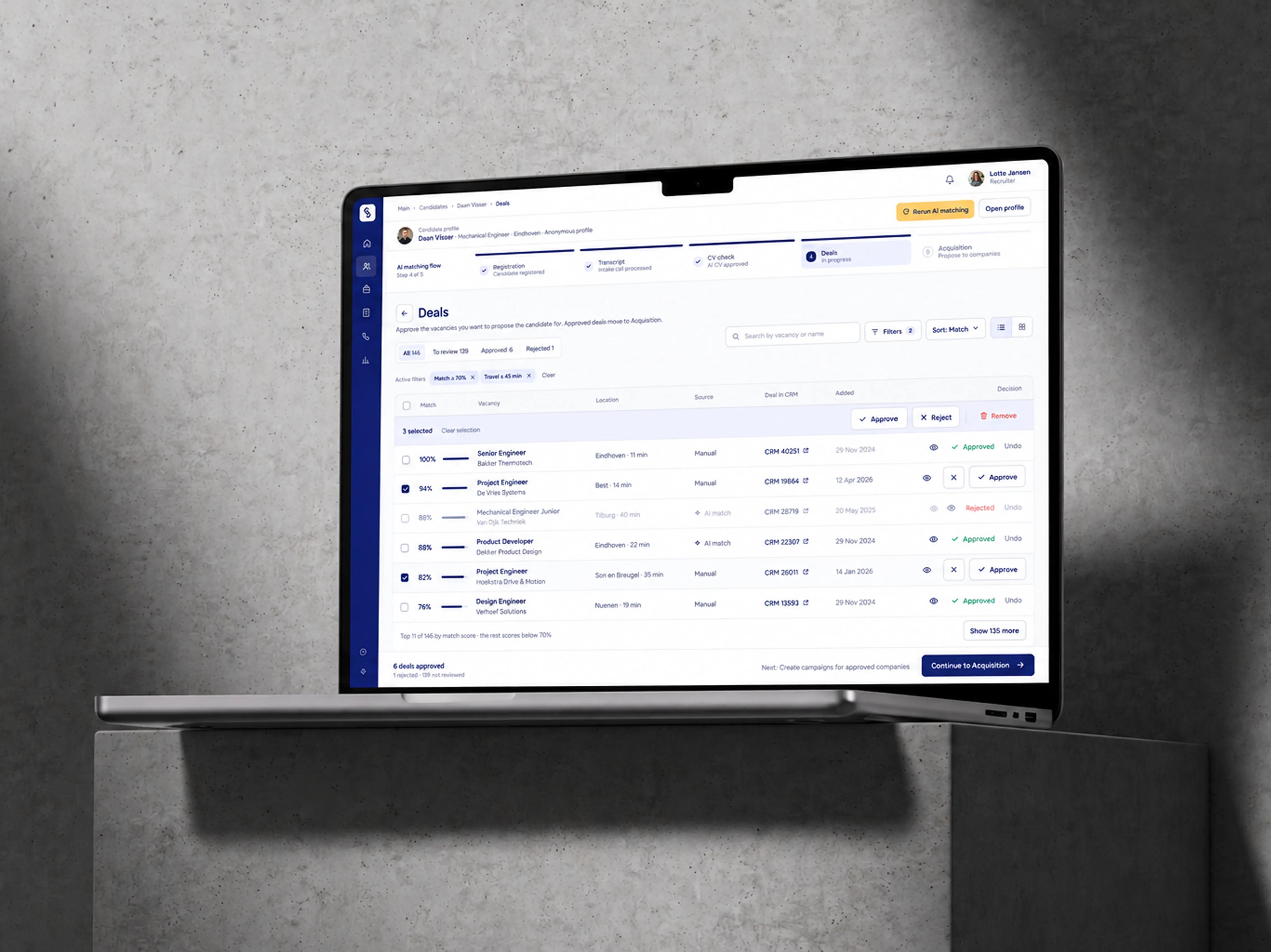
We wired it all into one custom applicant tracking system (ATS) the sales consultant team uses every day, closing the gaps Synsel was looking to address.
Getting new vacancies in front of consultants within an hour
We integrated Synsel's ATS with a Dutch vacancy-aggregating service that pulls listings from roughly 20 external job boards. New vacancies are pulled in automatically every hour, deduplicated, matched to an existing company or used to create a new one, and enriched with additional data. The scrapped vacancies are also automatically regenerated with AI to get published on the Sysnel's website for attracting new leads.
As a result, vacancies now reach the website and sales consultants in about an hour instead of days, pulled in far more frequently than the old manual checks ever managed. The records themselves are cleaner, with far fewer errors slipping through. And fewer people are involved in the process, with oversight limited to what comes in.
Automating outbound sourcing and outreach
We built a system that turns market-wide job activity into a live sourcing channel:
- It captures candidates the moment they apply to any listing on the aggregated job boards, not just Synsel's own postings.
- Each candidate is scored against Synsel's live vacancy pool using a retrieval-augmented generation (RAG) approach with vector similarity search – powered by Vertex AI Search – which ranks openings by fit and then filters further by realistic commute distance, calculated through a routing service that compares the candidate's location against the company's.
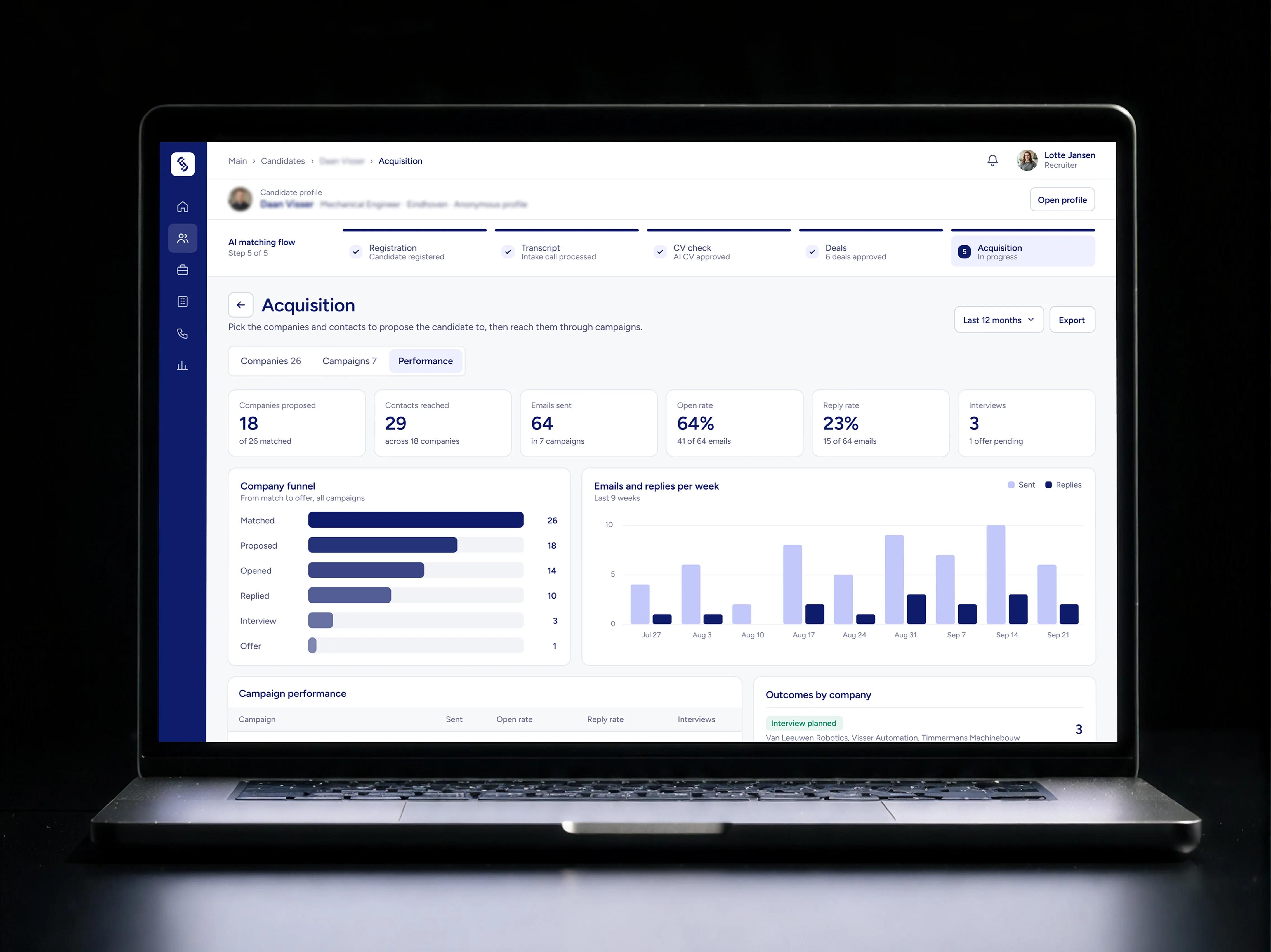
- Qualified matches get an automated outreach message over WhatsApp and email.
- Candidates who reply are routed straight to a consultant for a live call.
- A separate re-engagement flow also periodically resurfaces past candidates who were qualified but never placed.
This new sales channel closed a costly loophole in the old marketing setup. Previously, a candidate who visited the site and left had to be won back through paid remarketing on Google and Facebook. That remarketing also depended on a costly customer data platform to track which channel brought each candidate back. Reaching candidates automatically, at the moment they're active elsewhere, made both the ad spend and the attribution platform's cost unnecessary. On top of that, the new channel converts at about 20% – making it not just cheaper, but more effective than the approach it replaced.
Taking the paperwork off consultants' plates
The three tasks that used to eat into a consultant's day are now automated:
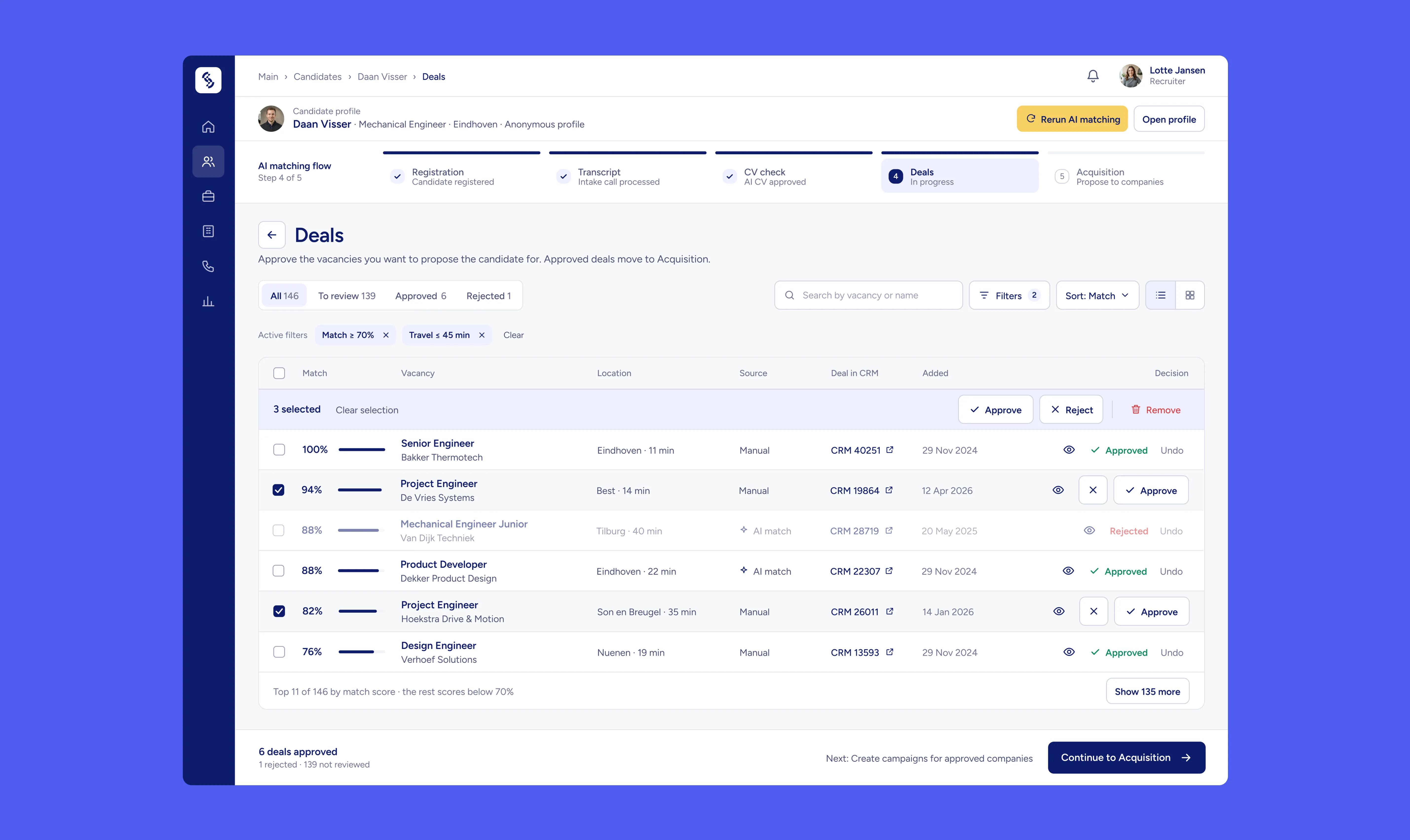
- CV generation. An OpenAI-powered pipeline builds an anonymized, client-ready CV directly from the call transcript, the candidate's LinkedIn profile, and their original CV – stripped of names and other identifying details before it ever reaches a hiring company. 95% of generated CVs need no manual edits.
- Vacancy matching. The same RAG-based matching engine that powers outbound sourcing runs here too, scoring candidates against a live pool of over 150,000 vacancies and surfacing up to 250 relevant matches per candidate, each with a plain-language explanation of why it fits – a talking point junior consultants can reuse directly in a pitch.
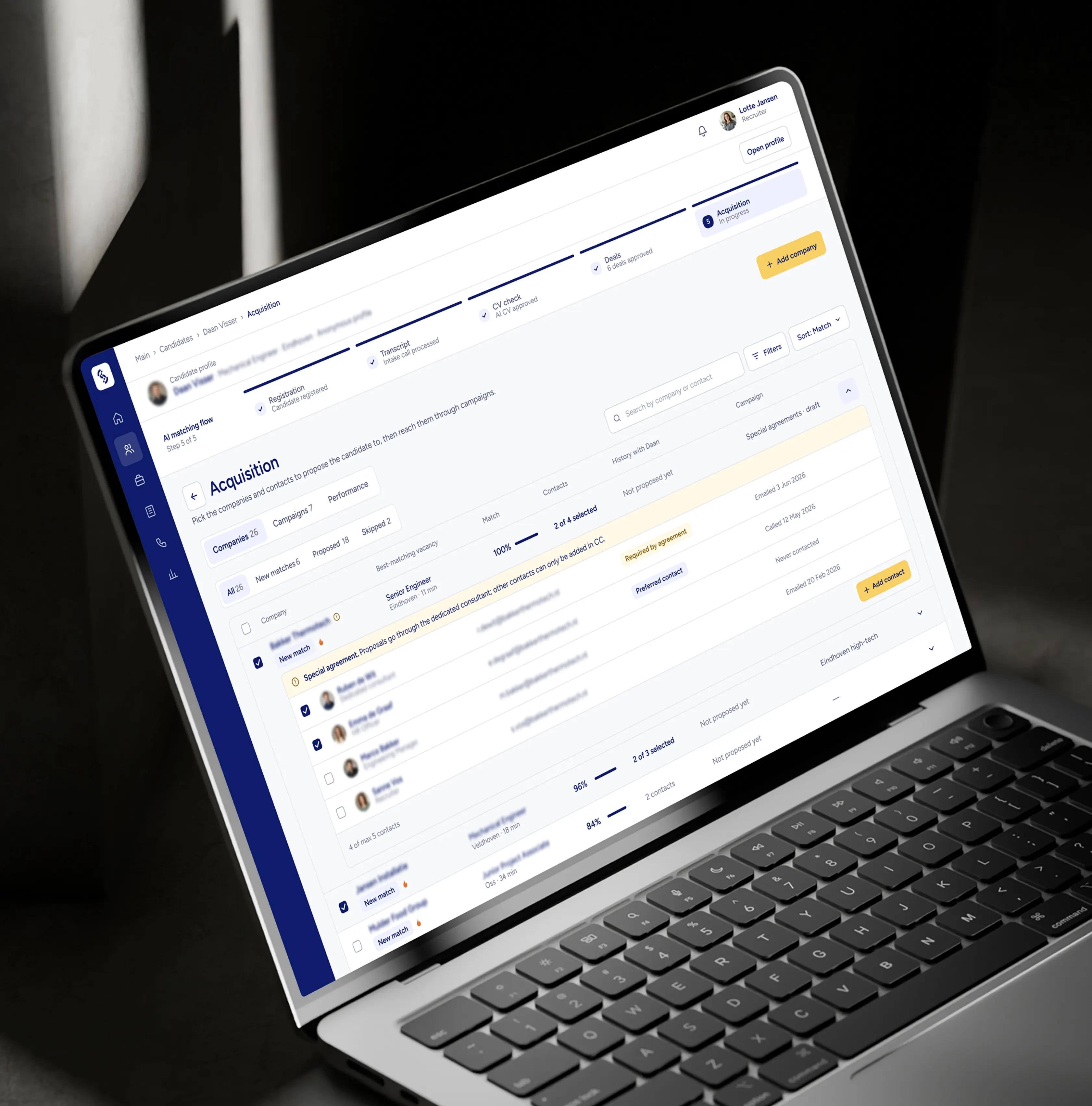
- Outreach emails. Once a CV is ready, the system also identifies the right contact at the hiring company – pulling from internal records and external sources, then flagging the best person to reach – and drafts a personalized outreach email referencing the specific match, ready for a quick review and send.
Making call quality visible, so ramping up is faster and steadier
Every prescreen call now runs through an automated pipeline:
- The call is recorded and transcribed using AssemblyAI's speech-to-text API
- An AI pipeline scores it against Synsel's required discovery script, checking tone of voice and question coverage, and produces a 0-5 quality score, a summary, and concrete follow-up actions
- The same transcript feeds directly into the CV and outreach-email generation described above, so nothing gets re-typed or re-explained further down the pipeline
Every consultant now gets objective feedback on their calls, including recommendations on where to improve their pitch. That shortens the learning curve, cuts the stress, and gives new consultants a clearer path to better results.
"The biggest shift wasn't any single feature. It's that our consultants now open the platform DigitalSuits built, where everything is AI-driven and organized to help them work more efficiently. We source 3x the candidates with the same team, and our cost per candidate dropped by about 60%."
Marco KoersCEO, Synsel Techniek3x more candidates sourced monthly, 60% lower cost per candidate
Automation now runs the Synsel flow end to end. As a result, more candidates enter the pipeline at a lower cost, and consultants work from clear step-by-step guidance with far less routine.
Here's what that looks like in numbers:
~60% lower CAC
automated outreach replaced heavy reliance on paid ads for candidate acquisition
3x more candidates
sourced every month, without growing the team
50% faster onboarding
ramp time for new sales managers dropped from 6 months to about 3
530 hours saved monthly
on admin work (equal to 3 full-time data research specialists)
50% larger pool
from integrating the ATS with the scraping service
40–50% cleaner data
in the ATS now catches every duplicate automatically
~60% return to the hiring funnel
as automated nurturing brings back unplaced candidates, lowering CAC