

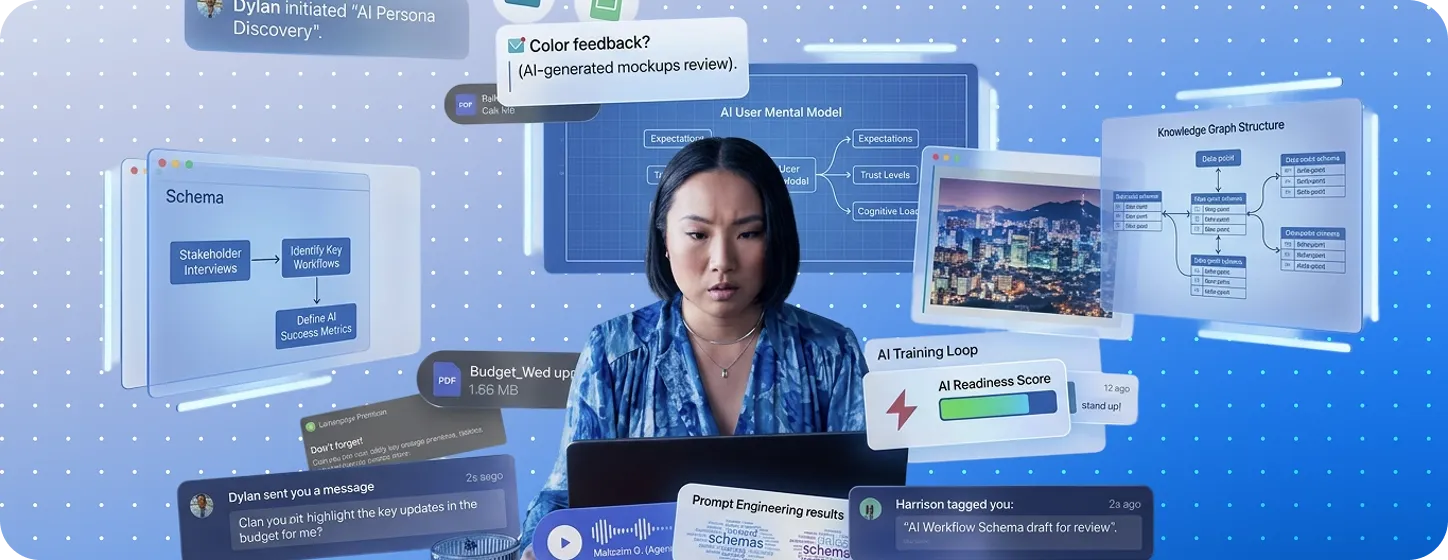
Many teams skip product discovery entirely — or rush through it because interviews take weeks and synthesis takes even longer. So they build on gut instinct, ship features nobody asked for, and wonder why adoption is flat.
AI for product discovery changes that equation. Not by replacing the judgment calls that matter, but by handling the parts that slow teams down: pattern-spotting across dozens of transcripts, surfacing signals buried in support tickets, simulating user responses to new concepts before a single line of code is written.
What does good product discovery with AI look like? And where do you actually start? This guide breaks down where AI fits in the discovery process, which tools are worth your time, and how to tell whether it’s working.
TL;DR: AI-driven product discovery essentials
- AI in product discovery speeds up research synthesis, surfaces hidden user patterns, and helps teams validate product ideas earlier — without replacing human judgment.
- Traditional discovery struggles with slow feedback loops, siloed data, and inconsistent prioritization. AI directly addresses that.
- Key use cases: automated interview analysis, sentiment clustering, feature prioritization, and rapid concept validation.
- Best tools by job-to-be-done: Dovetail for insight management, Maze for rapid testing, Productboard for roadmap prioritization, Sprig for in-product feedback.
- Measure impact with: time-to-insight, decision confidence, feature adoption rates post-launch, and the ratio of validated to unvalidated releases.
What is product discovery in software development lifecycle?
Product discovery is the front end of the software development lifecycle (SDLC) — the phase where teams answer two questions before writing code: What problem are we solving? and Is this the right way to solve it?
In practice, it covers user research (interviews, surveys, usability tests), competitive analysis, requirements clarification, and early validation of hypotheses. Get it right, and development teams build things users actually want. Get it wrong, and you spend three sprints building a feature that gets cut in the next quarter.
Discovery sits between ideation and detailed design. It’s the phase with the lowest cost to change direction — which is exactly why skipping it is so expensive downstream. Research from CB Insights found that up to 42% of startup failures trace back to “no market need.” That’s a discovery failure, not an engineering one.
Done well, discovery is iterative and continuous — not a single phase before a big launch. Teams that run weekly discovery rituals make smaller, more confident bets throughout the entire SDLC.
Challenges of traditional product discovery
Even teams that invest in discovery run into consistent friction points. The most common ones:
- Slow synthesis. A single round of user interviews generates hours of recordings and pages of notes. Synthesizing all that into actionable findings manually can take a researcher a full week. By the time results land, the sprint has moved on.
- Insight fragmentation. Research lives in Drive folders, Notion pages, Slack threads, and individual researchers’ heads. Ask “what do we know about onboarding friction?” and you’ll get five different answers from five different people.
- Confirmation bias in prioritization. Without structured data, decisions often go to whoever argued most convincingly in the room. Gut feeling dressed up as product intuition.
- Coverage gaps. Traditional discovery relies on recruited participants — a self-selected group that rarely represents the full user base. Churned users, lurkers, and power users all carry different stories that standard research misses.
- The speed vs. depth tradeoff. Moderated interviews are rich but slow. Surveys are fast but shallow. Teams often have to pick one rather than running both.
Let's see how AI empowers product discovery and which tools help address the most common problems.
Benefits of using AI for product discovery
AI doesn’t eliminate these problems overnight, but it meaningfully reduces friction across all five.
Speed is the most immediate gain. What used to take a researcher three days — tagging transcripts, clustering themes, drafting a synthesis summary — can now take under an hour with the right tool. That shift is well documented: Maze’s 2026 Future of User Research Report found that 88% of researchers identify AI-assisted analysis and synthesis as the top trend impacting their field, and 63% of teams using AI tools report faster research turnaround. Teams running continuous discovery often report a 3–5x reduction in time from research to decision.
Pattern detection at scale is where AI genuinely outpaces manual work. When Productboard’s AI analyzes thousands of support tickets and feature requests, it surfaces recurring themes that no human reviewer would catch across that volume. The signal is there in the noise; AI makes it visible.
AI in product discovery also extends research coverage. LLM-based tools can simulate responses to product concepts, letting teams pressure-test ideas before scheduling a single interview. Research from Harvard Business Review on generative AI for early-stage market research found that these simulations can closely approximate traditional survey findings — at a fraction of the time and cost.
And prioritization becomes more defensible. When feature scoring ties to real feedback volume, sentiment trends, and strategic alignment rather than whoever spoke loudest in the last planning session, roadmap decisions carry more weight with both engineering and leadership.
Using AI for product discovery. Which tools to use and when
No single tool covers everything. The right stack depends on which question you’re trying to answer first.
Tool | Best for | Not suited for |
|---|---|---|
Long-term insight management; centralizing mixed research across distributed teams | Running tests or generating new data | |
Fast prototype validation; usability testing; concept testing | Deep, moderated qualitative sessions | |
Feedback aggregation; roadmap prioritization; stakeholder alignment | Generating new user insights from scratch | |
In-product micro-surveys; real-time behavioral triggers | Unmoderated prototype testing |
Think of these tools in two groups. Maze and Sprig help you gather new data — they go out and ask users questions. Dovetail and Productboard help you make sense of data you already have — interviews, tickets, feedback sitting in various places. A solid discovery setup needs both.
Thinking about integrating AI into your product or development process? DigitalSuits offers custom AI development services that include everything, from discovery tooling to full-cycle delivery. Talk to our team.
AI in product discovery. Use cases
How to actually improve product discovery with AI? Let's see how the AI-powered tools address the most common bottlenecks in the product discovery process.
Research synthesis and theme detection
Upload interview transcripts to Dovetail, and instead of spending days reading through everything manually, it tags key quotes, groups recurring themes, and puts a summary in front of you. Companies like Canva use this to handle large volumes of research without hiring more people to keep up.
Sentiment analysis and feedback clustering
Sprig pops up short surveys inside your product right when a user does something specific — not in a follow-up email they'll ignore three days later. Responses get grouped by topic automatically, and the tool flags which complaints are showing up more often over time. You see what's frustrating users this week, not last quarter.
Feature prioritization support
Productboard pulls in feedback from email, Salesforce, Slack, and support tickets into one place. Instead of a PM manually digging through hundreds of requests, the tool surfaces which features come up most, which user segments are asking, and how each request maps to the broader strategy. Much easier to walk into a planning meeting with a defensible list.
Rapid concept validation
Maze turns a Figma prototype into a shareable usability test in minutes. Follow-up questions fire automatically as users click through — "which part of the navigation stopped you?" — so you get specific answers rather than vague impressions. A round of testing that used to take a full research sprint can now run on its own over a couple of days.
DigitalSuits' insights on using AI in product discovery
At DigitalSuits, we provide product discovery services to help our clients decide on which functionality they need to develop and which features to build first. To analyze the massive scope of information associated with the client's product, we adopted an agentic approach using Claude capabilities.
This way, we can not only summarize the insights and see the trends within a short period of time, but also identify the product gaps where development is required. This approach also helps our team ask stakeholders the right questions and find the best solutions for their requests. How does it work in practice?
When a new project comes in for discovery, we collect everything the client can give us — call recordings, documents, requirements, briefs. All of it goes into a shared Claude project, so the whole team is working from the same base.
Instead of everyone reading through files on their own, we use that knowledge base to prepare questions, catch gaps in the brief early, and put together the first draft of documentation. Nobody has to sit through every call to get the full picture.
One case was particularly memorable. A client sent over an archive with 15 files — some in French, some in English, different formats throughout. We uploaded everything, got translations and summaries ready before the kickoff call, and showed up knowing their product in detail. That kind of preparation changes how the conversation goes — clients notice it, and it sets the right tone from day one.
The takeaway is straightforward: the more you centralize upfront, the better your questions get, the tighter your documentation is, and the less time the whole team spends playing catch-up.
Tips and considerations in using AI for product discovery
A few things worth knowing before you go all-in on AI discovery tooling:
- AI amplifies existing research quality — it doesn’t fix bad inputs. If your interviews use leading questions and your surveys are poorly structured, AI will synthesize bad data faster. Garbage in, garbage out still applies.
- Proprietary data matters for accuracy. HBR’s research on generative AI for market research explicitly notes that LLM-based simulations need fine-tuning with your own proprietary data to produce accurate preference estimates. Out-of-the-box models simulate generic users, not your actual customers.
- Build a light taxonomy before the data floods in. Dovetail is significantly more useful when your team has agreed on tag categories upfront. Setting this up takes about two hours and saves two weeks of cleanup later.
- Don’t skip the human review layer. AI theme detection surfaces patterns, but interpreting why a pattern exists still requires a human who knows the context. Treat AI-generated findings as a first draft, not a final answer.
- AI-native vs. AI-bolted-on matters more than vendor marketing suggests. Some tools added summarization as a feature update last year. Others have AI embedded in the core workflow. The difference shows up in the depth and reliability of outputs over time.
How to improve product discovery with AI. A practical framework
Instead of squeezing AI into the way you already work, use it as a reason to rethink the process from scratch — with speed in mind.
Step 1 — Find the biggest drag. Where does your team lose the most time, or quietly skip steps and guess instead? Usually, it's one of three things: going through interview recordings, sorting through feedback, or deciding what to build next. Start there.
Step 2 — Pick a tool that solves that specific problem. Don't buy a research repository if what you actually need is faster concept testing. Figure out the bottleneck first, then find a tool that addresses it — not the other way around.
Step 3 — Run a two-week pilot. Take one real ongoing project and run it through the tool. See how long it takes to go from raw research to something the team can act on, and compare that to how long it used to take. Two weeks is enough to spot problems early.
Step 4 — Agree on a tagging system before you scale. Spend an hour aligning on shared tags and categories before the whole team starts using the tool. Without it, everyone labels things differently, and the outputs stop being comparable across projects.
Step 5 — Make findings part of your planning meetings. Insights that never reach a decision don't matter. Add a standing agenda item — in sprint planning or quarterly reviews — where discovery findings get discussed alongside engineering updates.
Step 6 — Keep a human in the loop. Have someone read through the summaries before they feed into roadmap decisions. It doesn't take long, and it catches the moments where a pattern was spotted but the actual meaning was missed.
How to measure the impact of AI-powered product discovery
You can’t assess whether AI-driven product discovery is working without knowing what to track. Four metrics worth building into your practice:
Time-to-insight. How long does it take from raw research to synthesized findings the team can act on? Track this before and after adding AI tooling. According to Maze’s 2026 Future of User Research Report, 63% of teams using AI tools report faster research turnaround times — and teams running synthesis through platforms like Dovetail and Maze commonly report 40–70% faster results. That kind of reduction confirms the tool is pulling its weight.
Decision confidence scores. Before major roadmap decisions, ask the team to rate confidence on a scale of 1–10 and explain why. Teams with richer discovery inputs consistently score higher. Tracking this over quarters shows whether discovery is improving decision quality, not just speed.
Feature adoption rate post-launch. If the discovery process is working, features that went through proper research should perform better after launch than those that didn't. Track how many users actually pick up a new feature at 30 and 90 days — and compare that number between features that were well-researched and those that were built on gut feeling.
Validated vs. unvalidated releases. Out of everything your team shipped, how many features went through discovery and how many were pushed out on assumption? Keeping track of this ratio keeps the team honest about when the process gets skipped. If the share of properly validated releases grows over time, that's a good sign the process is becoming a habit rather than an occasional extra step.
The bottom line
Rushed discovery has always been expensive. The cost just wasn’t always visible until a few sprints later when adoption numbers came in flat.
AI-powered product discovery doesn’t make the process less rigorous — it makes the rigorous parts faster. Synthesis that took days takes hours. Coverage that required large research budgets becomes accessible to smaller teams. Patterns that would have been invisible across thousands of data points become visible in minutes.
The teams seeing real results aren’t the ones who bought the most sophisticated tool. They’re the ones who identified a specific bottleneck, chose a focused solution, and built a habit of bringing discovery findings into planning decisions — week after week, not just at launch.
That discipline, paired with the right AI tooling, is what turns AI product discovery from a productivity experiment into a genuine competitive edge.
Written by
 Anton ShevchenkoTeam Lead/AI Advisor
Anton leads AI initiatives at DigitalSuits, advising businesses on adopting and implementing AI technologies — from generative AI to intelligent automation. He translates emerging AI capabilities into production-ready solutions for client teams
Was this helpful?
0No comments yet