HR Software Development Services
Build HR systems that cut manual work, speed up hiring, and connect the tools your team already uses. From discovery to deployment, DigitalSuits covers the full cycle.
HR software development services for teams that need more than off-the-shelf tools
DigitalSuits builds custom HR software at every stage — early concepts, focused additions, full ATS setup, and modernization of platforms that have become too slow or too rigid to work with.
Off-the-shelf tools are solid up to a point. The problem shows up when your workflow doesn't fit their assumptions, such as when you need a matching model trained on your data or integrations the platform doesn't support.
At that point, you're either working around the tool or paying for workarounds someone else built. That's usually when companies come to our HR software development company, ready to build something that actually fits.
What is HR software and why it matters
HR software is any system that manages people operations — from recruiting and onboarding process to payroll, performance tracking, and workforce analytics. The category covers everything from standalone applicant tracking systems (ATS) and candidate relationship management (CRM) tools to full HRMS platforms used by enterprises with thousands of employees.
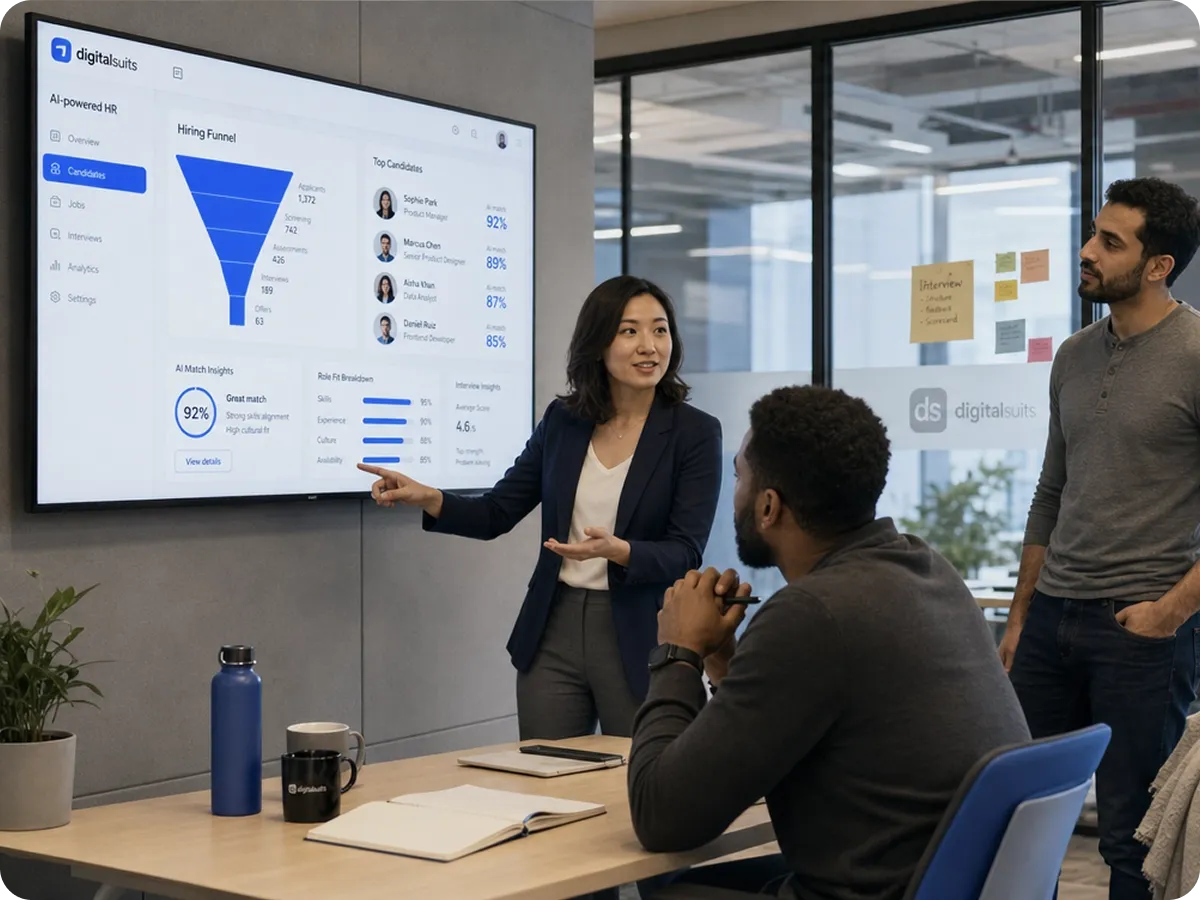
Why does recruitment software matter? Companies running manual or fragmented HR processes lose time on tasks that software handles in seconds. It changes the quality of decisions too. When your team has a single source of truth for candidate data, job market signals, and pipeline status, the work gets better, not just faster.
For staffing agencies, recruitment startups, and internal HR teams that have grown beyond what off-the-shelf tools can handle, custom HR software development is the path to systems that actually fit how you work.
Full-cycle HR software development, from concept to production
HR mobile app development
Benefit from iOS development and Android app development for HR workflows that need to work outside a desktop browser to get recruiter tools with mobile performance designed in from the start.
Hiring workflow automation
Create the pipelines that save your team's time on everyday tasks, such as candidate scoring, CV generation, email drafting, interview scheduling, and connect them directly to your existing workflows.
CRM/ATS migration services
Ensure full data migration from legacy ATS and CRM systems with structure mapping, validation, and making sure nothing gets corrupted or dropped during the move.
Get effective human resource software solutions for your recruitment and talent teams
Candidate matching
AI-based scoring of candidates against open roles, with RAG and vector similarity search used to pull up profiles that are most likely to fit the current vacancy.
Job matching
Tools that look for suitable open positions for a specific candidate. The system can check internal job records, external job sources, and then rank the options by skills, experience, location, and things like commute distance.
Custom ATS/CRM development
Applicant tracking and candidate relationship systems built for your recruitment process optimization, instead of making your team adjust everything to a ready-made platform.
ATS/CRM integration services
API and webhook integrations that connect your ATS or CRM with the tools around it, including job boards, HRMS platforms, messengers, email tools, calendars, and other systems used in daily recruitment work.
Jobs lookup and integration
Connectors to job databases and vacancy aggregators that bring fresh job data into your own system. This helps with candidate matching, market monitoring, and keeping vacancy information up to date.
Data enrichments
Automated data pipelines that add more detail to candidate profiles, job records, and company profiles. The data may come from LinkedIn, external APIs, internal databases, or other approved sources, so recruiters do not have to collect everything by hand.
AI-powered vacancy publishing
Tools for creating and publishing vacancies from one place. They can help draft job descriptions, prepare them for search, and send them to selected channels without repeating the same work across several systems.
Candidate-facing job portal development
Job portals where candidates can search vacancies, use filters, apply, and see the status of the application. The portal is connected with the ATS/CRM, so the recruitment team does not need to move data manually.
ATS/CRM and marketing automation integration
Two-way integration between recruitment platforms and marketing automation tools. It can support triggered candidate emails, campaign tracking, lead nurturing, and reporting on recruitment funnels.
Data analytics and BI reporting
Dashboards and reporting flows that make recruitment data easier to use. Typical reports include pipeline speed, source of hire, recruiter workload, time to fill, candidate drop-off points, and other hiring metrics.

Plan your HR automation project
AI-powered HR software development services to handle the repetitive work
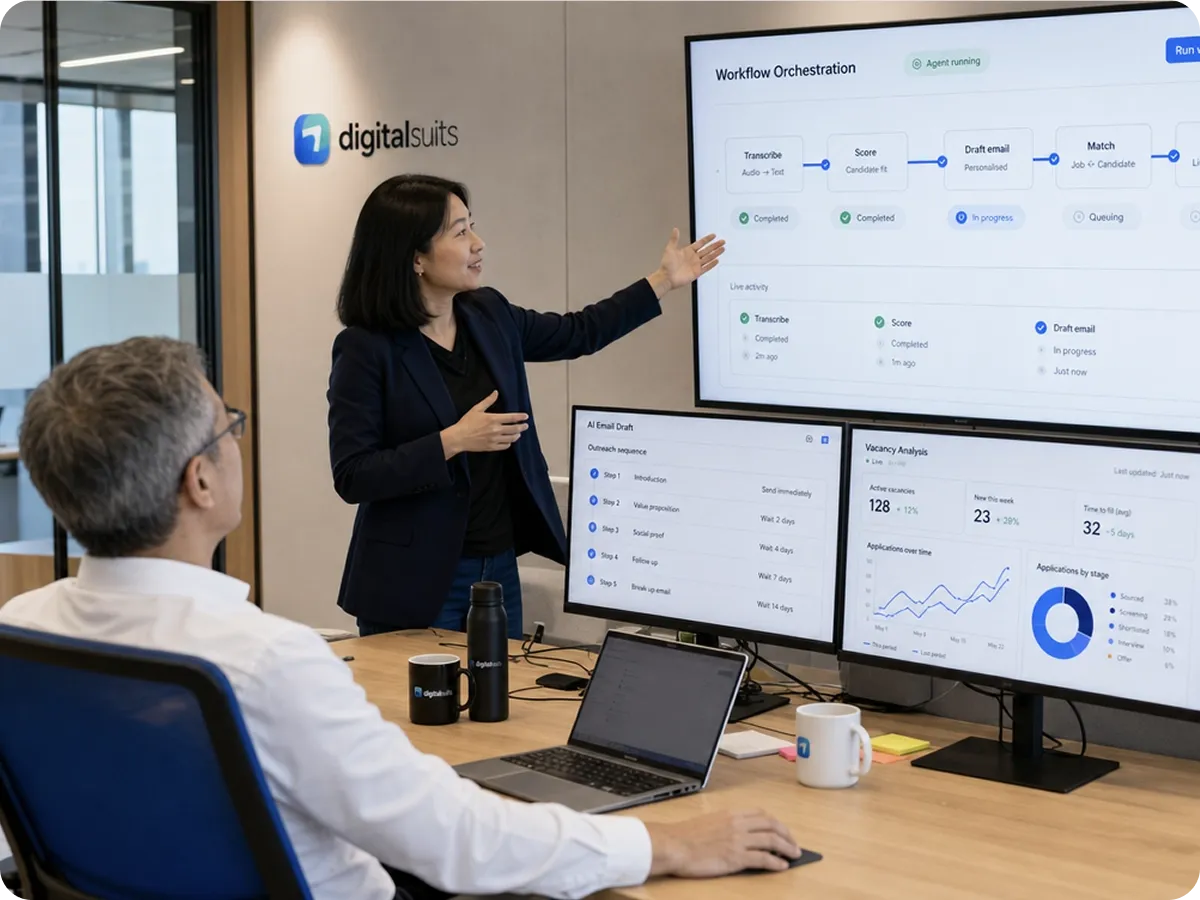
Most recruitment teams spend significant time on tasks that don't require human judgment — transcribing interview notes, drafting follow-up emails, formatting CVs, sorting applications against job requirements. Build agentic AI tools that take those tasks off the plate entirely, running inside your existing platform.
Agentic AI-driven recruitment tools DigitalSuits builds:
- Speech-to-text call transcription and automatic scoring
- AI-generated CVs from interview transcripts and candidate data
- Automated email drafting and outreach sequences
- Candidate-to-vacancy matching with RAG and vector similarity search
- Agentic workflow orchestration
- Real-time vacancy analysis and enrichment
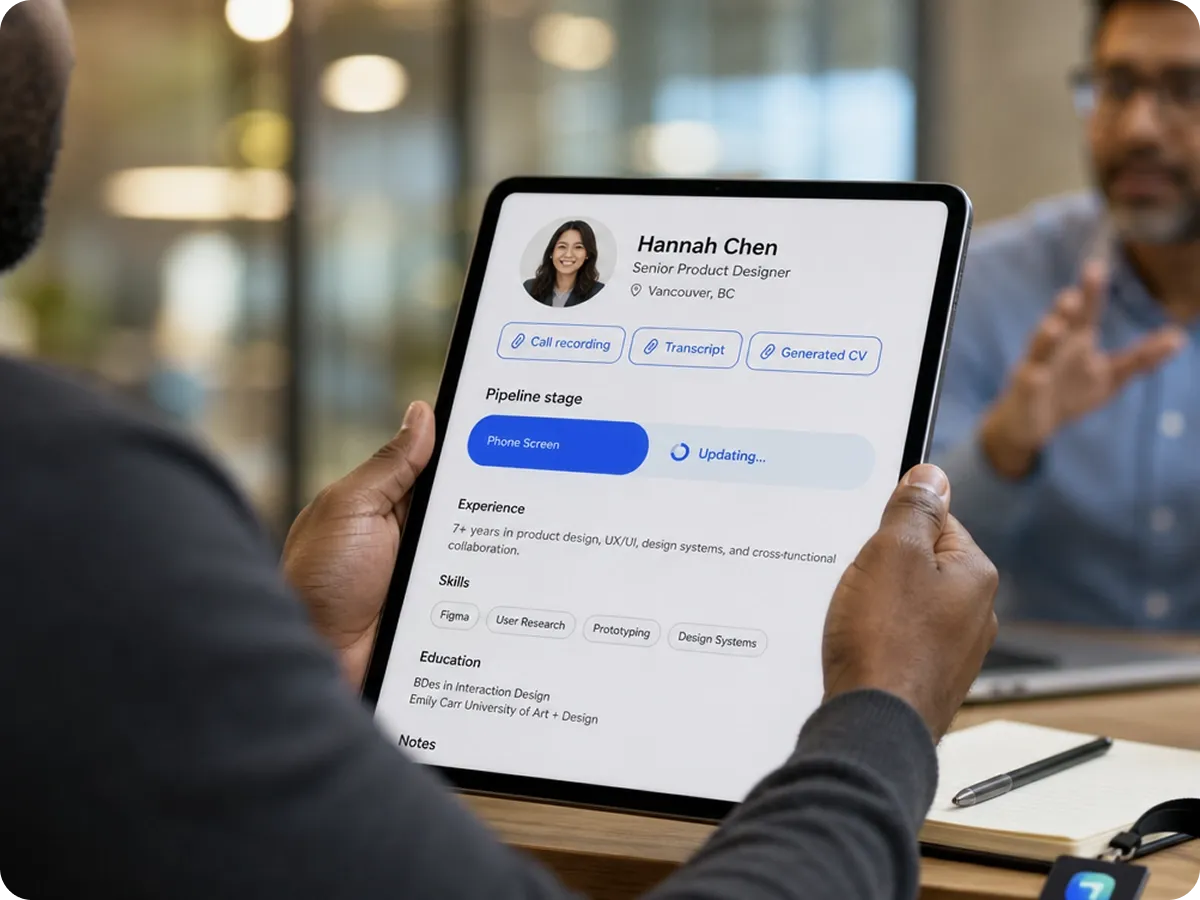
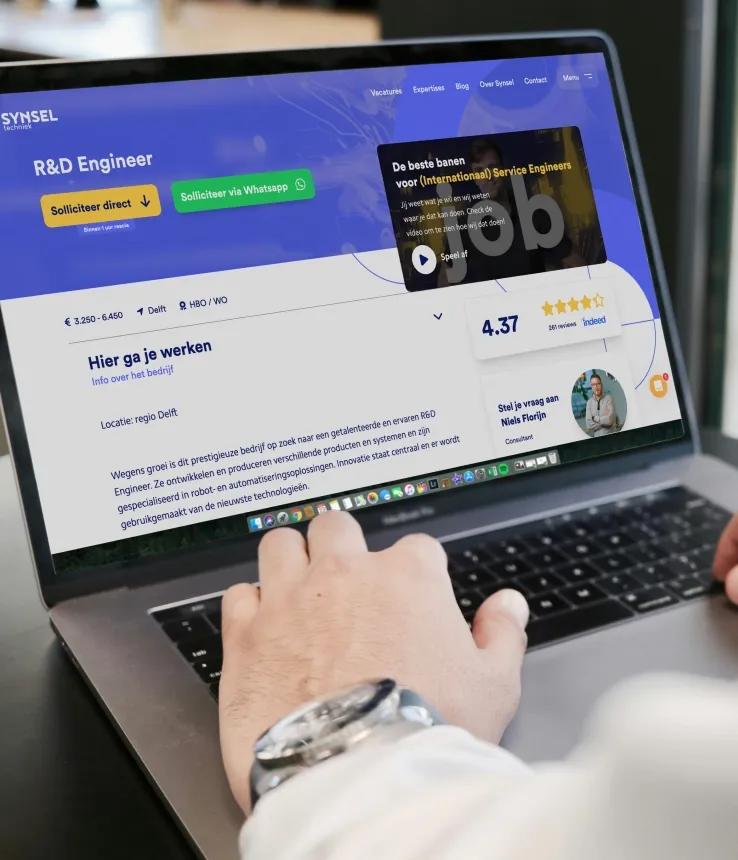
See how DigitalSuits approached HRMS software development for Synsel
Synsel is a Netherlands-based staffing agency that places technical specialists — mechanics, electrical engineers, and industrial automation experts — with companies across its network of 2,500+ clients. The agency puts candidate preferences at the center of every placement: matching people not just by skill, but by ambition, commute preference, and career trajectory.
When Synsel's hiring managers were spending a lot of their working hours on tasks that could be automated, the company decided it was time to rethink how recruitment worked. They brought in DigitalSuits to design and build a full AI-powered recruitment automation system from the ground up.
HR product consulting & discovery
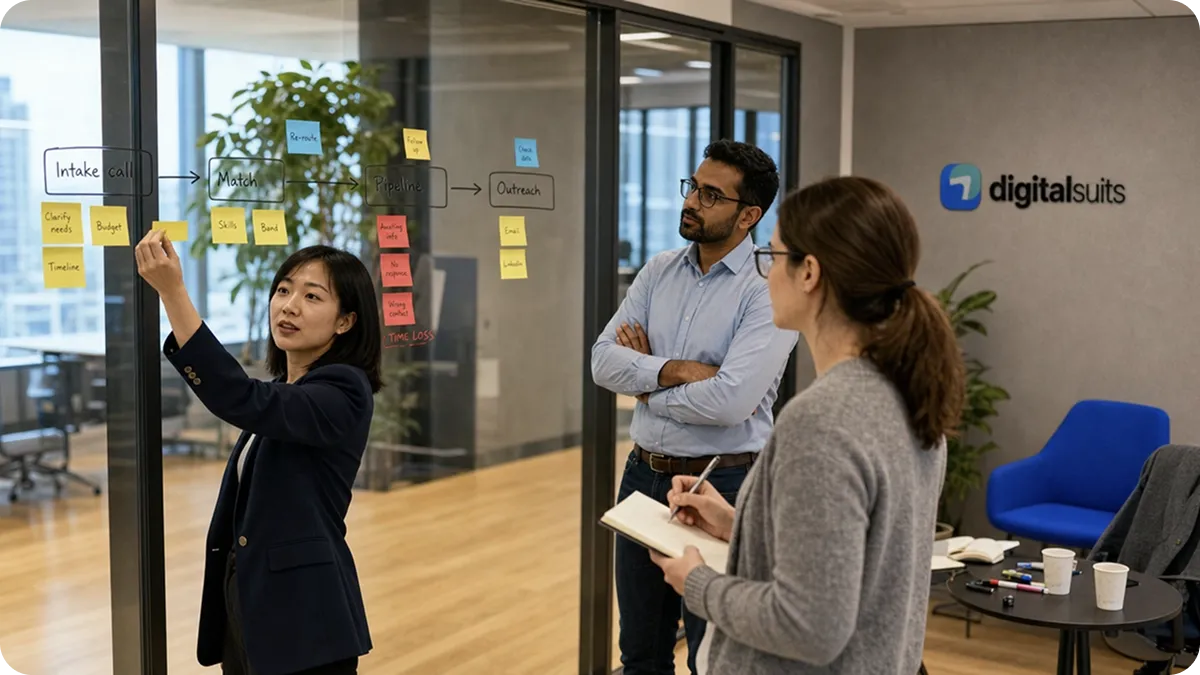
The project started with a structured discovery phase. Synsel's internal workflows were mapped in detail — how consultants handled candidate intake calls, how they searched for matching vacancies, what the sales pipeline looked like stage by stage, and where the largest time losses occurred.
DigitalSuits ran requirements analysis and technical scoping across three core problem areas: process management, candidate-vacancy matching, and outreach automation. The discovery output defined the technical architecture — including the decision to build a RAG-based matching engine, use Assembly AI for speech processing, and OpenAI for generative outputs.
Custom HR system development & UX/UI design
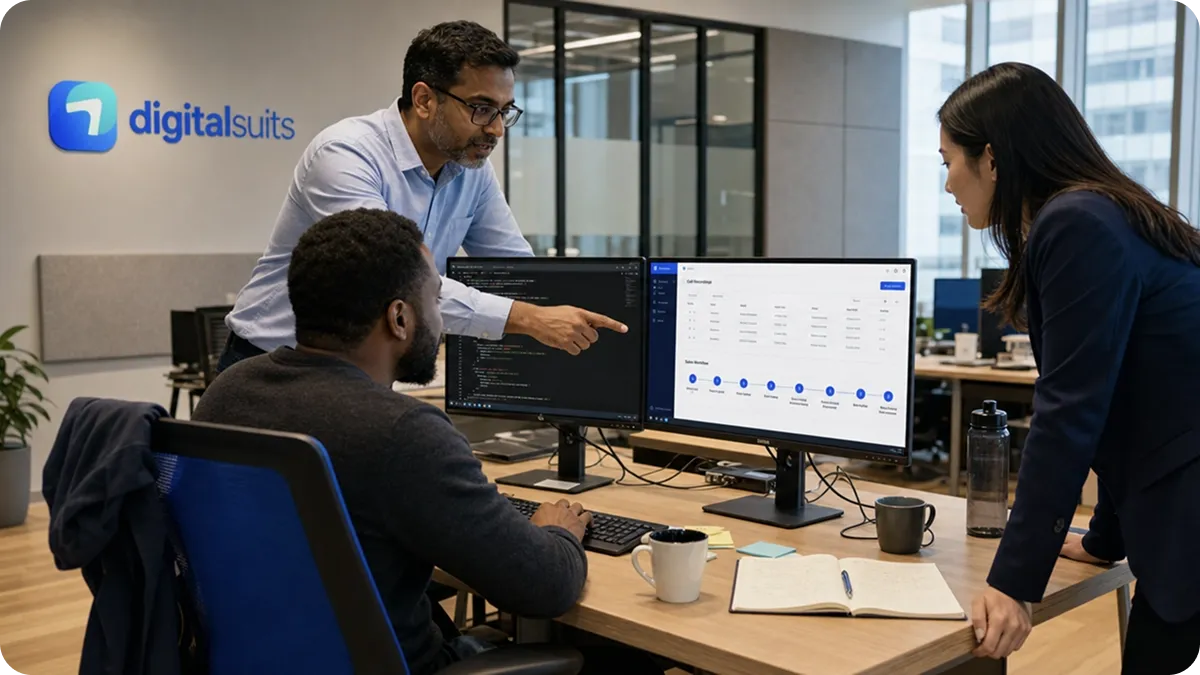
The core product is a recruitment management dashboard built on React.js and Node.js — giving Synsel's consultants a single interface to manage every stage of the hiring process. The dashboard surfaces all candidate call recordings, tracks an eleven-step sales workflow, and connects every automated tool the system runs.
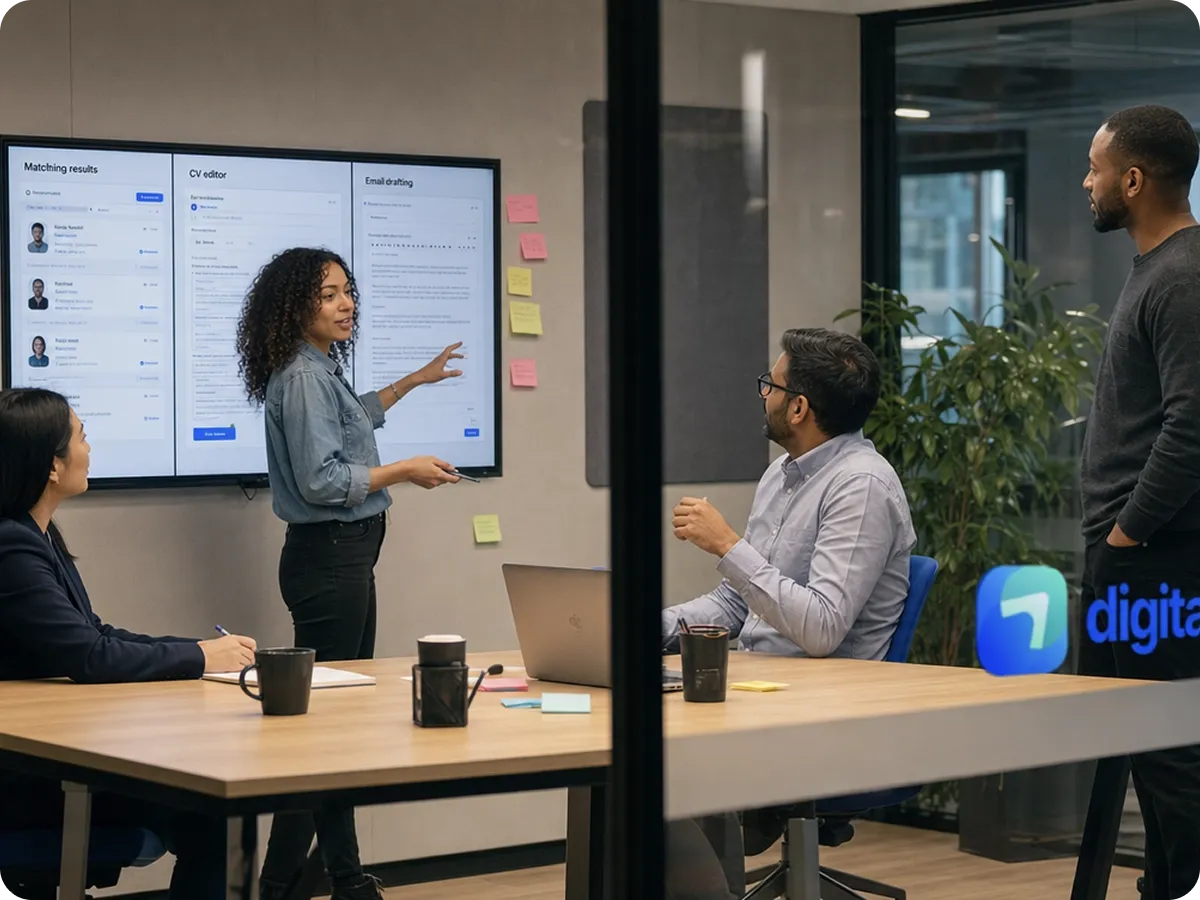
UI/UX design was built around the recruiter's actual workflow — not a theoretical process map. Key screens were prototyped and validated before development began, with particular attention to the tools recruiters would use most: the matching results view, the CV editor, and the email drafting interface.
AI-powered HR automation for Synsel

Speech-to-text transcription
Every candidate call is automatically transcribed using Assembly AI. The system generates a full transcript, a structured conversation summary, and a list of action points — then scores the call from 1 to 5 based on defined quality criteria. Managers can review each interaction and learn from it. Transcripts also feed into CV and email generation at later workflow stages.

CV generation
Using OpenAI integration, the system combines a candidate's interview transcript, LinkedIn data, and original CV into a structured, ready-to-send AI-generated CV. Consultants can approve it with minor edits or send it as-is, cutting what used to be a 30-minute manual task to under two minutes.

Email drafting
Outreach emails are automatically drafted based on the candidate profile and the matched vacancy shortlist — personalized by target company and role. Consultants review, adjust tone if needed, and send. No writing from scratch.

Candidate-to-vacancy matching
The matching engine uses RAG with vector similarity search to scan 20,000+ vacancies and surface the 250 most relevant matches for each candidate. Matches are scored by skills alignment, experience level, candidate preferences, and commute time — giving consultants a ranked shortlist in seconds.
ATS/CRM development & integrations
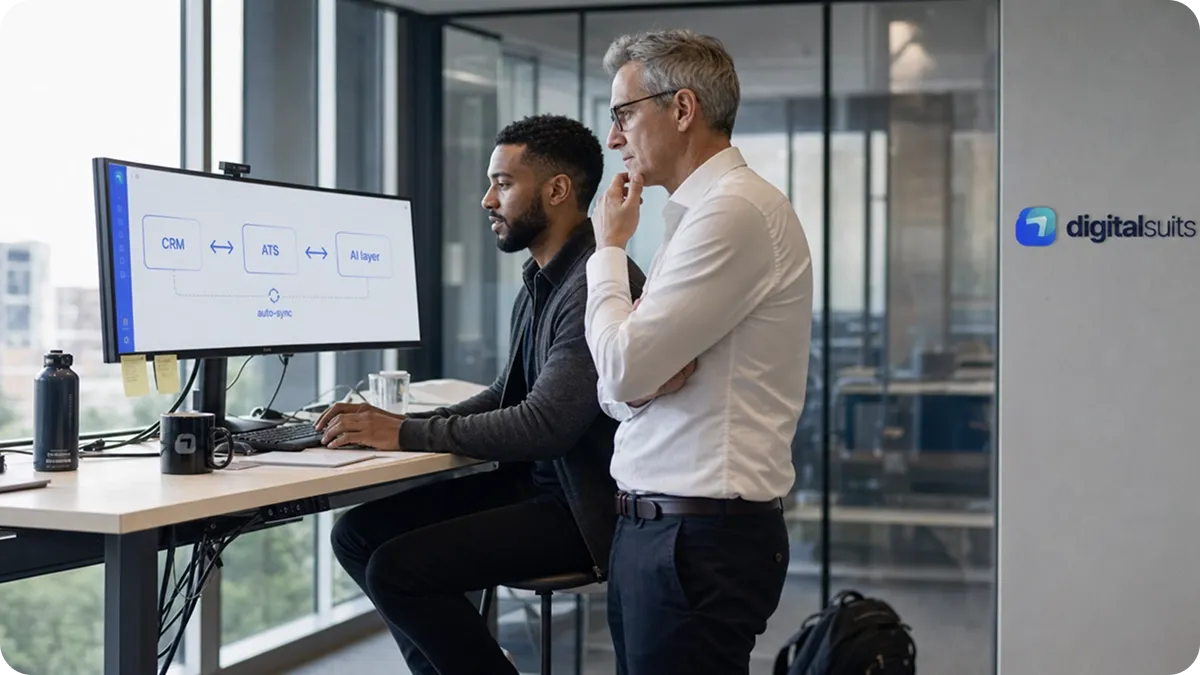
Synsel's CRM and ATS workflows were rebuilt to connect directly with the AI automation layer. Candidate records update automatically as they progress through the pipeline. Matching results feed into the sales dashboard without manual data entry. Call recordings, transcripts, and generated CVs all attach to the relevant candidate profile automatically.
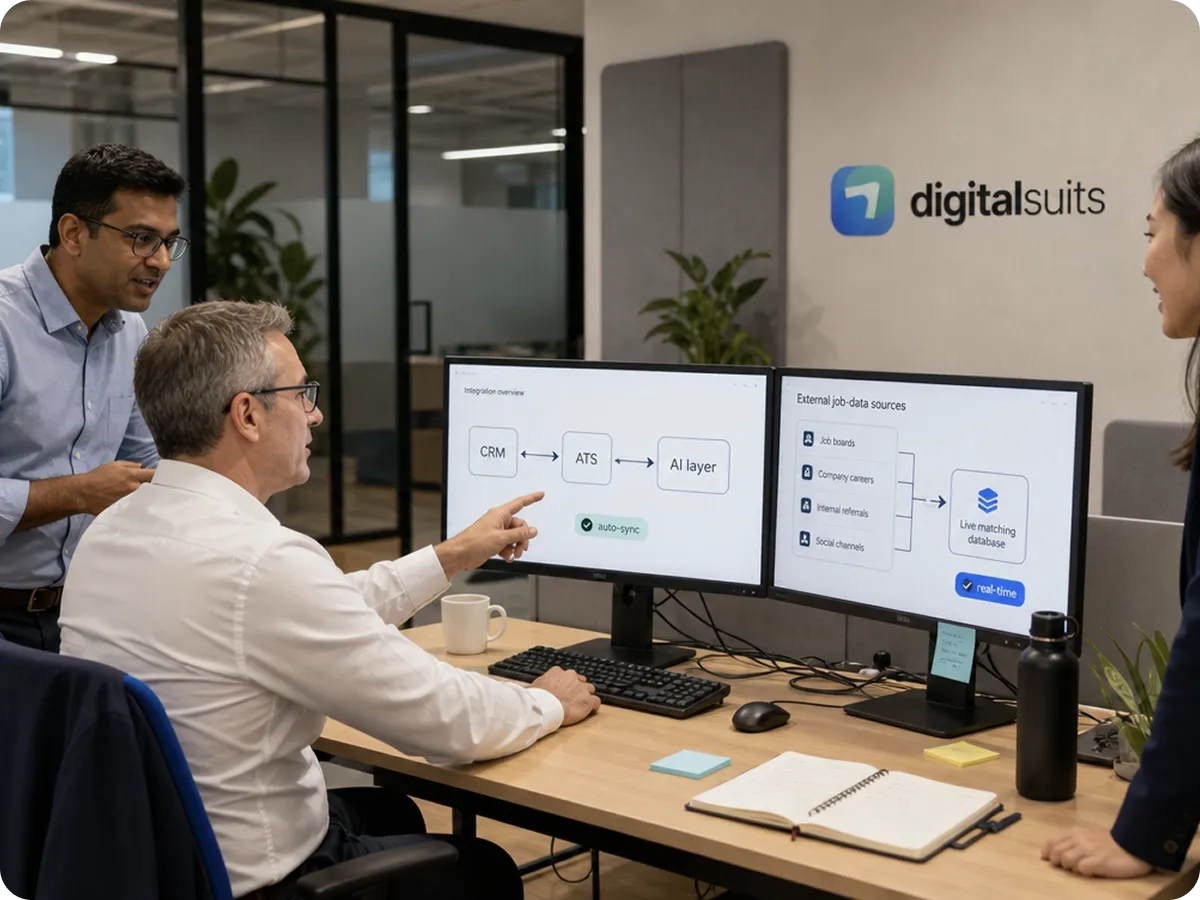
The system also integrates external job data sources — pulling vacancies in real time to keep the matching database current. For each matched company in the results list, contact information is retrieved from both the internal CRM and external sources, including LinkedIn, surfacing alongside the vacancy data so consultants can reach the right person immediately.
Data enrichment & marketing automation
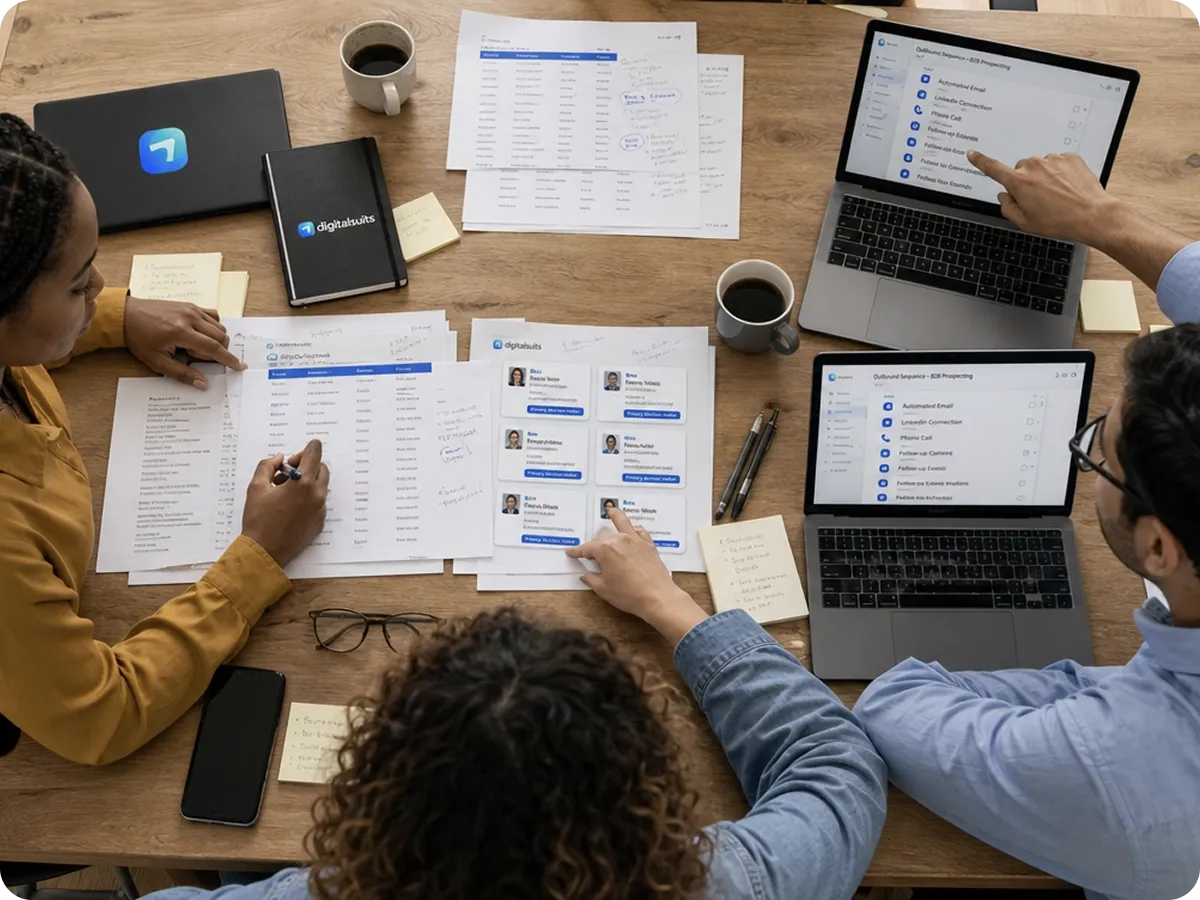
Beyond the core matching and CV tools, DigitalSuits built a contact enrichment layer that identifies the right person to approach at each company in the matched vacancy list. For every match, the system surfaces at least two contacts with name, email address, and a relevance tag that indicates whether this is the primary decision-maker — sourced from internal records and enriched with external data.
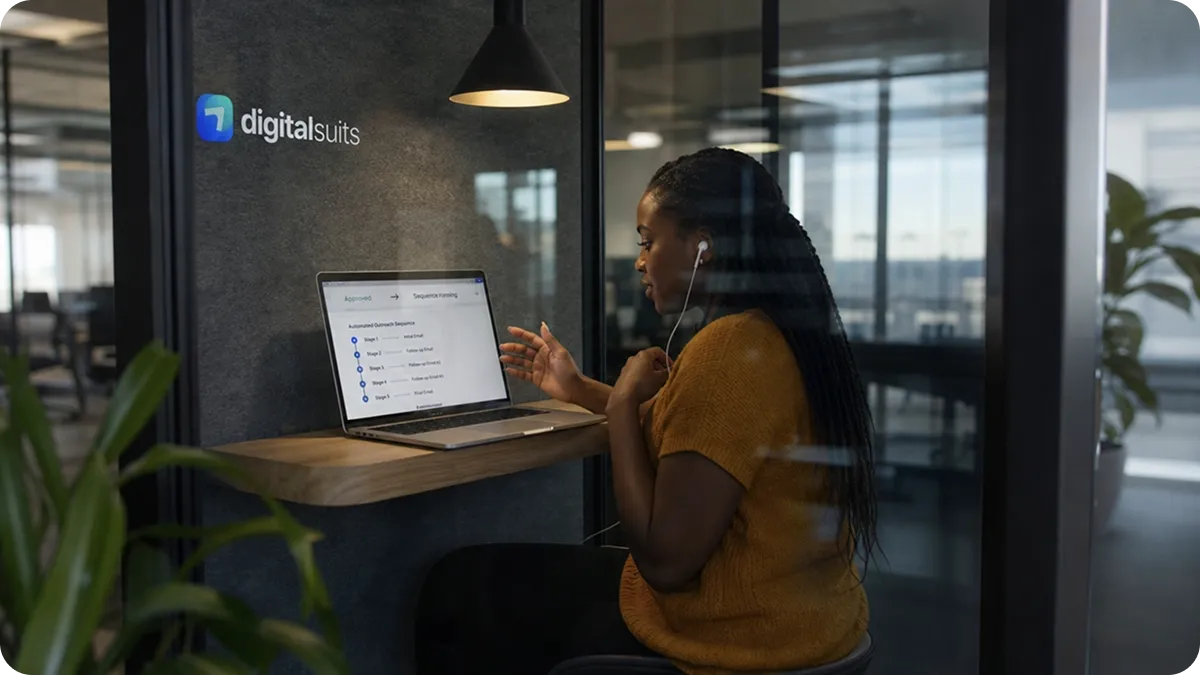
Automated email sequences tie into the outreach workflow: once a consultant reviews and approves the matched list and contacts, the system can trigger follow-up sequences by pipeline stage. This brings marketing automation logic into the recruiting workflow — keeping warm candidates and relevant companies engaged without manual follow-through.
Results of custom HR software development for Synsel
- 20,000 vacancies are in the ranked shortlist in seconds. What used to require semi-manual scanning of 20,000+ vacancies now produces a scored, ranked shortlist of up to 250 best-match positions — automatically, per candidate.
- CV creation cut to under two minutes. AI-generated CVs from interview transcripts reduced a time-intensive manual process to a review-and-send workflow. Consultants spend minutes, not hours, on each candidate.
- 30% less hiring routine with a full sales workflow in one dashboard. The entire hiring and sales pipeline — calls, transcripts, CVs, matched vacancies, contact data, and outreach — is managed in a single interface. No context switching, no manual data transfer.
Build your own AI-powered HR system
What you gain with a customized HR software development
Processes designed around how you actually work
ff-the-shelf HR software is built for the median use case. A custom system is built for your pipeline stages, data model, your integration requirements, and workflow logic.
AI automation where it creates real value
Not AI for the sake of it. We identify the manual tasks that cost your team the most time and build targeted automation around them.
Data you own and control
No vendor lock-in, no opaque data models, no subscription limits on your own candidate database. Custom-built systems give you full ownership of your HR data and how it's used.
Integration with the tools you already use
Custom HR software connects with your existing stack — job boards, marketing tools, payroll systems, communication platforms — rather than forcing you to replace them.
Systems that grow with your team
As your team and process mature, a custom system can grow with them with no seat limits, no missing features, and no waiting for the vendor's roadmap.
Cost predictability
With custom HR software development, you're not tied to per-seat pricing that scales against you as the team grows. The development cost is estimated upfront, and once the system is built, it's yours.
What sets well-organized HR tech software development apart
User-centricity
HR tools only deliver value if people use them. DigitalSuits designs around real recruiter and candidate workflows — running user research, prototyping key screens, and validating designs before development. The result is software your team reaches for, not works around.
Security & compliance
Candidate data is sensitive. Our team builds HR systems with role-based access controls, encrypted data storage, audit logging, and compliance-ready architectures designed for GDPR and other relevant data protection requirements from the initial architecture stage.
Mobile-ready capabilities
Recruiters work on the go. Candidates apply from their phones. DigitalSuits' specialists build HR software with mobile-first design principles and native app development where the workflow demands it, so the product performs on every device, not just a desktop browser.
Signs you need professional HR software development services
- Your recruitment process is inconsistent or slow. If finding and attracting the right candidates feels like a constant struggle, and your hiring pipeline lacks visibility or structure, great candidates are likely to walk away.
- Onboarding feels chaotic and inconsistent every time. When new hires go through different processes depending on who handles them (missing training steps or waiting days for system access) your onboarding becomes improvisation.
- Your data lives in disconnected systems. If candidate records are in one place, vacancy data is in another, and email history is in a third one, you're making decisions without the full picture.
- Payroll and time tracking eat up too much of your team's time. If compiling time entries and generating reports is still a manual process, mistakes multiply and compliance risks grow
- Learning and development plans are one-size-fits-all. If you can't personalize training paths or monitor individual progress, employee growth stalls — and so does your organization's performance..
- Post-employment tasks are falling through the cracks. If offboarding, alumni follow-ups, and transition support are handled inconsistently or not at all, your employer brand takes the hit.
- Internal communication lacks security or structure. When sensitive HR information is shared through general-purpose tools, the risk of leaks and miscommunication increases.
Why companies choose DigitalSuits as their HR software development company

Product thinking from day one
DigitalSuits runs discovery, maps edge cases, and plans the architecture before writing code, so what we build is actually what you need.
Full-stack team, one point of accountability
Backend, frontend, UX design, QA, DevOps — the complete team is in-house with no need for outsourced services.
Practical AI integration, not theoretical
We've built and deployed AI-powered HR tools in production, so we know what works and what overpromises
Successfully delivered projects
Our track record covers software product development, AI integration, and much more across various industries, which converts into deep expertise.
Long-term support after launch
Most of our client relationships shift into ongoing work after launch to get new features and performance fixes, as the product gets used by real people.
Transparent process, clear communication
We run weekly check-ins, set written sprint goals, and document decisions so nothing gets lost and you're always up to date.
Frequently asked questions
It takes somewhere between 3 and 9 months, sometimes longer.
- A basic system with employee profiles, leave requests, document storage, basic reporting can ship in 3 to 4 months.
- A system with recruitment workflows, onboarding, performance reviews, self-service portals, and several integrations, requires 6 to 9 months minimum.
The gap comes down to how workflow-specific HR systems tend to be. Two companies asking for the same thing can mean completely different projects. One needs a lightweight internal tool. The other needs multi-level approvals, several user roles, compliance logic, and connections to existing payroll and communication systems. Scope looks similar on paper until you get into the details.
Data migration is another thing that often doesn't make it into early estimates. Records from spreadsheets or legacy platforms need cleaning and remapping before they're usable. That work gets scoped separately and can add weeks depending on the state of the data.
Before committing to a vendor, it's worth asking:
- What's in the first version and what comes later?
- Which features typically push timelines out?
- Are integrations and migration included in the estimate, or quoted separately?
- How long do discovery and QA account for in the total timeline?
The DigitalSuits team pins down the timeline during discovery once we know what's actually in scope. Contact us to estimate timelines for your project.
Usually yes. If your current system has APIs or can export data in a usable format, there's typically a way to build on top of it without starting over. What that looks like in practice depends on what the system exposes. If you're looking for the right AI solution for your system, contact us to figure out what fits you.
- Basic HR system costs between $40,000 and $70,000.
- Mid-level HR platform with more modules, user roles, and integrations costs roughly $80,000 to $150,000.
- Enterprise-grade HR software with advanced automation, analytics, multi-location support, and deep integrations starts from $200,000.
The number follows what's being built. An employee directory with leave management is not the same project as a platform covering recruitment, onboarding, performance reviews, compensation changes, compliance reporting, and three external system connections.
Some things push the budget up without showing up clearly in early conversations:
- Approval flows that involve multiple roles and conditional logic
- Compliance and security requirements that affect architecture decisions
- UX research and design work that has to happen before development starts
- Data migration from a legacy system where the records need cleaning first
Building in phases is worth discussing with your vendor. An MVP gets a project live faster and at lower upfront cost. More importantly, it gives you real usage data before you commit to building the rest — and that data usually changes what gets prioritised. Contact us to get a detailed estimate after a discovery session.
Yes. We map the data structure of the source system, handle the transformation, and validate everything before your project goes live. Historical records, candidate profiles, company data — it all comes across.

Explore more of the DigitalSuits services

They quickly grasped what we wanted to do and have designed and delivered solutions to achieve this.
DigitalSuits dug deeper into the business and the idea to have a better understanding of the business and the market. They quickly grasped what we wanted to do and have designed and delivered solutions to achieve this. They regularly communicate well. I'm very happy working with them.

DigitalSuits proved themselves to be specialists in their field.
The successful launch of the first demo has generated positive feedback and interest. DigitalSuits seeks constant product improvement through continuous communication and proactive team integration. Their industry expertise contributes to intuitive, efficient project management.

They've been very thoughful about approaching the build, making sure we don't have to rework elements somewhere down the line.
The DigitalSuits team fully devoted themselves to producing a quality final product, making sure they’re thorough in their development and taking preventative action when needed. They delivered superior services, assigning only highly-experienced professionals to the project.