
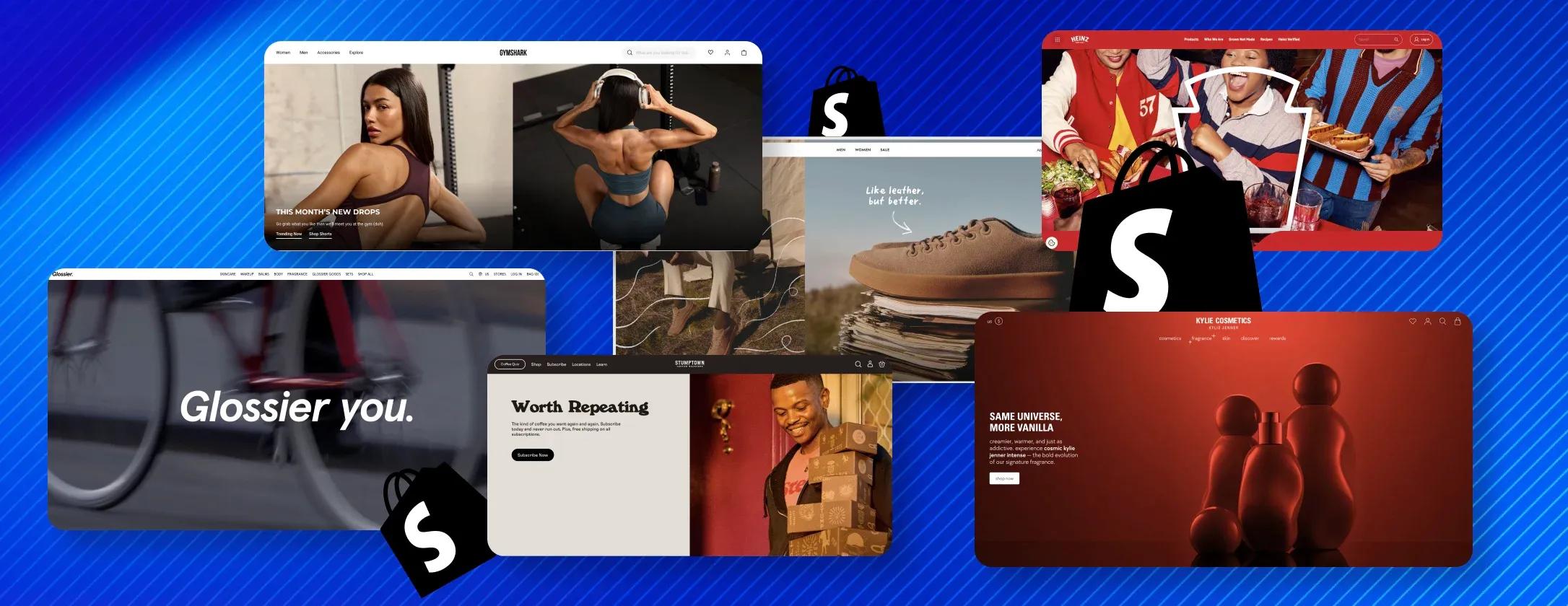
Shopify Plus websites have an average year-over-year growth of 126%, and enterprise merchants in the $1M-$500M sales range have seen especially strong results. In this guide, we'll look at the best examples of Shopify Plus stores and break down what makes them successful and high-performing. Before we proceed to the details, let's take a quick glimpse at the full list of successful Shopify Plus store examples that we've gathered.
Let's start with industries:
- Fashion and apparel
- Beauty and cosmetics
- Food and beverage
- Accessories and lifestyle
- Entertainment and merchandising
Brand name | Industry | Approximate annual revenue |
|---|---|---|
Fashion and apparel | $500+ million | |
Fashion and apparel | $250+ million | |
Fashion and apparel | $79+ million | |
Beauty and cosmetics | $200+ million | |
Beauty and cosmetics | $28+ million | |
Food and beverage | $25 billion+ | |
Food and beverage | $50+ million | |
Accessories and lifestyle | $50+ million | |
Accessories and lifestyle | $150+ million | |
Entertainment and merchandising | $30+ million |
Please note that all revenue data referenced above has been gathered from publicly available financial reports and reputable industry sources.
Why websites built with Shopify Plus make sense and why you should consider it?
The success of a strong Shopify Plus store isn't defined by its premium look or price, it's valuable because of its features and capabilities. It handles more traffic, processes more orders, and supports more markets. Here are the big things the best Plus stores tend to have in common.
It's ready for international growth
The store feels local wherever customers are. Pricing, language, and checkout details make sense for the particular market. The team can run multiple regions without turning operations into chaos.
It supports more than one sales model
As brands grow, new sales models almost always appear. Many expand into wholesale partnerships, invest in Shopify B2B development, and launch corporate gifting programs – and they rarely stay DTC-only. Strong Shopify Plus shops handle different customer types without the need to run a separate store.
It's custom in the right places
Websites that use Shopify Plus customize what impacts revenue and experience: checkout, promotions, pricing rules, and key flows. They build it in a way that holds up over time, so Shopify updates don’t turn into fire drills or suddenly break things that were working yesterday.
Operations run smoother in the background
Customers don't see the backend, they actually don't have to. However, your team works with it every day. Websites using Shopify Plus change manual work with automation, cleaner order workflows, and fewer "we need a person to fix this" moments.
It works under high pressure
Shopify Plus can stay fast and stable, but only with the right setup. It's built to handle big launches and traffic spikes, yet real performance depends on clean code, a sensible app stack, optimized assets, and regular maintenance. When that's configured, your site and checkout stay smooth even under pressure.
It connects properly to the systems you use
When expanding, ecommerce can't live on an island. Inventory tools, Shopify ERP integration, Shopify CRM integration, and analytics. In strong Plus stores, your systems stay in sync. Inventory, customer info, and analytics update automatically, instead of someone chasing errors in a Google Sheet.
It gives you room to build more advanced experiences
Some brands want full creative control over the frontend. You can start with Shopify customization services, and when your store outgrows that, Shopify Plus supports a more advanced setup.
It helps keep costs under control
This one surprises people. A smarter setup often costs less over time because you reduce patchwork tools, manual processes, and expensive "emergency fixes." With solid Shopify Plus development, you invest in a cleaner foundation once, then spend far less time (and money) propping it up later.
It takes security seriously
As revenue grows, so does the risk. Strong Plus stores treat security like part of the shopping experience. The bigger you get, the more it matters. When it's handled properly, customers feel safe checking out, and your team deals with fewer headaches later.
What makes a successful Shopify Plus store?
If you have already migrated to Shopify, you have taken an important step. However, the success can't depend solely on platform choice; it won't replace the strategy. When looking at examples of Shopify Plus stores, several patterns appear consistently.
First, the customer journey is simplified. Getting around the store feels effortless. The categories make sense, filters help customers find what they want quickly, and the homepage explains what the brand is about and why they should care.
Second, performance is prioritized. Pages load quickly even under heavy traffic. It's built into the theme, the images, and the way the store is put together.
Third, checkout is optimized for conversion. Custom logic supports subscriptions, bundles, tiered pricing, or international tax. All is being held without technical issues.
Finally, backend runs as it should. Integrations with inventory systems, fulfillment providers, or marketing automation tools allow the business to scale without operational chaos.
That's what great Shopify Plus websites look like, simple for shoppers, solid and scalable for the business.

Ready to scale on Shopify Plus?
Most prominent examples of successful Shopify Plus stores
Now, we are in the most important place. We have the names, let's see how these businesses achieve success using Shopify Plus development.
Fashion and apparel
Gymshark
What stands out You can tell Gymshark is ready for busy days. Their drops bring a lot of people in at once, and the site doesn't feel like it's struggling. Shopping is also swift, and categories make sense. Customers are not locked in the menu to find what they came for. Even during high-demand moments, the experience feels controlled.
What you can apply
- Prepare infrastructure before major campaigns
- Structure collections around shopping behavior, not internal naming
- Keep performance a priority when scaling visual content
Allbirds
What stands out Allbirds proves that storytelling and conversion can coexist. Sustainability messaging is built directly into the store, not hidden in a separate "About" section. Product pages answer questions before they become objections. The experience feels calm, clear, and confident.
What you can apply
- Integrate brand values directly into high-converting product pages
- Remove possible questions by addressing common concerns early
- Keep educational content structured and digestible
Fashion Nova
What stands out New arrivals change all the time at Fashion Nova. Despite a high SKU count, the store remains easy to browse. You can scroll, filter, and get to products fast, even with tons of items. The mobile experience is especially sharp, which matches its audience behavior. It's a wonderful reminder that size does not have to imply chaos.
What you can apply
- Update merchandising frequently to drive repeat visits
- Optimize for mobile-first decision making
- Keep filtering intuitive in large catalogs
Beauty and cosmetics
Glossier
What stands out Glossier keeps things simple on the surface. Navigation is clean, collections reflect customer intent, and product pages mix reviews with education naturally. It feels approachable rather than overproduced. This is one of the clearest examples of good Shopify Plus stores that balance branding and usability.
What you can apply
- Organize products around customer needs, not just categories
- Use social proof without overwhelming the layout
- Let the interface support the brand voice
Kylie Cosmetics
What stands out It's a launch-first setup. The site supports fast merchandising changes and traffic surges, while keeping checkout minimal so conversions don't drop when the store gets busy. The store is ready for traffic surges without compromising speed. It shows what happens when marketing ambition meets technical preparation.
What you can apply
- Build for demand spikes before they happen
- Keep checkout distraction-free
- Align merchandising strategy with campaign rhythm
Food and beverage
Heinz
What stands out Heinz uses Shopify Plus to experiment beyond traditional retail. Limited bundles and themed collections are integrated perfectly into the storefront. The experience feels playful but organized. It's one of those websites made with Shopify Plus that shows how legacy brands can innovate without losing clarity.
What you can apply
- Test limited editions through dedicated landing pages
- Use bundles strategically to increase average order value
- Keep promotions structured, not chaotic
Stumptown Coffee Roasters
What stands out Stumptown blends storytelling with subscription-driven commerce. Educational content supports product discovery, and subscription options are visible without feeling forced. The recurring model feels natural.
What you can apply
- Make subscriptions easy to understand
- Use content to support trust and retention
- Keep product explanations clear and benefit-focused
Accessories and lifestyle
Blenders Eyewear
What stands out Blenders Eyewear leans into bold visuals and lifestyle branding. Still, the product pages remain focused and easy to navigate. Upsells feel relevant rather than pushy. This is a good reference when people ask, "what do Shopify Plus websites look like when branding is strong but performance still matters?"
What you can apply Let visual identity enhance usability instead of overloading it Present bundles organically Keep the layout hierarchy clean
Ruggable
What stands out Ruggable sells a product that needs explanation. Instead of overwhelming users, it breaks the system down step by step. Interactive elements clarify how the product works. Complexity is simplified.
What you can apply
- Use visuals to explain multi-part products
- Structure PDP content in logical sections
- Reduce confusion before it slows conversion
Entertainment and merchandising
Paramount Shop
What stands out Paramount Shop manages a wide catalog of licensed merchandise without feeling messy. Products are grouped around franchises and themes, making discovery intuitive for fans. It's a strong example of how Shopify Plus websites handle high SKU volume while staying organized.
What you can apply
- Organize collections around audience interests
- Prioritize search and filtering accuracy
- Keep catalog expansion structured
If you're comparing these stores to your own, don't focus only on the visuals. Look at the structure underneath:
- How collections are organzed
- How product pages guide decisions
- How the checkout stays clean
- How the store holds up when demand spikes
Those are the patterns worth copying.
Develop performing Shopify Plus websites with DigitalSuits
At DigitalSuits, we don't treat every project the same, and we know that what drives growth for a fashion brand does not necessarily work for food, beauty, or entertainment. Each industry has its own peculiarities, customer behavior, and operational quirks. That's why we shape the strategy, UX, and performance work around your specific market.
If you want to apply the same thinking to your Shopify Plus, you can explore how DigitalSuits approaches it by industry and see real results in our case studies. You can explore how we work by industry and see what that looks like in practice:
- Fashion & apparel. We can share here one bright example of cooperating with KOIO. We moved them to Shopify 2.0, redesigned the store, and kept improving it over time. The result is +22% AOV.
- Beauty & cosmetics. Our contribution to the beauty world is through our support of the Yepoda brand. We rolled out 5 redesigned Shopify 2.0 sites and made the shopping experience smoother across all of them.
- Food & beverage. Our work here was with Cadootz! We've simplified the user flow and made the store's UI easier to read, leading to +506 fulfilled orders in the first month.
- Accessories & lifestyle. Here, we joined forces with Lunchbox Packs. We optimized their store and customized a Shopify theme to improve speed and overall performance, resulting in a 15% increase in conversion rate.
- Furniture & home. Cooperation with Noah Living was a remarkable example. We migrated their store to Shopify 2.0, focusing on scalability and customization, which led to a 28% increase in site traffic.
- Vitamins and supplements. While working with Luma Nutrition, we customized their Shopify Plus store to improve the user journey, which resulted in a 17% increase in average order value.
Start with the industry closest to your business and see how the same thinking can be applied to your Shopify Plus store.
Final thoughts
If you're seriously considering Shopify Plus, chances are your business is already moving in the right direction. Growth and demand are there, the question is whether your current Shopify store setup can keep up.
The stores we've looked at aren't successful just because they're on Plus. They've built the right structure, clear navigation, fast performance, and smart checkout logic, and have probably made a few mistakes they've learnt from.
Shopify Plus gives you the room to grow, the real difference comes from how you use it. If you're ready to build something that supports the next stage of your growth, take a look at our Shopify Plus development services and see how we approach it by industry. Contact us and let's plan it properly.
Written by
 Yurii ZablotskyiContent Marketing Specialist
Yurii Zablotskyi is a passionate content writer and storyteller with a strong marketing background, focusing on marketing, sales, and technology, turning complex ideas into valuable content.
Was this helpful?
0No comments yet