










If you try to get a clue for the app development cost in 2026, you've chosen quite an interesting period. We say it because this year won't be anything like the years before, especially in this field. The number of factors influencing that cost is vague: AI (first and foremost), automation, infrastructure, development, design, and many more. Quite obvious but so often missed part that brings surprises in the final estimation.
To make it straight the cost of developing a mobile app in 2026 will be somewhere between $15,000 to $500,000, or even more. To answer your next question, "why" – because there are many factors, and each of them influences the price.
In this article, we'll break down the key factors behind app costs and show what usually goes into the budget for building a mobile app in 2026.
TL;DR: Brief mobile app development cost breakdown
The smartest way to figure out mobile app development costs is to split them by stage. The development will take the largest share, with the rest divided among planning, design, testing, launch, and support.
Most projects roughly break down like this:
Discovery and planning: 10%
UI/UX design: 20%
Development: 50%
Testing and QA: 10%
Launch prep: 5%
Support after launch: roughly 5% of the initial cost each year
So, what does mobile app development cost look like in actual budget terms? A basic MVP usually costs $20,000 to $50,000. A more advanced app with user accounts, dashboards, and integrations often ranges from $60,000 to $150,000. If the product includes real-time functionality, complex backend systems, or AI features, the budget can reach $150,000-$400,000+.
Mobile app development cost by stage
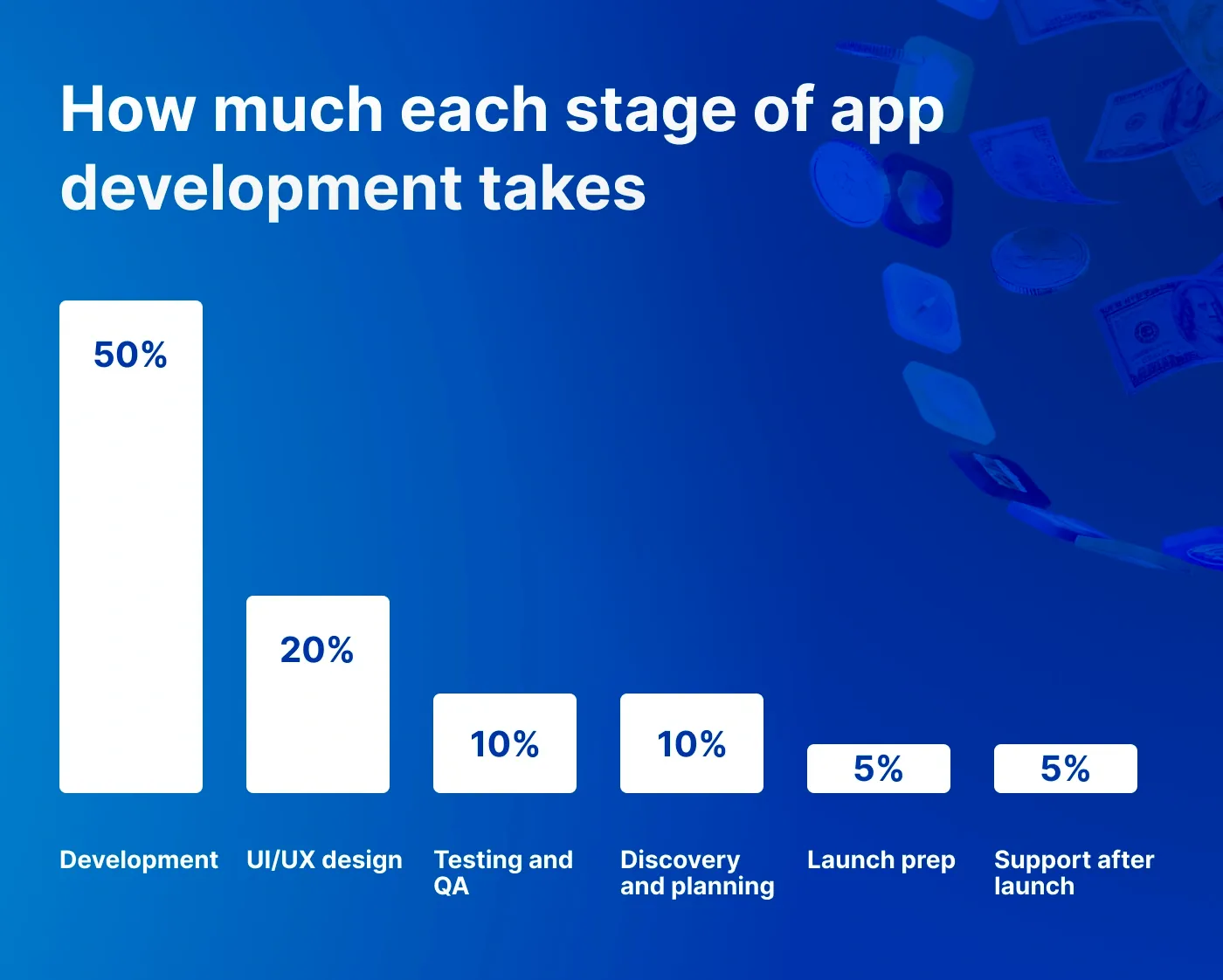
Most of the budget usually goes into development, which often takes up around 40-60% of the total. Design and testing also account for meaningful shares of 10-25% and 15-20%, respectively. In terms of overall cost, a basic app will cost between $40,000 and $100,000, while more complex products can easily exceed $300,000. In most cases, the cost is spread across discovery, design, development, QA, launch, and support.
Gathering requirements
This is the starting point when you find out what you actually need. Here, the budget starts to make sense. Discovery usually covers stakeholder interviews, user flows, feature prioritization, technical planning, and scope definition. In real projects, this stage typically accounts for 5-10% of the total budget.
The approximate range at the discovery stage of building a mobile app could look like this:
Simple MVP: $1,000-$5,000
Mid-size app: $5,000-$15,000
Complex product: $15,000-$40,000+
Without this step, any answer to "how much does it cost to develop an app?" is usually too loose to trust.
UI/UX design
In UI/UX design, the real challenge is not the number of screens but how users move through the app. That includes things like:
Design systems development
Developer handoff
Altogether, it usually takes 10-20% of the total budget. However, consider that app design itself often falls between $3,000 and $30,000, depending on depth and quality expectations.
Typical ranges at the mobile app development design stage are the following:
Simple app: $3,000-$8,000
Mid-complexity app: $8,000-$20,000
Complex or polished B2C product: $20,000-$30,000+
Development
This is the core and most invested part in most projects. Be ready for it to take roughly 40-60% of the full build cost.
A few things usually drive this number up:
Cross-platform vs native approach
Backend complexity
Number of integrations
Real-time features, AI, or advanced business logic
Frontend
The main cost driver here is the details that should be included in the interface. More screens, custom interactions, animations, and support for different devices all increase the price tag. Building separately for iOS and Android usually increases the budget, while Flutter can reduce some of that overlap.
Typical frontend app development prices range:
Simple app UI: $8,000-$20,000
Mid-range product: $20,000-$50,000
Complex frontend: $50,000-$100,000+
Backend
Be ready to spend, as backend development now often costs more because many SaaS products need stronger logic, AI integration, and live data handling. Apart from that, consider:
Databases
APIs
Authentication
Admin panels
Notifications
Payments
Analytics
Cloud infrastructure
Once you gather it all, you'll have a more or less realistic outcome.
Typical backend app development prices range:
Basic backend: $10,000-$25,000
Mid-level backend with integrations: $25,000-$60,000
Complex backend: $60,000-$150,000+
Testing and QA
Not yet the end. Software testing and QA services cover functional testing, regression, device coverage, usability, and release validation. Most benchmarks place QA at around 15-20% of the project budget.
Typical QA app development prices range:
Simple app: $3,000-$8,000
Mid-size product: $8,000-$20,000
Complex app: $20,000-$50,000+
Launch
It takes much less than development, for instance, but the costs are real. You need to prepare store assets, finalize metadata, check privacy information, and connect crash reporting and analytics. There are also a few fixed costs to keep in mind:
Google Play charges a one-time $25 registration fee
Apple’s Developer Program costs $99 a year
Typical mobile app launch stage costs:
Basic release prep: $1,000-$3,000
More involved launch support: $3,000-$10,000+
After-launch support
This is where many teams get relaxed and underbudget. After you have got your app to the market, other work starts. You need to look for bug fixes (if any appear) and compatibility updates, get the continuous performance monitoring, or implement small UX improvements. Be ready to allocate around 10-20% of the initial build cost per year.
Typical yearly support for a mobile app costs:
For a $30,000 app: around $3,000-$6,000
For a $100,000 app: around $10,000-$20,000
For a larger platform: often much more, circa $25,000+, depending on the roadmap and infrastructure
Mobile app development cost estimate by type and complexity
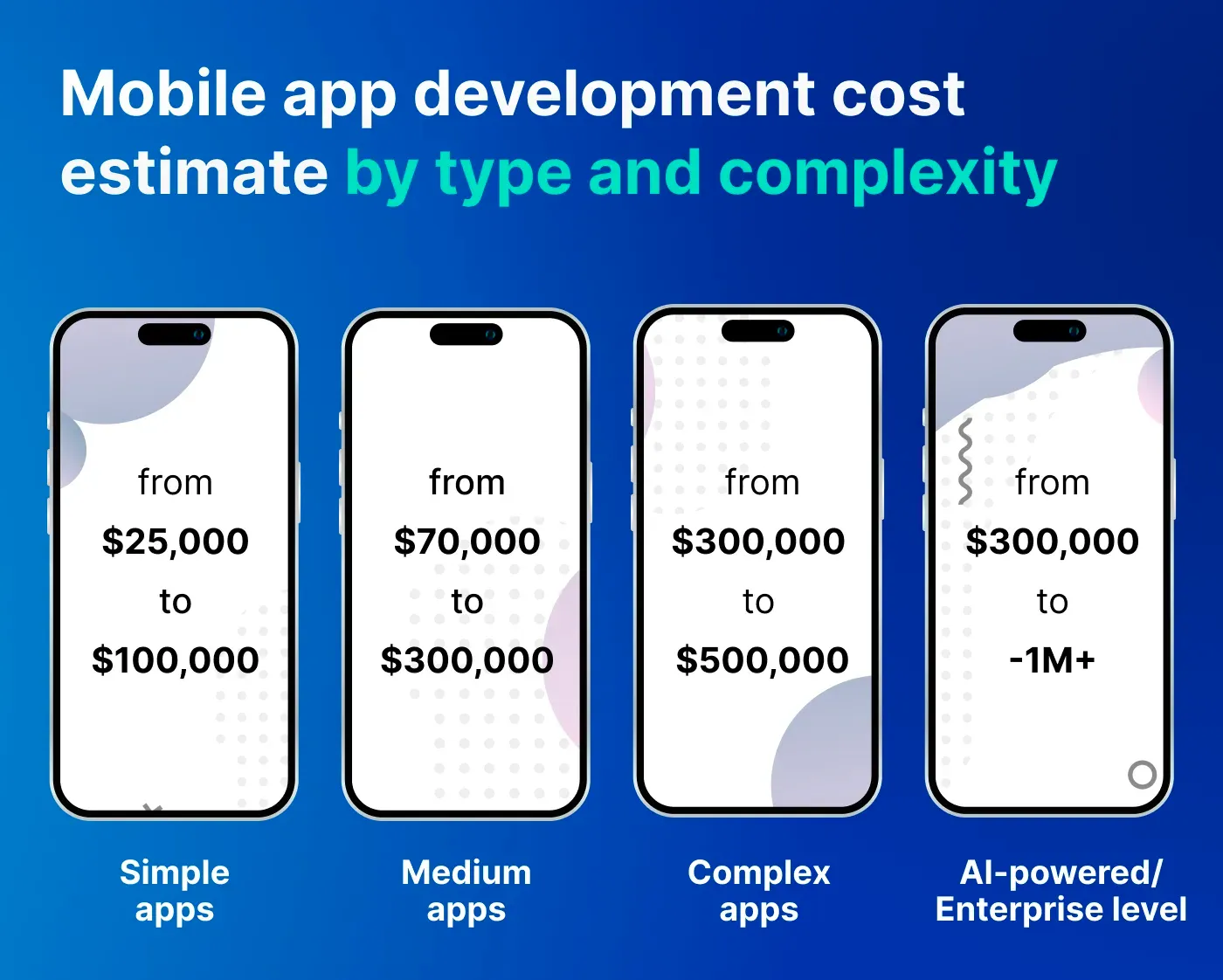
The mobile app development price depends mostly on what you want the app to do. The more features involved, the more time and budget the project will need.
| Complexity level | Features | Timeframe | Average price | Examples |
|---|---|---|---|---|
| Simple | Core functionality, straightforward user flows, standard UI components, single platform, basic user account setup, simple admin controls | 2-3 months | $25,000-$100,000 | Habit trackers, note-takers, and appointment booking apps |
| Medium | Broader feature set, more polished and branded UI, third-party integrations, payment functionality, and user engagement tools | 3-9 months | $70,000-$300,000 | Fitness, food delivery, e-learning, and marketplace apps |
| Complex | Advanced architecture, real-time functionality, cross-platform development, custom backend, high security requirements, AI/ML or AR/VR capabilities | 9+ months | $300,000-$500,000+ | Social networking, banking apps, telemedicine platforms, streaming apps |
| AI-powered/Enterprise level | LLM integration, advanced analytics, compliance-focused architecture, DevOps workflows, enterprise-grade security, complex system integrations | 12-24+ months | $300,000 - 1M+ | Enterprise AI assistants, healthcare platforms, fintech systems, and large-scale internal business tools |
Simple apps: $25,000-$100,000
A simple app is usually built to do one thing well. It can help a business bring an idea to market, test demand with an MVP, or cover a straightforward need without a complex feature set.
The team is usually small:
1-2 developers, often with broad full-stack skills
1 part-time designer
1 part-time QA specialist
What is normally included:
Basic sign-up and login
A few content or information screens
Simple forms
One main feature
Limited backend logic
Integrations are usually minimal. In many cases, this means social login, maps, or another standard third-party service rather than a long list of connected systems. This is often the right starting point for companies that need to validate demand before investing in a bigger product.
Mid-complexity app: $70,000-$300,000
Once the product includes more advanced features , it typically moves into the mid-range level. These apps are often designed as full MVPs or early growth-stage products, where performance, usability, and connected systems start to play a bigger role.
The team usually becomes more specialized:
1 project manager
2-3 developers
1 dedicated QA engineer
This level often includes:
Custom user profiles
Push notifications
In-app messaging
Payment integration
Dashboards
Admin functionality for managing content or operations
Integrations start to take up a bigger share of the work at this point. Things like payments, maps, analytics, and sign-in services are common for this stage. That is one of the reasons that affects the mobile app development cost breakdown. By this stage, the app needs to support real users and work more reliably.
Complex app: $300,000-$500,000+
Apps in this range are usually built for products that have outgrown a basic setup. They need to support more users, more data, and more complicated flows. Common examples include marketplaces, fintech tools, logistics systems, and social platforms.
The team is usually broader and more structured:
1 product manager
1-2 designers
4-6 developers
2 QA engineers
Typical functionality may include:
Real-time data updates
Advanced search and filtering
Multi-language support
Reporting dashboards
Role-based permissions
Higher security requirements
At this point, a large share of the cost comes from what sits under the surface. The backend will change in the future, and integrations are often more difficult to implement. Especially when it has to work with ERPs, CRMs, analytics tools, or compliance-related systems. This is where mobile application development cost starts to reflect not just feature count, but the long-term demands placed on the product.
AI-powered or enterprise app: $300,000 - 1M+
This is the highest end of the app development cost range. The product is for businesses that need more than a standard app can offer. It may involve advanced automation, heavy data processing, stronger security requirements, or machine learning features. Common examples include recommendation engines, analytics platforms, and enterprise workflow tools.
The team usually goes beyond a standard product squad and may include:
Product and delivery roles
Designers and developers
Data scientists
ML engineers
DevOps or MLOps specialists
Security experts
What often drives the budget here:
Machine learning model integration
NLP or computer vision features
Recommendation systems
Predictive analytics
High-volume data pipelines
Advanced access controls and encryption
Infrastructure is also more demanding. These products may need environments for model training and deployment pipelines for ML systems. The app may need to meet standards such as GDPR, HIPAA, or SOC 2.
For companies planning this kind of product, the main question is usually not just "how much does it cost to build a mobile app?", but "how much investment is needed to build it?" The main takeaway is simple: complexity shapes everything. It affects the team, the architecture, the delivery timeline, and the final mobile app development cost.
App cost by industry
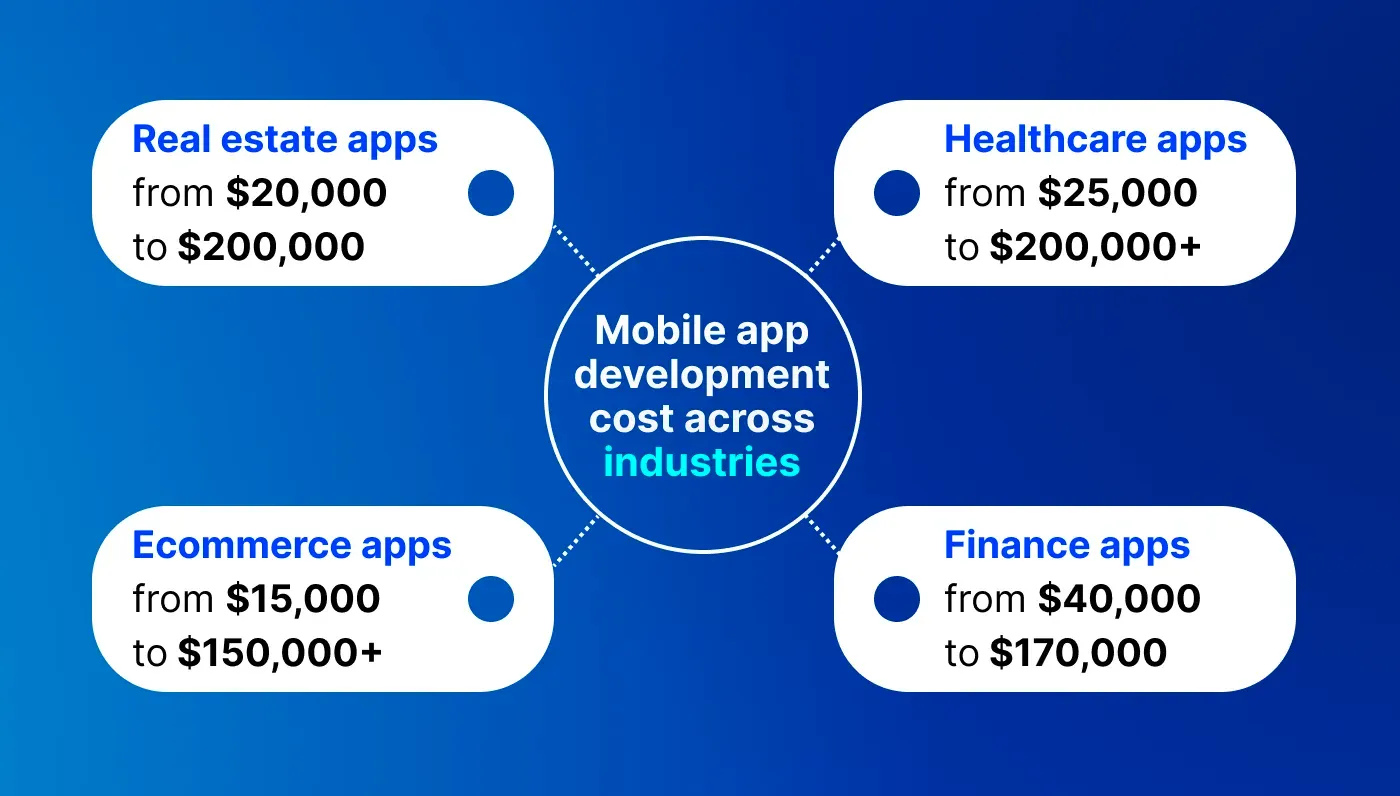
Industry is one of the key factors behind mobile app development pricing. Obviously, a health care app won't hit the same price tag as a delivery app, for instance. That affects not only the features but also the architecture, testing, release, and, in the end, the overall mobile app development cost.
See the short breakdown and the approximate calculations:
Healthcare. Apps for the healthcare industry will be more expensive by default as they have little room for error. The product has to support telemedicine, e-prescriptions, patient monitoring, and EHR connectivity. At the same time, it has to meet strict privacy and compliance standards. This is why healthcare app budgets often range from $25,000 to $200,000+.
Finance. Apps in the fintech industry are based on trust, speed, and security. Whether the app is built for payments or digital banking, it usually needs secure authentication, real-time data handling, and strong compliance controls. With those demands in place, finance app development often falls somewhere between $40,000-$170,000.
Real estate. Apps for the real estate industry are about listings, maps, filters, chat, mortgage calculators, and CRMs. The build becomes more demanding when MLS data, broker tools, and agent-buyer communication are part of the product. A realistic range here is usually $20,000 to $200,000.
Ecommerce. Apps in the ecommerce industry can be simple or quite advanced, depending on the business model. A basic option may only need product listings, checkout, and account functionality. A larger product may include inventory sync, custom promotions, logistics integrations, or multi-vendor logic. In most cases, ecommerce app budgets sit somewhere between $15,000 and $150,000+.
Cost of developing a mobile app for different operating systems
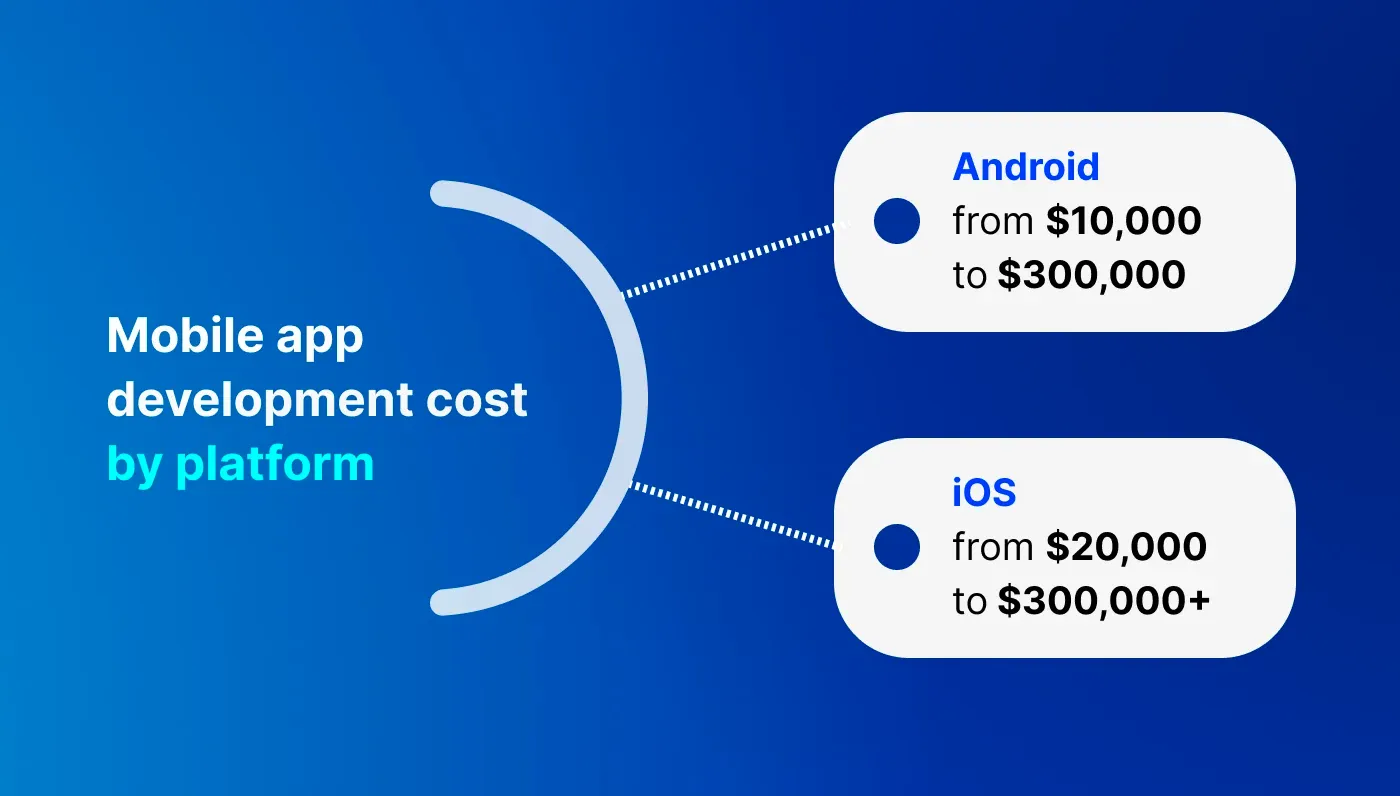
In practice, that choice affects more than just the budget. It also shapes the timeline and how much platform-specific work the product will need. In 2026, most businesses are building for iOS, Android, or both. You may see that the price stays almost identical for both. However, app development pricing will depend on the platform strategy behind the product and the amount of work required for each version.
Android app development
Android usually comes as a first must-have. Logical move, as this market has a broader reach. Businesses are attracted by its large user base, which is around 3.5 billion users. However, as usual, there are two sides to one coin. Be ready for a less straightforward development process due to the variety of devices, screen sizes, and hardware.
In mobile app development, that usually means more testing and more adaptation work across devices. As a result, app development costs for Android can start at around $10,000-$20,000 for a simpler product and rise to $300,000 for an app with more advanced functionality and heavier backend requirements.
iOS app development
iOS development usually happens within a more consistent device environment, which makes development and testing easier to plan. At the same time, if you work on a customer-facing app, be ready for a demanding environment. Users pay a lot more attention to visual quality, responsiveness, and overall polish. That also affects mobile app design, since the interface often needs more careful adaptation to feel fully native on Apple devices.
In terms of app development pricing, a simpler iOS app may start at around $20,000-$50,000, while more complex products can cost $200,000-$300,000+.
Building cross-platform apps
Cross-platform development has become a popular choice for businesses that want to launch on both platforms – iOS and Android – faster and with a more controlled budget. Instead of building two separate apps, developers use frameworks such as React Native, Flutter, or similar technologies to share a significant part of the codebase across platforms.
In practice, this approach can help keep costs more reasonable by cutting down on duplicate work across iOS and Android, especially for MVPs or products that don’t require deep platform-specific functionality. However, apps that rely heavily on complex animations, high performance, or deep native integrations may still require platform-specific customization. In such cases, part of the codebase might need to be written separately, which can affect both tim eline and budget.
Building cross-platform apps will typically cost between $25,000 and $150,000+, depending on functionality, integrations, and scalability requirements.
Mobile app development cost by features
The more features you want to pack into your app, the more budget load you'll have. Two products can belong to the same category but end up with different budgets. For example, one relies on basic user flows, and the other includes live communication, payments, or offline access.
That is why app development cost is often shaped by scope at the functionality level. The broader and more technically demanding the product becomes, the more work goes into architecture, integrations, testing, and support. In most cases, this is one of the clearest cost factors for building a mobile app. It also explains why the cost of developing a mobile app can rise quickly even when the app looks fairly simple on the surface.
Basic functions with minimal app development costs
These are the core product elements many apps need in their first release:
Account creation and sign-in: $1,500-$3,000
Personal accounts for users: $1,000-$2,000
In-app search: $2,000-$4,000
Alerts and reminder delivery: $1,500-$3,000
Input fields and submissions: $1,000-$2,500
Display of written and visual content: $1,500-$3,000
Complex features with meduim cost impact
This is where the product starts to demand more backend work, more third-party services, and more QA coverage:
Built-in conversation tools: $4,000-$10,000
External account connection: $2,000-$5,000
Media upload and sharing: $3,000-$8,000
Checkout and transaction handling: $3,000-$8,000
Location tools and map support: $3,000-$7,000
Schedule and date coordination: $2,000-$5,000
Usage insights and basic reporting: $2,500-$6,000
Advanced features with high cost impact
These features usually push the budget up the fastest and take time for implementation:
Live messaging and video connection: $10,000-$25,000
Predictive or model-based logic: $15,000-$50,000
Custom motion effects and smoothed transitions: $5,000-$15,000
Camera immersive experiences: $15,000-$75,000
Multi-layer payment logic: $10,000-$30,000
Instant updates across devices: $8,000-$20,000
Enhanced data protection: $10,000-$25,000
Offline usage, with later syncing: $8,000-$18,000
What can be hidden under the mobile application development cost?
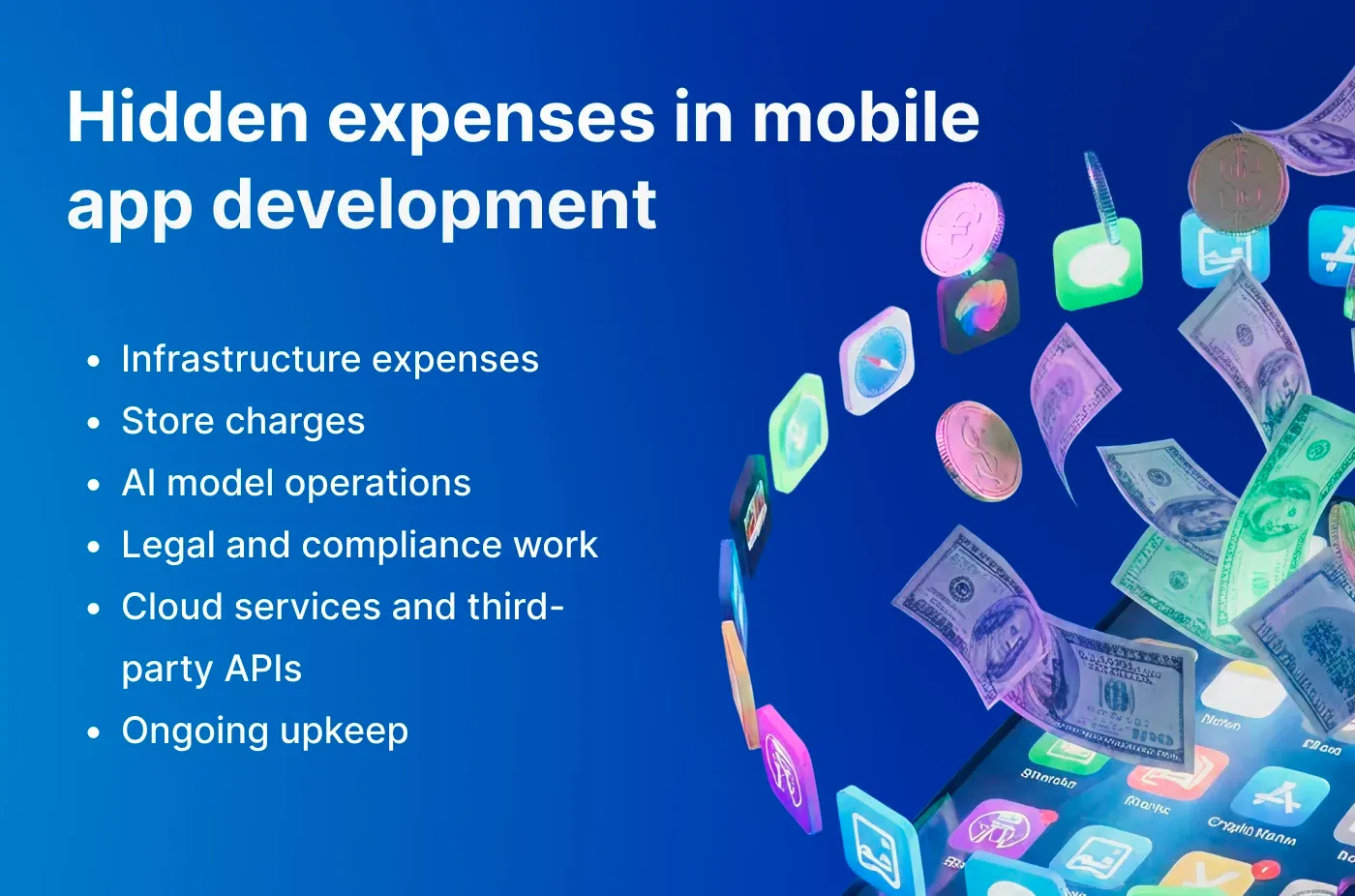
The launch budget is a must, however, it is only a part of the picture. Be sure that after the release, you'll start to see new costs appear in the background. The thing is, these additional expenses can't be ignored, as you risk increasing the overall app development cost. Apart from the money problem, you'll definitely have maintenance and improvement issues.
One of the most common ongoing expenses is infrastructure. As the app attracts more users and handles more data, hosting and API usage grow as well. Something that seems affordable at launch can turn into a much bigger monthly expense as the app grows.
Store-related charges also continue beyond development. Apple and Google require developer accounts, and both platforms apply commissions on purchases. That should be counted in when planning long-term revenue, especially for apps with subscriptions or inside payments.
Additional mobile app development costs may appear in product visibility and stability:
Performance monitoring
Crash tracking
Usage analytics
After launch, these tools help you keep track of performance, catch issues, and see how users move through the app.
For AI-based products, there is another layer to consider. Models need ongoing oversight, version control, and periodic retraining. Without that, results can become less accurate as data changes.
Legal and compliance work can also return year after year:
Privacy standards
Security requirements
Regulatory expectations
They do not stay fixed, so regular reviews are often needed to keep the product aligned with current rules.
A typical annual view may look like this:
Cloud services and third-party APIs: $5K-$30K per year. Usually grows with traffic, storage, and usage volume.
Ongoing upkeep: 15-25% of the original build cost per year. Use for bug fixing, OS updates, compatibility work, and continuous QA.
AI model operations: $3K-$20K per year. Relevant for apps that rely on machine learning or other AI-driven functions.
Ideally, it is better to set aside at least 20% of the initial build budget each year for maintenance, growth, and product updates. If the app includes AI, it is worth planning extra money for retraining, monitoring, and model support.
A practical way to calculate the cost of developing a mobile app
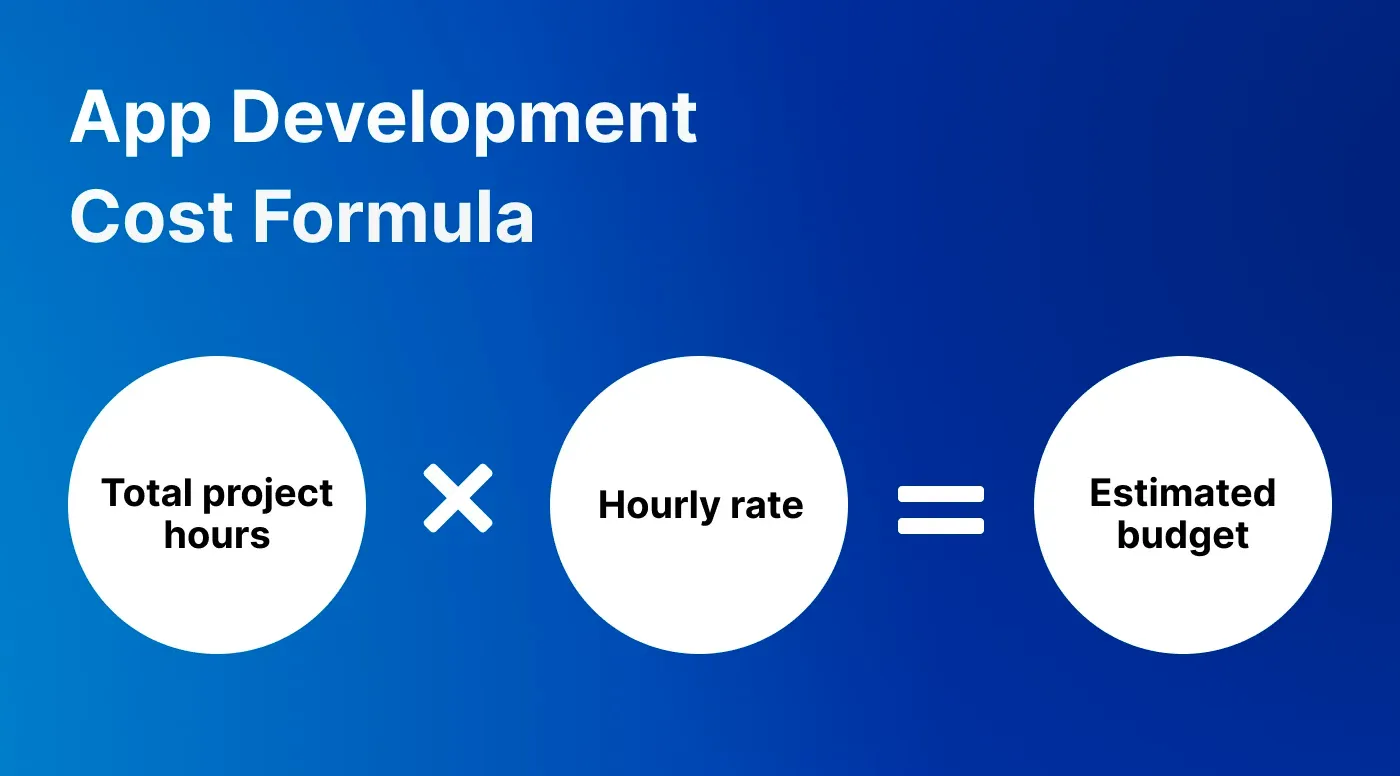
There are two most important variables for a reliable and accurate estimate:
How many hours is the product likely to take
Who does the work
Everything else usually comes later. Current 2026 market guides put senior developer rates in North America and Western Europe at roughly $45-$230+ per hour, depending on region, seniority, and delivery model.
A simple formula helps: Total project hours × hourly rate = Estimated budget
That sounds basic, but it gives teams a more grounded starting point than broad averages alone. The two numbers that matter most are scope and rate. Scope affects hours. Team profile and market location affect the rate.
A complex app with accounts, dashboards, and integrations can take 600-800 hours for development alone. Plus, add discovery, design, QA, and project management. Here is a simple example. If a project is expected to take 700 hours and the blended rate is $110 per hour, the core development budget comes to 700 × $110 = $77,000. Don't take it as a full budget. Discovery, UX, project coordination, and QA often add another 30-50% on top of it. As a result, it can push the total project range closer to $100,000-$115,000.
This is also why early quotes can feel inconsistent. Two vendors may be pricing the same app idea, but one may be estimating only coding while the other includes planning, design, testing, and release support. If you want a number you can actually budget against, ask for the estimate to be split by stage, team role, and hours, rather than presented as a single lump sum.
A rough way to size up the cost of developing a mobile app
Online calculators give you a rough idea of the cost of your app development. Sometimes it is not possible to include the entire scenario. We think it is better to provide a close to real simulation to show a more realistic view of how app development costs can be formulated.
Option 1: A basic app for an existing business
This kind of app is usually built to support a business that is already up and running. In most cases, it covers the basics of customers' needs (logging in, viewing content, or getting updates). It connects to the systems the business already uses.
Typical setup:
An app built for your current business
Sign-in, content, and notifications
Connection to an existing website or backend
One platform or a shared cross-platform build Estimated range: $15,000-$50,000
Option 2: A test version of a product
This usually works best when you want to put something real in front of users before doing a bigger build. The product covers only the key parts needed to test the concept. You don't need to launch it fully yet.
Typical setup:
Around 3-5 key functions
User accounts and essential workflows
A simple backend structure
Clean and credible design, no investing in details Estimated range: $40,000-$80,000
Option 3: A product that includes buyers and sellers
These products are more complex because they need to support two different user groups and the connection between them. That often means more backend work and more admin controls.
Typical setup:
Two-sided product model
Payments, search, messaging, and reviews
Separate experiences for each user group
Admin area to manage the platform Estimated range: $80,000-$180,000+
Option 4: An advanced product with high technical demands
This category usually covers apps with more advanced requirements, whether that means AI app development, connected devices, video, or strict compliance rules. Products at this level often need stronger architecture, broader QA, and a more specialized team.
Typical setup:
A lot more is happening in the backend
Parts of the app that need to react in real time
Added compliance work in industries with stricter rules
Different user groups, each with its own level of access Estimated range: $100,000-$400,000+
Your next steps after the mobile app development cost breakdown
By the time you reach the pricing stage, the real question is no longer "How much does mobile app development cost?" You'd better think if the scope, team, and delivery plan actually match what you are trying to build.
Before you move any further
A rough budget is good, but it is only a starting point. What matters more is whether the product has been scoped well enough for that number to mean anything.
A few things are worth pressure-testing early:
What the first version really needs to do
What can be delayed without hurting the product
Which parts of the build are likely to stretch the budget fastest
Whether the app should start lean or launch more fully formed That kind of clarity makes it much easier to compare estimates later.
When the numbers start coming in
This is usually the point where pricing begins to look clearer, but it can also get misleading fast. A lower quote is not always cheaper in practice. Sometimes it leaves out work that will come up later.
It helps to look beyond the headline figure and focus on what the proposal is actually covering:
Whether planning and discovery are included
How design, development, and QA are split
What has been assumed around integrations and backend logic
How launch support and post-release work are handled The goal is to understand how each team sees the product and what they believe it will take to build it properly.
When a quote looks fine on paper but still feels off
That usually means something in the assumptions has not been explained well enough. In that situation, the most useful thing you can do is ask for the estimate to be unpacked. Not line by line for the sake of detail, but clearly enough to see where the time is going and where the risk sits. That often tells you more than the total ever will.
A solid proposal should leave you with fewer question marks, not more. The apps that do well are not necessarily the ones launched on the biggest budget. More often, they are the ones planned with clear priorities, realistic trade-offs, and a team that is upfront about where the real complexity lies. If you want to sense-check the scope before you move ahead, contact DigitalSuits. A second look at the plan can help you spot gaps in the estimate and avoid paying for the wrong things.
Conclusion
At the end of the day, the numbers help if they show you what you are actually paying for. A clear mobile app development cost breakdown makes that easier. It turns a big estimate into something more practical, so you can see where the budget is going and whether the plan behind it really makes sense. That is usually where better decisions start.
You need to start with a clear view of priorities, not only a random price range. When you break down app development costs properly, it becomes much easier to judge what is essential now. If you'd like a practical second opinion on the scope and budget, reach out to DigitalSuits.
Frequently asked questions
Why can two agencies quote very different prices for the same app?
Because they frequently price various scopes even when the product description is the same. One team may include discovery, UX, backend planning, QA, and launch support. Another may quote development only. In many cases, the gap is about what is included and what is not.
Is cross-platform the cheaper option?
Usually yes, but not always. It is often cheaper because one codebase can cover two platforms at once. But if the app needs complex integrations, advanced AI features, or heavy animation, native development may be the more cost-efficient choice.
What is usually missing from an estimate that looks too low?
Usually, it misses the details that appear later:
UX work
QA
Release prep
Infrastructure
Third-party services
Post-launch support A low quote can look attractive early on, but it is not very useful if part of the work has simply been left out.
Can AI make app development cheaper?
It can save time in some parts of the process, but it can also add up to new costs. Once AI integration becomes part of the product, you may need to spend on model usage, infrastructure, and support. So it can help in one area and add expense in another.
Is it cheaper to improve an existing app than rebuild it?
Sometimes, yes. If the app still has a solid technical base, improvement is a better option. But when the code is outdated or too messy to work with, it is better to start from scratch.
Do app store fees make a difference to the overall cost?
They do once the app is live. Apple charges $99 per year for its developer account, and Google Play charges a one-time $25 registration fee. If the app earns money through subscriptions or in-app purchases, platform commissions can also take a share of that revenue (15-30% commission).

Written by
Yurii Zablotskyi
Content Marketing Specialist
Yurii Zablotskyi is a passionate content writer and storyteller with a strong marketing background, focusing on marketing, sales, and technology, turning complex ideas into valuable content.











Was this helpful?
0
No comments yet