

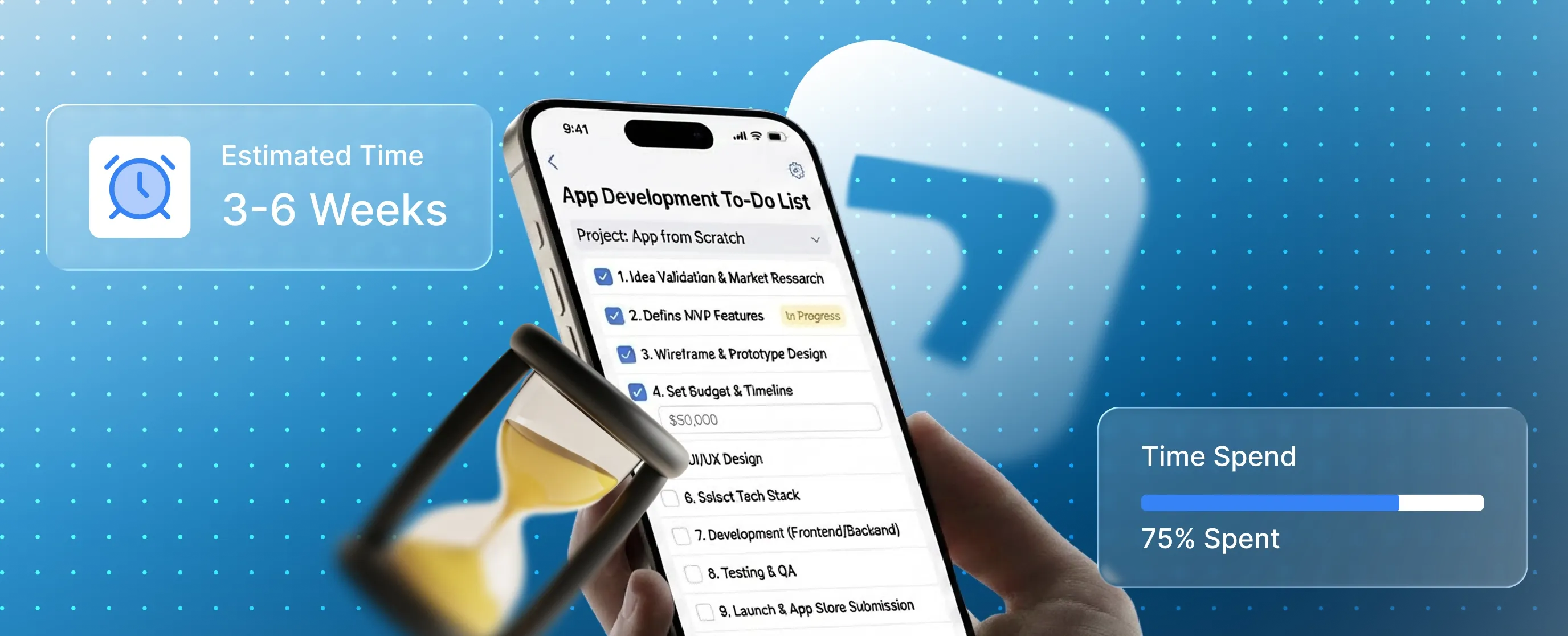
You have an app idea, but after discovery, it's still unclear how long it will take to develop a mobile app. The honest answer is more nuanced than most blog posts admit, since several things have recently shifted, making previous estimates unreliable.
TL;DR: What are mobile app development timelines?
Most mobile apps take 6 weeks to 18+ months from kickoff to live on the app store. Timelines vary based on complexity, integrations, and compliance requirements:
- Simple (MVP, 3–5 screens, minimal backend) – 6–12 weeks
- Medium (social features, third-party integrations, admin panel) – 3–6 months
- Complex (real-time data, compliance-heavy, multi-tenant) – 6–12+ months
- Enterprise-grade(large organization rollout, regulated industries, legacy system integration) – 9–18 months
What changed in mobile app development in 2026 and why it matters for estimating timelines
AI-assisted development (Cursor, GitHub Copilot, Claude)
AI coding tools have genuinely moved the needle — just not in the way most people assume.
Cursor, GitHub Copilot, and Claude can compress the raw coding phase by roughly 55% on well-scoped projects, according to GitHub Copilot research.Boilerplate, authentication flows, API wiring, standard Create, Read, Update, and Delete (CRUD) operations — all of it moves faster. A task that used to consume a day now takes a few hours.
But the coding phase is only part of the project. Product discovery still requires people talking to stakeholders and making hard prioritization calls. To design an app you still require iteration with actual users. QA still needs someone who understands what “done” means for your specific product. None of that speeds up just because the code writes faster.
Teams that assumed AI tools would cut the full timeline in half got a rude surprise; teams that used those tools specifically to shrink the development phase saved 4–6 weeks and called it a win.
App store congestion
This one is catching product teams completely flat-footed. According to Appfigures, worldwide app releases in Q1 2026 were up 60% year-over-year across both stores — and 80% on iOS alone. By April 2026, total releases were running 104% higher than the same period last year. Apple’s review team is processing roughly twice the submissions it was handling twelve months ago.
The practical result: what used to be a reliable 24-hour turnaround is now 2–5 days under normal conditions, with spikes reaching 7–30 days. Developers across Apple’s own forums have documented apps sitting in “Waiting for Review” for 2–3 weeks with zero status updates.
So, you need to plan for 2–4 extra weeks in your launch timeline to build an app just in time.
New compliance requirements: AI consent rules, updated privacy manifests, new SDK requirements
Three separate layers of compliance work have been added to most app projects in 2026.
- Apple clarified in November 2025 that apps sharing data with third-party AI must include explicit disclosure language and user consent flows. Ambiguous implementations are being caught in review.
- Privacy manifests — first required in 2024 by Apple — were expanded in scope. Every third-party SDK touching device signals, from crash reporters to analytics tools, needs to be declared. Missing or inaccurate manifests remain among the rejection reasons.
- On the Google side, Play updated its target API level requirements and is enforcing stricter data safety section accuracy. Teams copying data safety declarations from an older project submission are getting rejected for mismatches with what the app actually does.
Set aside 1–2 weeks in the planning phase specifically for compliance documentation. It’s tedious, but it’s cheaper than a rejection at launch.
Cross-platform maturity
The native-vs-cross-platform debate is mostly over for mainstream consumer apps. Flutter app development can cut the timeline for app development almost twice versus maintaining separate iOS and Android codebases.
The performance difference versus native Swift or Kotlin is narrow enough that only games and deeply hardware-dependent features still justify the split approach.
Low-code/No-code maturity
Platforms like FlutterFlow, Bubble, and Glide have crossed the threshold from “good enough for prototypes” to “good enough for production” — for the right category of app.
Internal tools, content-driven apps, and simple B2C products can ship in 3–8 weeks. The ceiling is real, though: custom logic, complex backend relationships, and performance-critical features will eventually force a rebuild.
How long does it take to build a mobile app: Five phases of development
Discovery & planning
This phase tends to get underestimated in two directions: some teams skip it entirely, and some teams turn it into a six-month strategy exercise that delays everything. Neither works.
What actually needed at this phase to make an app in time:
- document the feature scope
- agree on the tech stack
- map user flows
- identify third-party dependencies
Finally, you need to produce something the development team can build from without asking three questions per ticket. That output — a clear written spec — is worth more than any amount of prototyping later.
Typical duration: 2–4 weeks for straightforward apps; 4–6 weeks for complex or compliance-heavy products.
UI/UX design
The sequence of UI/UX design is wireframes → visual design → interactive prototype.
- A small app with 5–8 screens moves through this in roughly two weeks.
- Something with 15–25 screens and a custom design system takes 3–5 weeks.
Client feedback cycles are where timelines silently expand — two rounds of revisions is normal, four rounds means scope has drifted.
Typical duration: 2–6 weeks.
Development (back + front) & integrations
Mobile app development splits into two workstreams that have to stay synchronized: backend builds the server logic, database schema, and API layer; frontend consumes those APIs to build what users see. When the two tracks fall out of sync — which they do, regularly — one team idles waiting for the other. The data model decisions made in week two determine what's possible in week ten. Choose wrong early and you're refactoring under pressure later.
What most estimates undercount is the distance between "feature complete" and "production ready." Getting a login flow working takes a day. Getting it to handle expired tokens, failed refresh attempts, and account lockout correctly takes another three. That gap exists for almost every feature when you try to code an app.
Integrations multiply it — a payment gateway isn't just an API call, it's webhook handling, retry logic, and edge cases the sandbox never surfaces. Push notifications require device token management and fallback logic for revoked permissions. Each integration looks like a task on a sprint board and behaves like a small subproject once you're inside it.
To create an app within tight timelines, team size matters, but not infinitely.
- A team of 3–4 (one mobile developer, one backend developer, one designer, one QA engineer) can deliver a mid-complexity app in 4–5 months.
- Scaling to 5–7 people — adding a project manager, a second mobile developer, and a second backend engineer — typically shaves that to 3–4 months.
- Beyond 10–12 people on a single product, coordination overhead starts working against you.
Typical duration: 6–10 weeks for simple apps; 3–6+ months for complex ones.
Testing & QA
QA is not what happens after development finishes. Teams that treat it that way ship bug-heavy products and then wonder why. The ones that run QA in parallel with each sprint catch issues early, before those issues have had time to compound into architectural problems.
Production surfaces bugs that testing doesn't — not because QA was done poorly, but because no staging environment fully replicates real device diversity, real traffic, or the unpredictable ways real users move through an app. QA's job isn't to guarantee a bug-free launch. It's to eliminate everything that can be caught before production, so what surfaces afterward is manageable rather than critical.
Typical duration: 3–4 weeks for simple apps; 4–8 weeks for complex or compliance-heavy ones.
Deployment & app store submission
Most teams budget nothing for this phase and then lose two weeks to it. App Store Connect configuration, screenshot production, demo video recording, review notes, age ratings, data safety declarations, and privacy nutrition labels all need to be done before the app even enters the queue. Then there is a queue itself.
For 2026, treat this as a 3–4 week phase, not a two-day checklist. First submissions and apps touching AI, payments, or user-generated content tend to get the most scrutiny.
Typical duration: 1–4 weeks, heavily queue-dependent.
How long does it take to develop an application: timelines by app complexity
Tier | Features | Timeline |
|---|---|---|
Simple | 3–5 screens, basic auth, no backend | 6–12 weeks |
MVP | Core workflow, 1–2 integrations, basic admin | 10–16 weeks |
Mid-complexity | Multiple user roles, 3–5 integrations, admin dashboard | 4–6 months |
Complex | Real-time features, custom backend, compliance | 6–12 months |
Enterprise | Multi-tenant, high-security, deep integrations | 9–18 months |
It helps to think in product examples. Instagram at launch was a simple app — photo sharing and filters. That’s it. WhatsApp sits in the mid-complexity tier: messaging, voice calls, video calls, media sharing, all across a global user base. Amazon is what complex looks like: an ecommerce engine layered with third-party payment processing, seller logistics, a review system, personalized recommendations, and regional regulatory compliance.
These are not three points on a linear scale — they’re fundamentally different products requiring fundamentally different timelines.
Development timelines by app type
- SaaS and productivity apps typically land at 8–16 weeks for a tightly scoped MVP. A production-ready launch with onboarding flows, billing, team management, and proper role permissions adds up to 4–6 months.
- Marketplace apps — anything connecting two sides of a transaction, like Uber or DoorDash — need a minimum of 4–8 months. Dual user flows, transaction logic, search and matching, and the operational overhead of acquiring supply and demand simultaneously all pile up. The technical build is the easier part.
- AI-powered apps vary wildly. Wrapping an OpenAI or Anthropic API in a clean interface can ship in 8–12 weeks. Building custom ML pipelines or on-device inference models is a 6–12+ month project that involves a different skill set entirely.
Mobile app development timelines by industry
- Ecommerce: A mid-tier product catalog with Stripe payments and order tracking runs 3–5 months. Complexity scales roughly with SKU count, number of storefronts, and the depth of logistics integration.
- Healthcare: Five to nine months is the realistic floor for a HIPAA-compliant app. Telehealth platforms with video consultations, EHR integrations, and prescription flows typically run 8–12 months. Budget extra time for the compliance audit that happens before you submit.
- Fintech: KYC flows, banking API integrations, fraud detection logic, and PSD2 compliance push most fintech MVPs to 5–8 months. Penetration testing, which most financial apps require before launch, adds another 2–4 weeks.
- Education: 3–5 months for a content delivery app. Interactive platforms with gamification, progress tracking, and a content management system add another 2–3 months.
- Logistics and field service: Offline-first architecture — required for any app used in warehouses or remote locations — adds 4–6 weeks to a comparable CRUD application. Real-time tracking on top of that adds more.
How long does app development take: timelines by platform
iOS
iOS means fewer devices and OS versions to test against — QA runs faster and the build environment is more predictable. The trade-off shows up at submission: App Store review is stricter, and queue delays in 2026 hit iOS harder than Android.
Timeline: 3–7 months depending on complexity.
Android
Android’s device fragmentation is a real QA burden. Thousands of device models, varying screen densities, manufacturer-level OS modifications — all of it needs coverage within Android app development. Android-first is the right choice when your primary market is India, Southeast Asia, Latin America, or sub-Saharan Africa, where Android’s market share is dominant.
Timeline: 4–8 months depending on complexity; typically 2–4 weeks longer than iOS for identical scope.
Cross-platform
Flutter app development and React Native app development is the practical default for most mobile app projects launching in 2026. A single codebase targeting both iOS and Android significantly cuts the timeline versus separate native builds. The question of “iOS first or Android first” mostly disappears.
Timeline: 8–14 weeks for MVPs; 3–5 months for mid-complexity apps.
Low-code/No-code
Low-code/no-code development with FlutterFlow, Bubble, and Glide can ship a working product in 3–8 weeks. The catch: when your requirements outgrow the platform, you're rebuilding from scratch. Think about that before you commit.
Timeline: 3–8 weeks for the right scope; plan for a rebuild when requirements scale.
App development timelines by approach
App development timelines by approach
A freelancer or small assembled team works well for simple to mid-complexity apps. The practical risk is sequential work — design waiting on planning, development waiting on design, QA waiting on development. One person having to juggle client calls alongside actual development compounds the timeline. And if the key developer takes another project mid-sprint, you’ll feel it immediately.
Timeline: Add 20–30% to agency estimates for comparable scope.
Agency
A mobile app development agency runs design and development in parallel, has QA baked into the sprint cycle, and typically has a project manager absorbing the coordination overhead. That structure keeps things predictable. The trade-offs: cost, and the fact that a good agency has other clients whose fires occasionally pull attention.
Timeline: The ranges in this article apply most cleanly here. Ask for milestone-based contracts, not a single delivery date.
DIY AI-assisted development
How long does it take to create an app on your own? Technical founders using Cursor or Claude to build their own MVP can move surprisingly fast on well-defined features. Simple flows, standard integrations, basic backend — all of it is more approachable than it was two years ago. The ceiling shows up fast on anything requiring production security, complex state, or compliance logic. And the QA burden falls entirely on you: AI-generated code needs careful human review before it touches real users.
Timeline: Competitive with agencies for simple apps; expect to spend 50%+ more time than you planned on anything medium-complexity.
What may cause delays in building a mobile app and how to mitigate those risks
- According to PMI, 52% of all projects experience scope creep — and it's consistently cited as one of the top three causes of project failure. A feature added mid-sprint without adjusting the timeline quietly eats the time allocated to everything else. Fix: freeze scope per sprint, everything else goes in the backlog.
- Poor requirements are the most expensive problem when you try to make an app — not because they're hard to fix, but because they're usually fixed late. A misalignment that surfaces in week eight means unwinding decisions that had three more weeks of work built on top of them. Getting a written spec agreed on before development starts costs a few days. Not having one is a debt that compounds.
- Third-party integrations are the most predictable source of mid-project surprises. An API that looks clean in the documentation behaves differently under rate limits, real data, and production traffic. The fix is timing: get every integration into a staging environment during discovery, before a sprint depends on it.
- App store review delays need to be treated as a certainty, not a contingency. Submit to TestFlight and Google Play internal testing early. Have compliance documentation ready before you submit. If your app has AI features, payments, or user-generated content, assume you’ll face additional scrutiny and plan accordingly.
- Client feedback lag is the quietest timeline killer. When design approvals take a week instead of two days, that week compounds across every review cycle in the project. Put a 48–72 hour response Service Level Agreement (SLA) in the contract and hold to it.
Tips for reducing app development timeline without cutting quality
- Define the MVP ruthlessly. Any feature that doesn’t directly test the core value proposition is a phase-two feature. Teams that try to build the full product in the first release routinely stretch 5-month projects into 12-month ones.
- Use production-ready UI component libraries — Material UI, Shadcn/ui, and platform-native design systems — instead of building every component from scratch. The time savings are real: 2–4 weeks on most projects.
- Validate third-party integrations in week one or two, not week eight. Get your Stripe account approved, your mapping API credentials provisioned, your push notification infrastructure working in a staging environment. Dependencies that aren’t tested early tend to fail at the worst possible time.
- Use off-the-shelf solutions for non-core features. Auth0 and Clerk handle authentication. Retool handles admin dashboards. Zapier or Make handle email workflows. These tools exist so you don’t have to build what’s already built.
- Run QA throughout the project, not at the end. A bug caught during the sprint it was introduced takes an hour to fix. The same bug caught in final QA takes a day and might require touching code in three other places.
How to build a realistic timeline before hiring anyone
Start with a feature list, then be brutal about what actually has to be in the first version. Sort everything into three buckets: must-have for launch, nice-to-have at launch, and phase two. Be honest about which bucket each feature belongs in — most things that feel essential aren’t.
Identify every third-party service the app will need before you talk to any vendor, such as payments, maps, authentication, analytics, push notifications. Each one adds integration time that isn’t always accounted for in initial estimates.
Confirm the platform strategy early. iOS-only, Android-only, or both? Native or cross-platform? These decisions shape the architecture, the team structure, and the budget.
If your industry has compliance requirements, research them now. Healthcare, fintech, and children’s apps each carry specific technical and legal obligations that affect the architecture. Finding out about HIPAA requirements in month four is a very expensive discovery.
When you get vendor proposals to build an app, ask them to break the estimate down by phase. A proposal with a single delivery date and a single price tells you almost nothing about whether the vendor has actually thought through your project. A proposal broken into discovery, design, development, QA, and deployment tells you they have.
Need a partner?
The decisions made in the first two weeks of a mobile app project — platform, architecture, scope — have a way of compounding for the next six months. Getting those right at the start is most of what separates projects that launch from projects that get rebuilt.
DigitalSuits is a reliable mobile app development partner who plans everything in advance to avoid surprises later. If you want a scoped estimate based on your actual requirements, talk to our team.
Written by
 Anastasiia MoskvichovaContent Marketing Specialist
Anastasiia is an enthusiastic content writer who diligently researches and curates valuable information to craft engaging content tailored for readers with a keen interest in marketing, sales, and technology.
Was this helpful?
0No comments yet