










If you are now surrounded by calculators, pages full of numbers, and checking your bank account, you are probably bothered by a question: "How much does an ecommerce website cost?" Well, that's hell of a question. Here’s the honest answer: anything between a couple of hundred and a dozen thousand, yet not millions, we have to point! Yes, we can hear you, that's not the answer. But there's no one.
The price range is wide because "an ecommerce website" can mean anything from a clean Shopify build with a paid theme to a headless B2B platform with ERPand PIM.
How much does an ecommerce website cost?
$5,000–$15,000: small store (template-led, light customization)
$20,000–$60,000: mid-market store (custom UX + core integrations)
$80,000–$250,000+: enterprise / B2B / headless (complex data + systems)
Now let's break down what drives ecommerce website cost in 2026, part by part, and more importantly, how to estimate it.
Why is knowing the ecommerce website development price essential?
Understanding ecommerce website development cost is no longer a tactical concern. In 2026, it is a strategic concern. Online sales worldwide are expected to surpass $6.8 trillion by 2028. Therefore, the margin for poor online execution is rapidly dwindling. When there's no clarity in the budget, the business will either overspend or underinvest. Whatever happens, the revenue will be impacted directly.
Knowing the cost for ecommerce website helps businesses to plan realistically and prevent costly revisions after release.
Ecommerce complexity has fundamentally increased in 2026
One of the main reasons ecommerce website development cost is harder to predict in 2026 is that the industry itself has structurally changed. New ecommerce trends set that modern stores are no longer static storefronts with add-to-cart functionality. They are intelligent systems that operate, decide, and adapt in real time.
AI and agentic commerce
AI in 2026 has advanced beyond chatbots and simple suggestions. The dominating approach is Agentic Commerce. It involves AI agents acting on behalf of both customers and entrepreneurs. AI now handles most of Level-1 operations, including:
customer support resolution
inventory reordering
dynamic, real-time pricing
While this reduces manual workload, it increases development complexity. AI development requires advanced backend logic, clean data pipelines, monitoring systems, and ongoing technical oversight.
Discovery has also moved. Shoppers have to turn to generative AI technologies to locate items rather than standard search engines. This needs store owners to be engaged with generative AI integration services.
As a result, organizations must optimize not only SEO but also algorithmic exposure in AI-powered discovery platforms.
The era of AI adoption experiments has gone, now it's a must. That shift directly affects the cost of ecommerce website, because AI-ready architectures require structured data, integrated systems, and governance layers.
Hyper-personalization as a standard requirement
In 2026, modern stores respond dynamically to user behaviour, context, and intent. AI-driven personalization in ecommerce now operates across:
sessions
devices
channels
Predictive models analyze habits to predict what a user wants before they are explicitly expressed. This includes personalized product offerings, communication, and price reasoning. Personalization now affects core logic, not visuals. Different users trigger different pricing, catalogs, and purchase flows. That complexity directly increases development and maintenance effort.
Connected ecosystems and united commerce
Most ecommerce projects in 2026 fail on the same thing: disconnected systems. The storefront is often the easy part. The hard part is making data consistent across channels. A typical build has to keep these in sync:
Product data (titles, attributes, variants)
Inventory (available-to-sell, reservations, backorders)
Pricing (lists, discounts, contracts, taxes)
Customer records (accounts, segments, consent)
Orders (status, refunds, returns, fulfilment)
When that data is spread between different tools, the website becomes unreliable. Customers see items that cannot ship. Support spends time fixing avoidable errors. That's why many brands move to composable or headless commerce because they need the storefront to consume data from multiple systems without breaking. API-first architecture adds cost for a simple reason: you are building and maintaining the connections. You also need error handling, retries, and monitoring, or the whole chain fails quietly.
Compliance and regulatory pressure
In 2026, compliance shapes architecture from day one. AI governance is one example. If pricing, ranking, or customer decisions are automated, teams must be able to explain outcomes internally. That means the system needs records of what happened and why. Practically, this adds requirements like:
Decision logs (inputs, outputs, timestamps)
Access controls (who can change rules or models)
Audit trails (what changed, when, and by whom)
Cross-border selling adds a different type of complexity. Taxes, duties, and restricted shipping rules affect checkout. They also affect the product page, because availability and final price can change by location. It requires a systematic approach to updating price and compliance without disrupting checkout. This increases the work required for deployment and maintenance.
A launch budget answers "what will it take to go live?" An ownership budget answers "what will it take to stay profitable and stable for 12-36 months?” You need both, or your estimate is incomplete. Long-term ownership typically includes:
Platform fees and app subscriptions
Hosting and infrastructure (for headless or open-source stacks)
Security updates, patching, and compliance work
Performance monitoring and ongoing optimization
Development support for fixes, enhancements, and new features
A cheaper launch can become expensive ownership if the site relies on too many apps or rushed architecture. If you plan for ownership early, you make smarter launch choices. You prioritize features that reduce future cost, not just those that look good in a demo.
How much does it cost to build an ecommerce website?
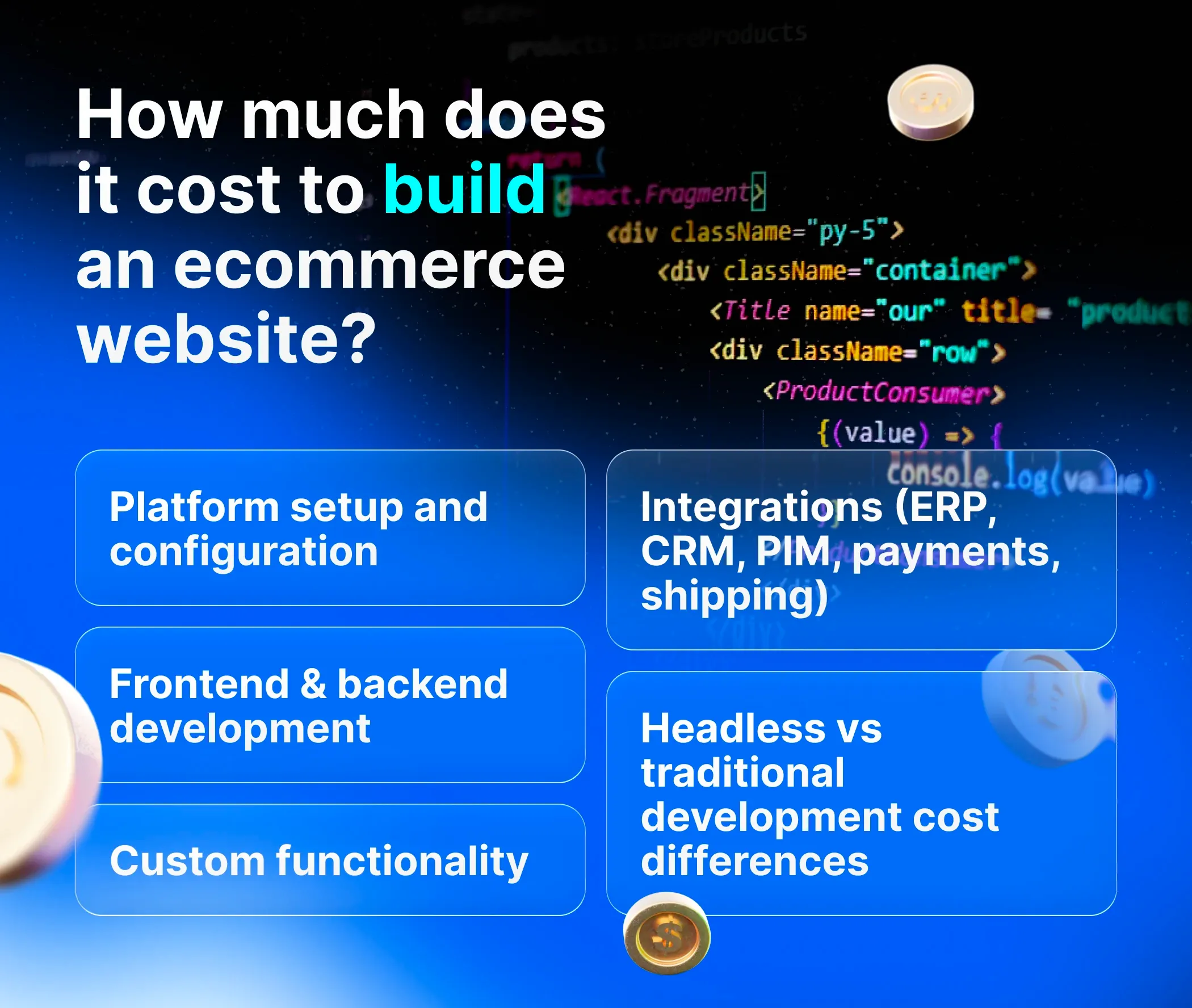
As we've already mentioned, there's no clear answer. However, now we'll break down the essential parts that determine the final price and the main components to note. Your first step should be choosing the platform as the basis of your future website. The choice is vast, and prices are determined by the paid and free features each offers. This is what are the most popular platforms:
Shopify. Public pricing starts at $29/month (annual billing) on Basic
BigCommerce. Standard pricing is at $39/month
Woocommerce. Starts at less than $10/month for beginners and goes up to $40/month for bigger plans.
Yet, that's only the initial, we would even call it a zero phase, as you get only the hosting and domain. The next step is platform setup and configuration, and it comes as a separate cost of an ecommerce website.
Platform setup and configuration
"Setup" can mean basic settings or rules that affect every order. Here's what the ranges usually cover:
$1,000-$3,000 - clean setup
Single market, single currency, no migration, no custom logic.
Standard tax setup (one region)
Basic shipping profiles (flat rates/simple zones)
Payment gateways connected and tested
Basic catalog structure (categories, collections, variants)
Theme or template install with baseline settings
$3,000-$8,000 - advanced configuration
International selling, non-trivial shipping/tax rules, migration prep.
Multi-currency or market rules
Carrier rates, shipping tables, complex delivery logic
Advanced tax handling (VAT prep, exemptions, state-level rules where relevant)
App or plugin stack selection + configuration (search, reviews, subscriptions, etc.)
Data migration prep (products, customers, orders)
$8,000+ - complex setup (B2B, multi-region, scale)
System-level modelling and governance.
Multi-region pricing and tax across markets
B2B policies (roles, permissions, price lists, payment terms)
Multi-store or multi-brand structure
Deep catalog modelling (bundles, kits, complex attributes)
ERP/PIM/CRM data mapping and consistency rules
Custom checkout and operational workflows
Frontend & backend development
This is where your basic setup becomes a product, not a template. Typical ranges:
Small store: $3,000-$10,000
Mid-market store: $12,000-$35,000
Enterprise: $40,000-$150,000+
The amount increases when you add:
Complex product configuration
Advanced filtering and discovery
Custom CMS blocks and landing systems
Multi-warehouse inventory logic
Localization rules that affect checkout
Custom functionality
Custom features are where ecommerce website development cost usually jumps. Not because developers like to overcomplicate things. Because these features sit right on top of checkout, customer data, and "what if" scenarios. A small change here can ripple through taxes, discounts, shipping, refunds, and reporting.
Typical custom modules and ranges:
Custom checkout: $2,000-$10,000
Subscriptions (pause, skip, renewals, proration edge cases): $3,000-$12,000
B2B accounts (roles, price lists, payment terms): $6,000-$25,000
Marketplace mechanics (multiple sellers, commission logic): $15,000-$60,000+
Integrations (ERP, CRM, PIM, payments, shipping)
Integrations are often the difference between "storefront" and "business system." Typical per-integration ranges:
Simple API connection: $1,500-$4,000
Two-way sync (orders, customers, inventory): $4,000-$15,000
ERP/PIM with mapping + error handling: $10,000-$40,000+
Payment processing fees are separate, but they matter for true ownership cost. For instance:
Stripe lists 2.9% + 30¢ per successful online card transaction (US)
PayPal's US lists 2.99% + fixed fee for standard card payments
Headless vs traditional development cost differences
Headless commerce development is not automatically "better." It does its magic for specific requirements: performance control, multi-channel delivery, complex UX, and large scale.
In practice:
Traditional builds are usually cheaper to ship
Headless are usually cheaper to evolve at scale
Typical ranges:
Traditional ecommerce build: $15,000-$70,000
Headless ecommerce build: $60,000-$250,000+
If you're asking "How much does it cost to build an ecommerce site with headless?", assume:
More engineering time
More DevOps and hosting setup
More QA complexity
Price for ecommerce website design
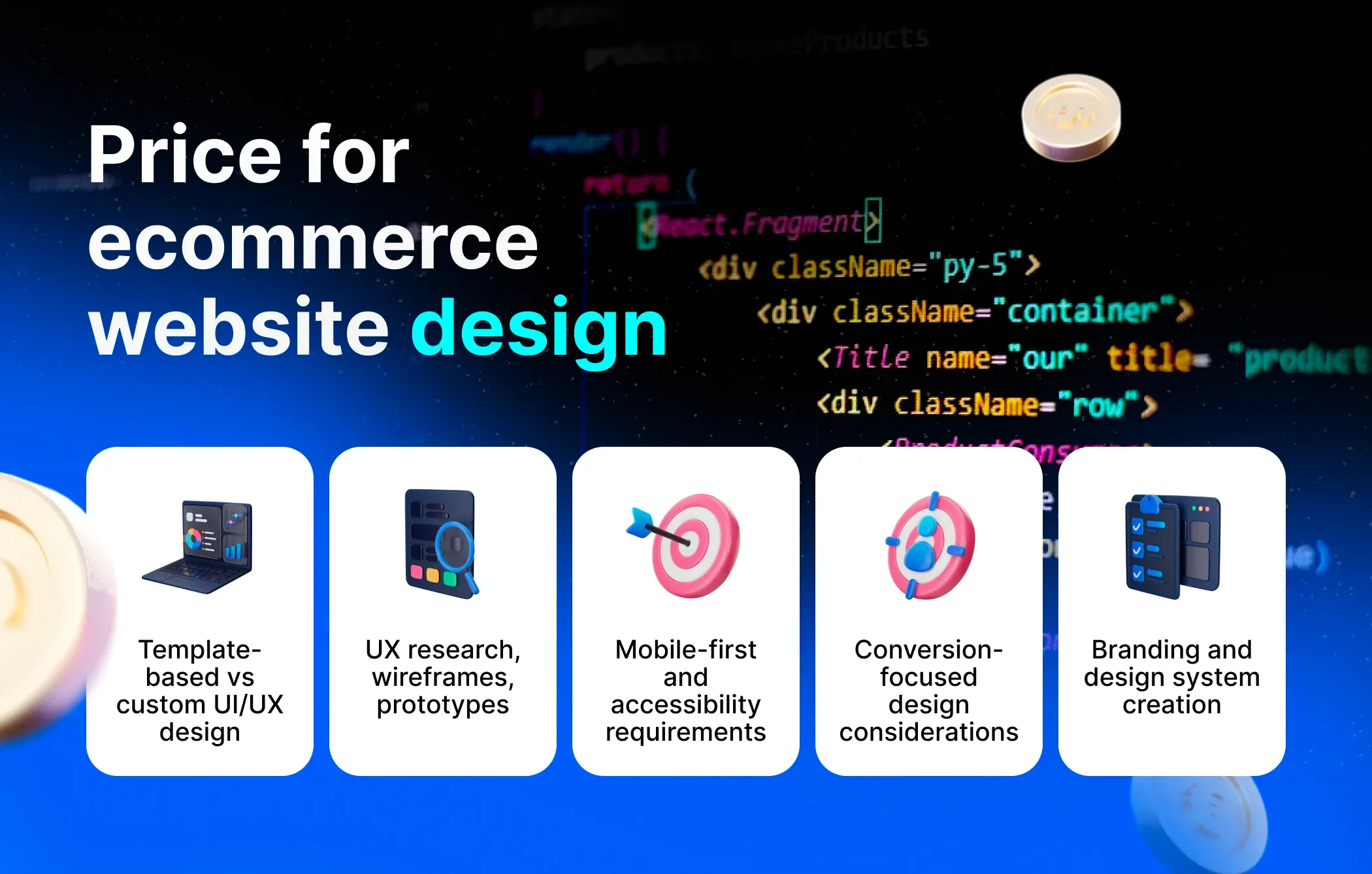
Design is not a sprinkle that makes the website look good and attractive. Its quality distinguishes how quickly a buyer understands your store, trusts it, and finds the path to checkout.
Template-based vs custom UI/UX design
The theme on the chosen platform can be free or a one-time purchase. For example, on the Shopify Theme Store right now, paid themes commonly cost around $100-$420. Web design pricing often depends on the website builder you choose. Clutch highlights that for common builders in 2026, the typical rate range looks like this:
Wix: $25-$49/hour
WordPress: $25-$49/hour
Squarespace: $25-$49/hour
Webflow: $25-$49/hour
Shopify: $25-$49/hour
However, that theme price is just the beginning. The cost comes from adjusting it to your brand and conversion goals. Typical design work ranges:
Template style and minimal UX cleanup: $1,500-$5,000
Custom UI package and rework of essential web pages (home, collection, PDP, cart): $6,000-$18,000
Completely customized UX and design process: $20,000-$50,000+
These ranges fit within broader market pricing for ecommerce website costs, where web design projects can run from a few thousand to six figures, depending on scope and complexity.
UX research, wireframes, prototypes
Ecommerce web design feels expensive only when it arrives late. When it happens early, it prevents wasted build time. Typical ranges:
Research and customer patterns: $1,500-$6,000
Wireframes: $1,000-$4,000
Interactive prototypes: $2,000-$8,000
Why this matters: a prototype often replaces multiple rounds of dev rework. It's cheaper to move boxes in Figma than rebuild templates after launch.
Mobile-first and accessibility requirements
Mobile-first isn't a "best practice" in 2026. It's the default experience for most shoppers. WCAG 2.2 is a formal W3C Recommendation (web standard). If you treat accessibility as an afterthought, you pay twice: first to design, then to fix. Budget ranges:
Mobile UX: $1,500-$6,000
Accessibility remediation: $2,000-$12,000 (depends on how late issues are found)
Conversion-focused design considerations
Conversion design is not "bigger buttons." It’s reducing decision friction. Where teams usually put design effort (because it pays back):
Clearer navigation and category logic
Product discovery (filters, sorting, search UI)
PDP structure (info order, variants, delivery, and returns)
Cart and checkout
These changes can look subtle, but they often influence whether a buyer completes checkout or bounces.
Branding and design system creation
Expect $10,000-$49,999 for a complete branding engagement. Hourly rates typically range from $100 to $149. If you only need a refresh (logo, palette, simple guidelines), the budget is usually $2,500-$10,000. If we go into details, this is what we'll find:
Brand refresh (logo, palette, basic guidelines): $2,500-$10,000. This often fits smaller stores or tighter budget builds and covers visual identity basics.
Full brand identity package: $10,000-$50,000+. This includes strategic work, visual identity, and usage guidelines.
Design system creation: $10,000-$40,000+. A design system bundles reusable UI patterns, spacing systems, and documented components.
Ecommerce website cost for maintenance and support
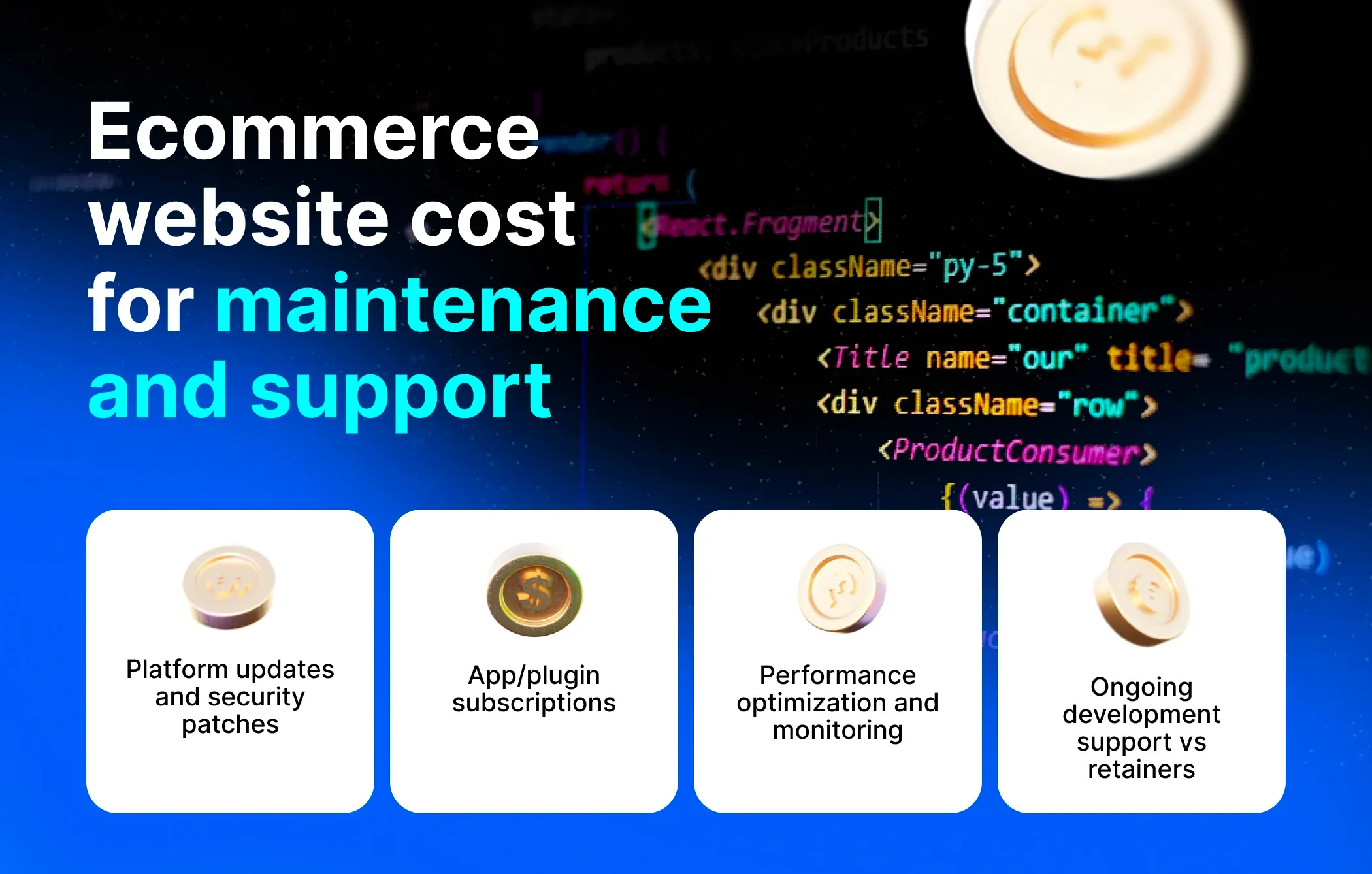
It'll be a useful thing to ask yourself - how much does it cost to run an online store for 12 months? Maintenance and support can't be ignored or avoided when your store works and makes money. Running an ecommerce site isn't a one-time expense. Most stores spend between $500 and $5,000+ per month just to keep things stable and secure. On a yearly basis, that means around $3,000 for a small shop, while large or complex platforms can easily reach $60,000+.
Hosting is a big part of that cost. Basic shared hosting can start at $5-$20 per month, but once traffic grows or performance really matters, it alone can jump to $1,000+ per month.
Platform updates and security patches
Typical yearly maintenance ranges:
Small sites: $600-$6,000 per year
Ecommerce and larger sites: often $24,000+
App/plugin subscriptions
Consumer app subscriptions: $37.51/year average
No-code tools: typically $10-$500/month depending on integrations
App build cost: $10k-$50k (simple), $50k-$150k (medium), $150k-$400k+ (complex), $300k-$1M+ (AI-heavy)
Cloud hosting per month: $50-$200 (small), $500-$2,000 (medium), $2,000-$10,000+ (enterprise)
Performance optimization and monitoring
Monitoring and monthly upkeep: $300-$2,000
Core services. This usually covers hosting, plugin or app updates, security monitoring, and routine upkeep ("technical babysitting")
Performance monitoring tools: speed and uptime tools often add $10-$50/month
Enterprise scaling: Bigger stores with heavy traffic and complex setups often spend $2,500-$10,000+ per month to keep performance on the same level
Dedicated resources. This budget often includes dedicated hosting ($150-$500+), deeper analytics, and sometimes performance-based pricing tied to conversion results
Ongoing development support vs retainers
Ongoing development:
Freelancers: $50-$300/hour
Agencies: $100-$300/hour
Retainers:
Small or medium-sized retailer: $100-$400/month
Large or enterprise level: $300-$2,000+/month
For instance, at DigitalSuits, if you have a particular interest in Shopify retainer services, they start as low as $900/month and go up to $2,500+/month.
Extra costs for ecommerce website development
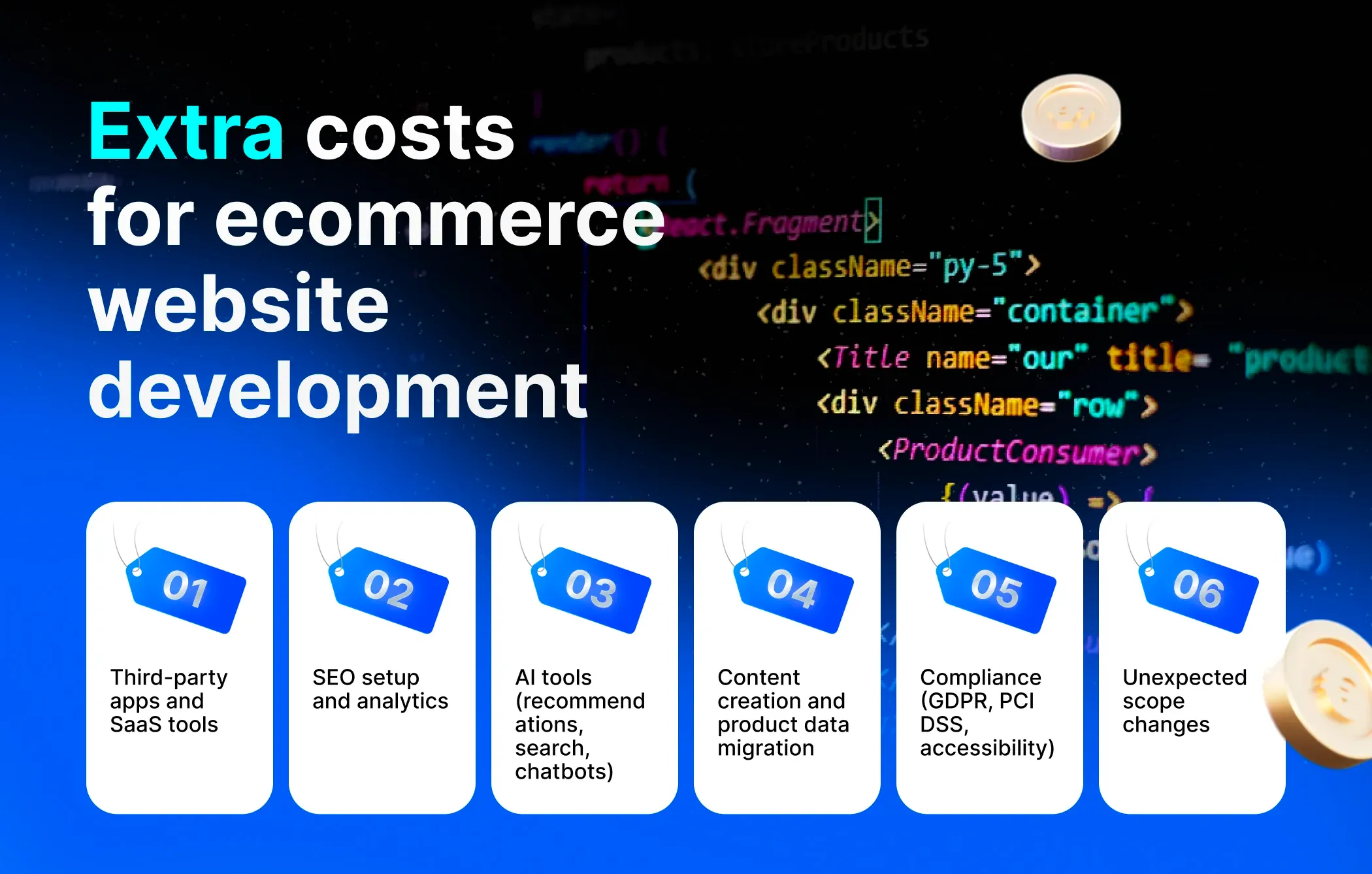
The site may look like it's "done," but that's not quite the end of spending. Add-ons and fixes come next and take a serious part of the budget.
Third-party apps and SaaS tools
Additional integrations keep an ecommerce store running. They handle payments, shipping, and customer management. Cost depends on what you connect and how many systems you add. More tools usually mean more work. Complex software raises the effort, too. A rough budget range is $2,000 for payment-related integrations and up to $20,000+ for custom CRM development and integration.
SEO setup and analytics
SEO and marketing drive ecommerce growth. Without them, traffic and sales will drop. You need clear numbers to plan, spend, and track ecommerce ROI. There are two paths: outsource or build a team in-house.
An agency can cover more areas, but it gets expensive. Top-tier retainers can reach $20,000 per month. You still need internal time for briefs, approvals, and quality control. An in-house team costs a lot, too. Total salaries can land around $461,000 per year. On top of that, your team needs paid tools. Those fees can run $1,000 to $10,000.
If you consider using Shopify for your business and are trying to figure out what it'll cost to hire a freelancer (and when it makes more sense to bring in an agency), this Shopify experts agency vs freelancers article breaks it down.
AI tools (recommendations, search, chatbots)
Chatbots. Entry-level AI chatbots often cost around $100-$500 per month for usable conversational support. More advanced AI chatbot development with deeper automation can exceed $800+ per month.
Recommendation engines & search enhancements. In the broader ecommerce market, there are tools with tiered pricing where mid-range plans typically start around $49-$299+ per month for personalized recommendations or smarter search behavior.
Custom or advanced AI development services. You may need a premium plan or a custom configuration if you want AI that seems "organic" and personalized to customers' buying behavior. That typically costs $199 to $999+ per month, and it rises as traffic and usage grow.
Content creation and product data migration
Some migration tools start at $59. If you want someone to handle the migration for you, managed services can start from $129, then rise based on the product amount and complexity. What really takes time and money:
Map the data. Options, variants, attributes, and categories rarely match perfectly.
Fix URLs. Redirects matter if you don't want rankings and old links to break.
Rebuild structure. Collections and navigation usually need a manual pass.
Clean images. Missing files, duplicates, bad naming, and alt text issues show up fast.
Metadata check. Tags, custom fields, and filters.
Compliance (GDPR, PCI DSS, accessibility)
GDPR applies if you collect EU personal data (including non-EU enterprises that target EU customers).
If you accept credit cards, PCI DSS applies to all parties that store, process, or transfer cardholder data.
Accessibility work often needs an audit and remediation. WCAG 2.2 is the reference standard many teams align with.
Audit pricing varies by scope, approximate ranges start at $1,250-$2,750 and go up to $1,500-$5,000 for many small-to-mid audits.
Unexpected scope changes
The safest ecommerce store development cost plan assumes change requests (new integrations, revised templates, extra markets, tracking fixes). PMI examples commonly point to building a contingency buffer, often ~10% per risk category or ~20% on software work, with more for higher-risk phases.
Key factors influencing the cost of ecommerce website development
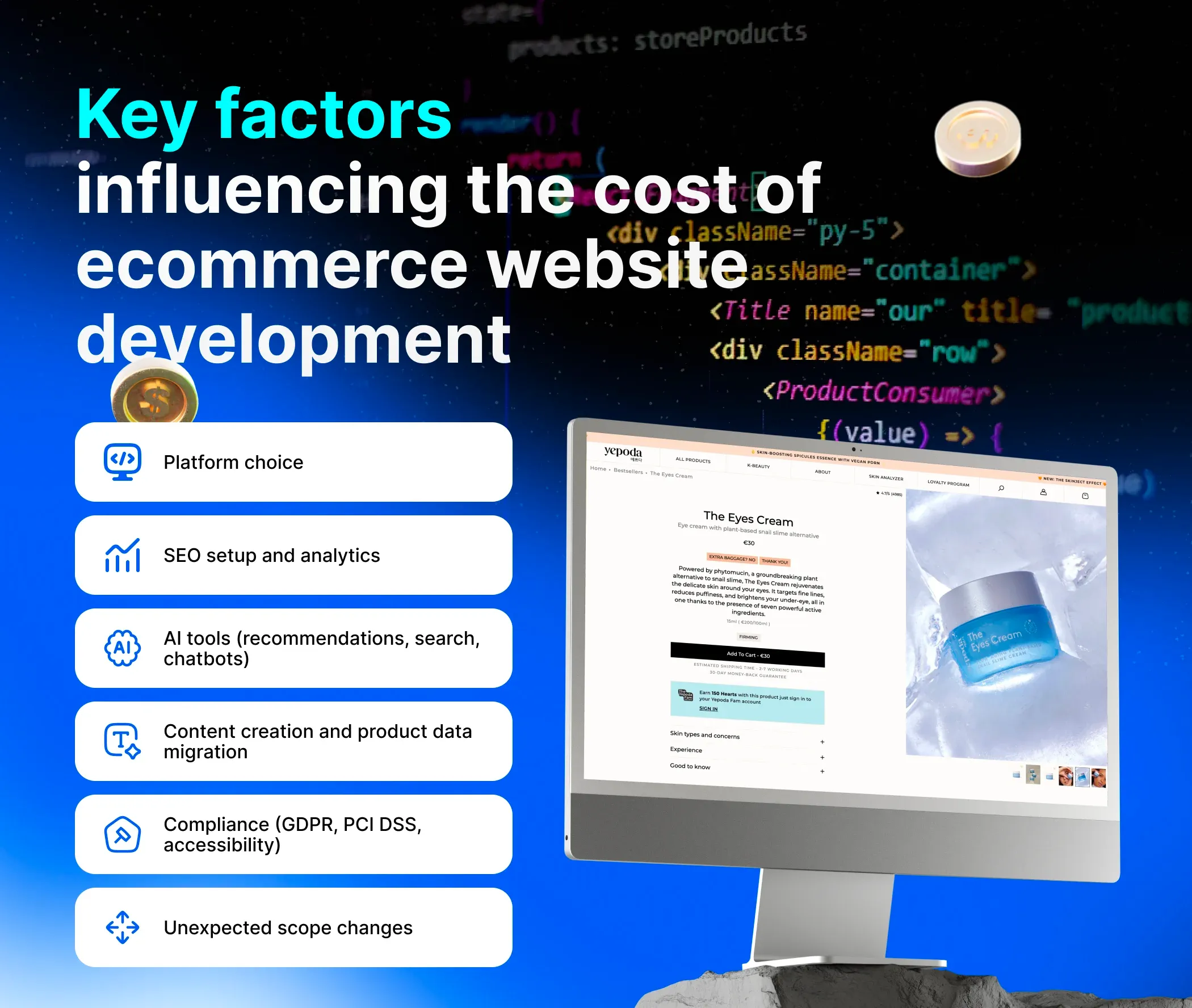
The ecommerce website price in 2026 won't be fixed. It boils down to a few decisions:
The platform you choose
Business model (B2C, B2B, hybrid)
Store size and catalog complexity
Level of customization
In-house, freelance, agency development, and staff augmentation
Geographic location of the development team
Platform choice
The platform sets the boundaries. Some things come ready. Others need custom work. It also decides what you pay upfront and what you keep paying every month. If you pick the wrong fit, you pay twice later.
Business model (B2C, B2B, hybrid)
B2C is usually straightforward. Product pages, cart, checkout, shipping. B2B changes the game. Company accounts, roles, approvals, quote flows, custom pricing, tax logic. Hybrid combines both, so the scope grows fast.
Store size and catalog complexity
It's not just product count. Variants, bundles, subscriptions, and custom attributes create extra rules. Filters and navigation need more logic and testing takes longer because more things can break.
Level of customization If you stick to conventional layouts, the job is predictable. Every modification you make to critical pages or custom checkout logic has an impact on design, development, and QA.
In-house, freelance, agency development, and staff augmentation
Agencies are more expensive, but they provide a whole staff and procedure. For simple, straightforward work, freelancers may be a suitable match. Tighter cooperation is required for larger scope. In-house costs are distributed among wages and equipment, but management and delivery time are still your responsibility. Staff augmentation sits in the middle. You add particular jobs to your team (developers, QA, UX, and DevOps) for a fixed period rather than creating a whole internal department. You maintain product ownership and priority internally, but the vendor provides talent and may replace employees as needed.
Geographic location of the development team
Each region has different rates. Western European and North American teams typically ask higher fees. Some areas could be less expensive. Speed, quality, and the number of revisions you save are what really make a difference.
Ecommerce store development cost ranges in 2026
Let's finally try to answer another common question: what is the average cost of an ecommerce website? There is no usable "average," but there are realistic levels to consider for planning.
Small store
When you keep the range tight, you may expect to pay $5,000 to $15,000 on average. Usually it consists of:
Platform setup
Theme-based design or light custom UI
Standard checkout
Basic apps
Standard payment setup
Mid-market store
Between $20,000 and $60,000, you can begin to buy real distinctiveness. Usually it consists of:
Custom UX/UI design
Key automations
1-3 integrations
Stronger performance work
Content migration support
This is where ecommerce store development cost becomes strategic.
Enterprise/Headless/B2B
When you add headless, deep integrations, or B2B complexity, the cost spans from $80,000 to $250,000+.
Usually it includes:
Custom frontend
Deep data modeling
Multiple environments and CI/CD
Advanced QA and security work
Ongoing development plan
The above are approximate sums that you have to be ready to spend. However, it is always better to discuss your specific case individually.
Average cost to build an ecommerce website by platform
Platform selection directly influences ecommerce website cost, from monthly subscriptions and theme costs to adaptability and the amount of custom programming required.
| Platform | Fees | Cost drivers | Best fit when |
|---|---|---|---|
| Shopify | $29/month (Basic, annual billing) | Custom features and system integrations | Fast launch, predictable costs |
| BigCommerce | $39/$105/$399 per month | Design depth and integrations | Larger catalogs, strong built-in commerce features |
| WooCommerce | Free plugin; hosting ~$20-$100/month, extensions $49-$299/year | Maintenance, performance, and plugin quality | Teams that want control and can manage WP upkeep |
| Adobe Commerce (Magento) | Magento Open Source: free to download | Dev hours, hosting, and governance. Adobe Commerce license cost | Enterprise complexity, deep custom rules, strict governance |
Final thoughts
At some point, the numbers stop being helpful and start asking a better question. Not how low you can go, but what you're actually building. Ecommerce website cost is never just a line in a budget, it's your future store. It specifies how it reacts under pressure and how easily it can develop without having to recreate everything months later.
The real cost to build an ecommerce website sits at the intersection of decisions, not features. If you want clarity instead of figuring out, the simplest way ahead is an honest talk about scope, priorities, and consequences.
If you're planning a new project or rethinking an existing one, DigitalSuits can help you map the numbers to real outcomes. We'll turn cost into a controlled, intentional investment. Reach out and let's talk through your ecommerce website cost before it turns into an expensive surprise.
Frequently asked questions
Can I create an ecommerce website on my own?
Yes. Shopify or WooCommerce templates can get you live fast. For anything custom or complex, you'll likely need a developer.
How much ecommerce website cost if I start small but want to scale later?
It depends on how you build it, what features you need, and whether you do it yourself or hire professionals. Break down the process into phases. For instance, you can launch lean at $5,000-$15,000, then budget $2,000-$8,000/month for improvement cycles based on the development rate. To get an accurate estimation, contact us.
Is headless worth it for a shop with less than $5 million in revenue?
Sometimes, but only for a valid cause. If performance, multi-site distribution, or custom UX are important aspects of your plan, it might be beneficial. If not, you'll most probably add complexity without getting a comparable benefit.
What are the most common costs left out of proposals?
Here are the objects that are "discovered" later:
Set up statistics and event tracking appropriately
Redirects and SEO migration
Clean product data (variants, characteristics, and duplicates)
Accessibility fixes discovered during QA
Monitoring and performance adjustment after launch
If a quote appears to be too simple, it is most likely missing essential details.

Written by
Yurii Zablotskyi
Content Marketing Specialist
Yurii Zablotskyi is a passionate content writer and storyteller with a strong marketing background, focusing on marketing, sales, and technology, turning complex ideas into valuable content.














Was this helpful?
0
No comments yet