Since our last review of Shopify B2B agencies a few years ago, the options for selling wholesale on the platform have changed. On April 2, 2026, Shopify brought company profiles, payment terms, and up to three active B2B catalogs to Basic, Grow, and Advanced. If you already run a DTC store on Shopify, you may now have much of what you need to start taking dealer orders.
That made us rethink what this review should cover. We wanted to see where a Shopify agency's work makes a difference, particularly when a business has complicated pricing or an ERP that needs to stay in charge of orders and inventory. So we reviewed the published B2B projects of six companies, including our own, to see how the top Shopify B2B agencies handle these requirements.
We graded the evidence behind their reported results and checked what they publish about post-launch cost and support (which is even more important for B2B stores at a 6+ figure revenue). For each one, we also took a particularly close look at how it handled large catalogs and complex integrations.
And, to be fully honest with the reader, we’ve explained where we’d recommend a competitor over ourselves, or where you may be able to get started with Shopify’s built-in features.
TL;DR: Which of the top Shopify B2B agencies fits your setup
Before the details, here is the short version. The match depends mostly on your ERP, your markets, and how your B2B buyers order today.
- You’re a hybrid brand selling to stockists, trade buyers, and consumers from one store, or leaving Magento B2B → Swanky, DigitalSuits
- You’re a US manufacturer and distributor on Epicor P21, Infor, Dynamics 365, or Fishbowl → Uncap
- You’re a consumer brand that wants a design-led wholesale portal next to DTC → Charle
- Your buyers need compatibility search on large catalogs → Fyresite, DigitalSuits
- You want the B2B build and growth marketing from one partner → Shero Commerce
- You run a European ERP → DigitalSuits
These are fit-based recommendations for Shopify ecommerce agencies for B2B, not a ranking. In November 2026, we checked every profile against the Shopify Partner Directory and the original case study source.
How we judged the top Shopify B2B agencies: the criteria a CTO would use
B2B on Shopify works differently from DTC. There are good reasons to choose Shopify for B2B, but your buyers are companies with agreed prices and payment terms, and the ERP usually has the final word. To pick the top Shopify B2B agencies, we checked their published work against eight criteria:
- ERP integration. We looked for named projects where the client's ERP stayed in charge of orders and stock.
- No overengineering. Native B2B should come first. Shopify B2B apps or custom code belong only where native falls short, and the agency should say why.
- Proven B2B patterns. If an agency claims multi-currency or account pricing, it needs a published project to back that up.
- Backend risk. Do the case studies show how API limits, bulk syncs or credit rules were solved?
- Evidence with a baseline. A result means little without a starting figure and a time frame.
- Post-launch support. Connector fees and support response times should be public, or at least shared before you sign.
- Low-risk entry. A fixed-price discovery phase, ideally credited toward the build.
- Catalog scale. Can the agency show a store with thousands of SKUs, fast search, and prices that stay in sync with the ERP?
A Shopify-published case study or an honest take on where Shopify B2B falls short earned a little extra credit. This time the list of top-rated Shopify B2B agencies goes beyond the US. Two of the six are in the UK, since plenty of B2B buyers run European ERPs.
Top Shopify B2B agencies at a glance
The table compares the six Shopify agencies for B2B on the details that matter for B2B. ERPs listed are only those we found in named, published work.
Agency | Best for (B2B) | Partner tier | Named ERPs in published work | Rate | Min. project | Support model & SLA | Best evidence | Case studies checked |
|---|---|---|---|---|---|---|---|---|
Design-led wholesale portals for consumer brands | Premier | Dynamics 365 Business Central | $100-149/hr | Not published | Retainer memberships; response times not published | Tier 3 | Checked Nov 20, 2026. Blake Envelopes | |
B2B + DTC on one store, EU stacks, automation | Plus | Dynamics 365 Business Central, Exact Online, Odoo | $50-99/hr | $5,000+ | Basic to Premium retainers; 48 h response on Basic, 24 h on Advanced, 12 h on Premium; immediate action on critical issues | Tier | Checked Nov 20, 2026. Aquablu, Astral Brands, Vive Health | |
Automotive parts and dealer networks | Premier | NetSuite | $150-199/hr | $30,000+ builds | Maintenance from $1,800/month; response times not published | Tier 3 | Checked Nov 20, 2026. 0 labeled B2B. ERP and fitment work only | |
B2B portal plus growth marketing | Premier | NetSuite, legacy ERP (STX) | $150-199/hr | $30,000–50,000+ | Documented post-launch check-ins; retainer response times not published | Tier 2 | Checked Nov 20, 2026. STX, GEN-Y Hitch, F-Musiikki, Painful Pleasures | |
Stockist, trade and DTC on one store; B2B platform migrations | Platinum | Sage 200, NetSuite | Not published | Not published | Not published | Tier 2 | Checked Nov 20, 2026. Natural Instinct, Saddleback, Cakesmiths, ePackageSupply, Goondiwindi Cotton, House of Colour | |
US manufacturers and distributors with an ERP | Platinum | Epicor P21, Infor Visual, Dynamics 365, Fishbowl | $140+/hr | $25,000+ | Connector at $390/month; support response times not published | Tier 2 | Checked Nov 20, 2026. ULE Group, Kooks, Farmers Depot, Vosges |
Partner tiers are the ones the Shopify Partner Directory shows until December 31, 2026. The next section explains what replaces them.
Best Shopify Plus agencies for B2B and wholesale in 2026-2027
Profiles appear in alphabetical order. Each covers the B2B work we could verify, where that evidence stops, and what to ask before you sign.
Charle Agency
Checked: November 20, 2026
Sources: Shopify Partner Directory, Clutch, Patchworks announcement
Snapshot:
- London, UK, with offices in New York and Manchester
- Founded 2018; 10 - 49 people
- Describes itself as an accredited Shopify Plus agency and an official Patchworks partner; Premier partner tier
- $100-149/hr on Clutch; minimum not published
- 4.9 from 4 Clutch reviews
Best for: brands for which sleek designs matter (like beauty and fashion brands) and they want their wholesale store to look like the brand, not like an order form.
Not a fit if: you’re an ERP-heavy manufacturer with a large technical catalog, or you need several B2B references in your sector before kickoff.
The evidence behind this verdict
Charle's best evidence is Tier 3. It's only a B2B case, Blake Envelopes, names the client and the ERP but gives no figures.
Highlights:
- One named B2B build with an ERP. For Blake Envelopes, a UK envelope and packaging supplier, the agency built a B2B-focused Shopify store and worked with Patchworks to connect it to Microsoft Dynamics 365 Business Central. Patchworks' launch announcement names both Charle and the ERP. In a verified Clutch review, Blake says its trade customers now find their customer-specific pricing more easily, and live stock on the site has cut refunds.
- A native-first stance in writing. Charle Agency's B2B and wholesale page calls native B2B the obvious choice for Plus merchants, names SparkLayer as the app option, and offers custom Functions with bespoke B2B UI for the rest.
- Design-before-development approach. Its B2B process runs requirements, high-fidelity UI and UX, then build, which suits brands whose trade buyers expect the same polish as consumers.
- A broader integration list than its portfolio shows. Its integrations page names Dynamics 365 suite (including MS Business Central), NetSuite, and Brightpearl, through Patchworks or direct APIs.
Watch-outs:
- The only B2B reference, and it’s off-site. Blake Envelopes appears only on Clutch and Patchworks. None of the 21 case studies on Charle Agency's own site covers wholesale, and the ones linked from its B2B page (Candy Kittens, CleanCo, Cambridge Satchel, 111 Skin) are DTC builds.
- Business Central is the only ERP tied to a client. Ask for proof before relying on NetSuite or Brightpearl experience.
- The thinnest B2B proof in this review. The case studies linked from its B2B page (Candy Kittens, CleanCo, Cambridge Satchel, 111 Skin) describe DTC work, not wholesale builds.
- An app option on Plus. SparkLayer sits alongside native B2B on Charle's page. On a Plus store, ask when Charle would pick an app over native catalogs, and why.
- No usable metrics. The Candy Kittens case lists post-launch results, but the figures display as zero.
- Small team. A B2B launch with an ERP integration and a redesign at once will stretch 10-49 people.
Ask on the first call:
- Do you have any additional proof of your Shopify B2B development expertise?
- Which live store runs native B2B that you built, and which ERP does it connect to?
- Who designs the B2B portal, and who builds and maintains the integration?
DigitalSuits
Checked: November 24, 2026
Sources: Clutch, Shopify Partner Directory
Snapshot:
- Miami, FL, with offices in New York, London, and Tallinn
- Founded 2016; 60+ specialists
- Shopify Plus partner tier
- $50-99/hr; $5,000+ minimum;
- 5.0 from 60 Clutch reviews; 5.0 from 15 Shopify reviews
Best for: Yes, this is us. Brands that sell direct and through dealers or partner stores from one Shopify store. We also fit multi-brand enterprises on Shopify Plus and manufacturers whose ERP can't be disrupted.
Not a fit if: you need named large enterprise B2B references in the US before kickoff.
The evidence behind this verdict
Our evidence is Tier 1. We publish three named B2B case studies (Aquablu, Astral Brands, and Vive Health) and one under NDA. Aquablu gives before-and-after figures for a project that ran from December 2024 to May 2025.
Highlights:
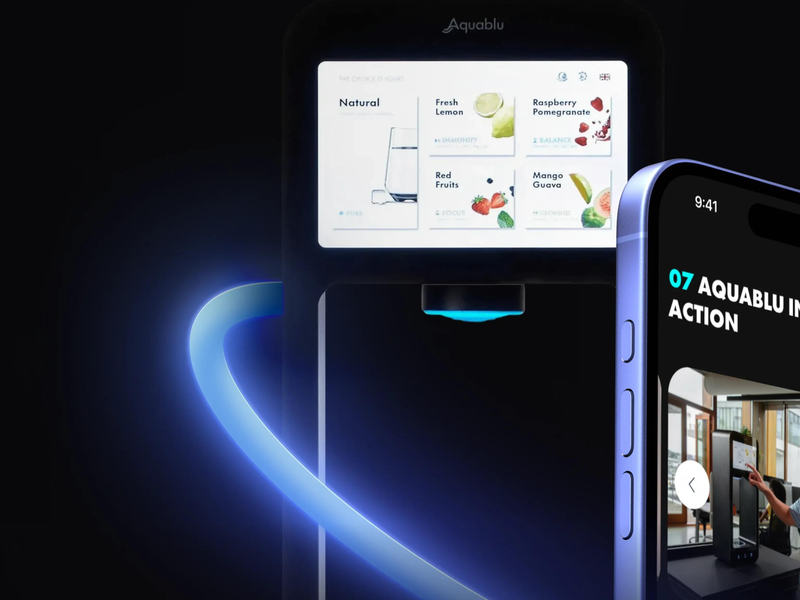
- B2B and DTC in one store. We moved Aquablu from WooCommerce to Shopify Plus, with B2B and DTC in one store and Exact Online left untouched as the system of record. Order building dropped from 1.5-3 hours to 15-30 minutes, and the shipping error rate fell from an estimated 8-12% to 1-2%. A custom app handles tax by product type and destination.
- Multi-brand headless with B2B. For an Australian manufacturer under NDA, we rescued a failed headless project and designed one B2B backend for four Hydrogen storefronts, connected to Business Central and five other systems.
- ERPs no connector can handle. Vive Health runs a heavily customised Odoo, with separate catalogs and prices for each of its 50+ dropshipping partners. We built a small bridge and a partner app. Stock, orders, and tracking now sync without the daily CSV email, and any partner who lists below Vive's minimum price gets flagged.
- Wholesale accounts at scale. For Astral Brands, we synced 1,486 wholesale accounts in three weeks, avoiding an estimated 495 hours of manual entry. The sync runs for about $13 a month.
- Start small. For complex B2B store projects with lots of moving parts, we suggest starting with a fixed-price Discovery Phase (starting at $2,000); it counts toward the build if you go ahead.
Watch-outs:
- Lowest confirmed partner tier in this group. Plus status reflects the volume we’ve brought to Shopify, not project quality. Our team also works on AI and custom software, not only ecommerce.
- Our biggest B2B references are anonymous. One of the four cases above can't name the client publicly. We can walk you through it on a call, within NDA limits.
- European engineering team. If you're on the East Coast, you'll get most of your morning with us. On the West Coast, it's an hour or two at best. It can work, though. However, our current headless client is in Australia, and we plan calls around their day, not ours.
Ask us on the first call:
- How would you approach migration from Magento and WooCommerce to a Shopify B2B store?
- Who owns the connectors and apps you build for us?
- Do you test an ERP (and other software) sync before go-live?
Fyresite
Checked on: November 20, 2026
Sources: Shopify Partner Directory, Clutch,Fyresite portfolio, NIS America case study
Snapshot:
- Tempe, AZ
- Founded 2008; 10-49 people
- Premier since April 2026
- $150-199/hr or $100-149/hr depending on the source; builds from $30,000; maintenance from $1,800 a month
- 5.0 from 38 Clutch reviews; 5.0 from 8 Shopify reviews
Best for: US automotive and aftermarket parts brands that sell to dealers and need vehicle fitment on Shopify Plus.
Not a fit if: you're outside automotive and need deep B2B pricing logic, or your budget is under $30,000.
The evidence behind this verdict
Fyresite's evidence is Tier 3. None of the 46 projects in its portfolio is published as a B2B or dealer case. The closest work is a NetSuite integration for NIS America and fitment builds for parts brands. Chassis Unlimited reports a 70% revenue increase, but with no time frame or baseline, and the case doesn't say whether B2B contributed.
Highlights:
- Solid ERP integration expertise. For NIS America, Fyresite connected Shopify and NetSuite through Celigo with two-way sync.
- Fitment for parts catalogs. Its Parts Intelligence system runs vehicle search for Corbeau, Chassis Unlimited and Fat Fender Garage. For a dealer network, accurate fitment is half the B2B problem.
- Solid migration experience (migrations from five platforms). Magento, WooCommerce, BigCommerce, Drupal and Miva.
Watch-outs:
- Small team. Ask how many large B2B builds run at once.
- Little published native B2B detail. We found integration work but few examples of company accounts, catalogs, or net terms in practice.
- Undated results. Chassis Unlimited’s 70% revenue increase has no time frame.
Ask on the first call:
- Can you show a live dealer portal with catalogs and payment terms?
- What does the maintenance plan cover when the NetSuite sync fails?
Shero Commerce
Checked on: November 20, 2026
Sources: Shopify Partner Directory, Clutch, STX, GEN-Y Hitch, F-Musiikki and Painful Pleasures case studies
Snapshot:
- Red Hook, NY, with offices in London, Helsinki, and Tirana, Albania
- Founded 2010; 65+ people; Finland’s Ambientia Group is a shareholder
- Premier in the Shopify Partner Directory (some Shero pages still say Platinum)
- $150-199/hr; budgets from $30,000-50,000
- 5.0 from 2 Clutch reviews, both on Magento projects; no Shopify reviews
Best for: Mid-market and enterprise brands that want a B2B portal, integrations, and growth marketing from one partner.
Not a fit if: your budget is under $30,000, or you want an integration specialist without the marketing bundle.
The evidence behind this verdict
Shero's evidence is Tier 2. We found four published B2B cases: STX, GEN-Y Hitch, F-Musiikki and Painful Pleasures. The strongest figures, STX's 200% revenue growth and GEN-Y Hitch's roughly 36% lower total cost of ownership, come with no starting values.
Highlights :
- B2B portal beside DTC. For STX, Shero migrated the store, connected a legacy ERP, and built a B2B ordering portal next to DTC sales. The legacy ERP exchanged CSV files through Xtento, and Shero rebuilt that flow with Matrixify rather than asking STX to change its ERP.
- Integration engineering. Shero connected Shopify to NetSuite through Patchworks for GEN-Y Hitch and runs integration pages for ERPs such as Epicor.
- Sales rep workflows. It reports 40+ B2B rep and draft order workflows configured.
- A documented launch process. QA gates, integration tests on real data, rollback plans, and daily check-ins after launch.
Watch-outs:
- Claims outrun proof. Beyond STX, we found little published B2B detail with numbers.
- "Since the partnership began" isn't a baseline. Ask what else changed at STX during that period.
- A file-based ERP link. CSV imports run in batches, so stock and prices are only as fresh as the last file. Ask how often STX's files run.
- Thin Shopify feedback. No Shopify reviews and two old Magento reviews on Clutch.
- Team location. Several technical roles sit in Tirana. Confirm who covers US hours.
Ask on the first call:
- Can we speak with STX, and what share of that growth came from B2B?
- Who owns the Patchworks setup and its subscription after launch?
Swanky
Checked on: November 20, 2026
Sources: Shopify Partner Directory, Clutch, Swanky B2B case studies (Natural Instinct, Saddleback, Cakesmiths, ePackageSupply, Goondiwindi Cotton, House of Colour)
Snapshot:
- Exeter, UK, with offices in Australia and France
- Founded 2010; 50–249 people
- Platinum Shopify Plus partner
- Rates and minimums not published
- 5.0 from 1 Clutch review
Best for: Hybrid brands selling to stockists, trade buyers and consumers from one Shopify Plus store, especially those leaving Magento B2B or another B2B platform.
Not a fit if: you want a US-based team, or you need published pricing before the first call.
The evidence behind this verdict
Swanky's evidence is Tier 2. We found six published B2B cases: Natural Instinct, Saddleback, Cakesmiths, ePackageSupply, Goondiwindi Cotton and House of Colour. The figures have periods but no starting values. Saddleback's 881% sales growth covers one month after launch, and Goondiwindi Cotton reports year-over-year sales doubled.
Highlights:
- Three channels in one store. Swanky moved Natural Instinct from Magento Enterprise B2B to Shopify Plus. The raw pet food brand serves 500+ stockists, registered breeders, and consumers. The build uses native catalogs per company, net terms shown at checkout, draft orders for phone and email orders, and a Buy Again button.
- Logic beyond native. Credit limits run on Flow plus external functions until native credit fits. A cart rule enforces a 5kg minimum for frozen products, and Sage syncs through a new Patchworks connector that replaced SFTP file uploads.
- Named ERP and PIM work. NetSuite for Lily’s Kitchen and Computer Lounge, with Akeneo PIM connected for Computer Lounge.
- Migrations off B2B platforms. Swanky publishes migration paths from Sana Commerce and Unilog, two B2B-specific platforms most agencies don’t mention.
Watch-outs:
- Results lack baselines. Saddleback’s 704% traffic and 881% sales increase one month after launch say more about a small starting point than about performance. Natural Instinct reports no figures.
- Few independent reviews. One Clutch review, from a retail client.
- Workarounds to maintain. The interim credit system is custom logic someone must keep running until the move to native.
- UK hours. Exeter is five hours ahead of New York, so US teams get afternoon overlap at best.
Ask on the first call:
- Has Natural Instinct moved to native credit yet, and what did that change cost?
- What was Saddleback’s baseline before that 881% figure?
- Who keeps the interim credit logic running after launch, and on what response time?
Uncap
Checked on: November 20, 2026
Sources: Shopify Partner Directory, Clutch, ULE Group on Shopify case studies
Snapshot:
- Chicago, IL
- Founded in 2013 as Pivofy; renamed Uncap in 2022
- 10-49 people; Platinum
- $140+/hr; $25,000+ minimum; a $7,500, four-week Blueprint credited toward a fixed-price build; ERP connector from $8,000 plus $390 a month
- 5.0 from 75 Clutch reviews; 5.0 from 65 Shopify reviews
Best for: US manufacturers and distributors that need Shopify connected to an ERP and have a large technical catalog.
Not a fit if: you’re a brand-led DTC business adding a small wholesale tier, or your ERP is European.
The evidence behind this verdict
Uncap's evidence is Tier 2. Of its four published B2B cases, Kooks is the strongest: Shopify's case study reports a 22% higher conversion rate and 38% lower total cost of ownership, but gives no starting values or time frame.
Highlights:
- The widest named ERP list in this review. Epicor P21 for ULE Group, Infor Visual for Kooks Headers, Dynamics 365 for Farmers Depot, and Fishbowl for Vosges.
- Large catalogs and quoting. ULE Group runs 1M+ SKUs with real-time Epicor sync, account-based payment terms, cart-level quotes, and Algolia search with 100+ filters.
- Packaged B2B apps. Quotes, rebates, fitment, warranties, and memberships, sold as products rather than rebuilt per client.
- Fixed-scope pricing. The Blueprint fixes cost before development, which suits finance teams that dislike open-ended B2B budgets.
Watch-outs:
- Mostly North America. We found no work with European ERPs such as Exact, AFAS, or Odoo.
- Rented connectors. The ERP connector carries a monthly fee. Ask what happens to it if you leave.
- App track record is thin. Most Uncap apps have few or no App Store reviews and no Built for Shopify badge.
- Growth without a baseline. Shopify's ULE Group case study reports 559% more traffic year over year and 599% online sales growth quarter over quarter, with no starting values. The same page also cites 225%, 250%, and "6x" without explaining how the figures relate.
Ask on the first call:
- If we leave, do we keep the connector and app code, or only stop paying?
- How are change requests priced once the fixed-scope build starts?
Shopify's 2027 partner tiers: what they mean when you shortlist the best Shopify agencies for B2B and wholesale ecommerce
On January 1, 2027, Shopify retires the Select, Plus, and Premier badges. Every partner starts on Registered and can move up to Silver, Gold, Platinum, or Diamond. Each tier needs two numbers at once: attributed GMV and attributed shops.
Tier | Attributed GMV | Attributed shops | Measured over |
|---|---|---|---|
Silver | $25K | 1 | 1 year |
Gold | $5M | 5 | 4 years |
Platinum | $50M | 20 | 4 years |
Diamond | $500M | 25 | 4 years |
Source: Shopify Help Center, About the Shopify Partner Program
What the new badge measures
A shop counts when the partner launches it or transfers it to a merchant, and Shopify counts shops equally on every plan. Attributed GMV covers sales from all channels, including the online store, POS, and B2B. A retail store on Basic and a Plus B2B portal with a two-way ERP sync add the same single shop to the count.
A Gold or Platinum badge in 2027 therefore confirms that an agency has put serious sales volume through Shopify. It doesn't confirm that any of that volume came from B2B work. ERP integrations, company-specific catalogs and tax mapping across regions never enter the tier formula.
The word "Platinum" also means something different. From January, it requires $50 million in attributed GMV and 20 shops over four years, a different bar from the 2026 Platinum tier. If a proposal in early 2027 quotes a tier, ask which system it refers to.
Use the badge as a volume filter
Read the tier as proof of scale and check B2B skill separately. Three questions cover most of it:
- what share of the agency's attributed shops run Shopify B2B
- which live B2B store with an ERP connection you can look at yourself
- which new tier the agency expects to hold after January 1.
Shopify locks a new tier for at least six months once a partner reaches it, so a badge earned on January 1 says little about mid-2027 on its own.
Catalog size: an extra criterion to judge B2B Shopify agencies
While going through the profiles, we kept coming back to one question: how big was the client's catalog? It matters more than most case studies admit, and it changes what you should want from Shopify ecommerce agencies for B2B.
Raw SKU count is only part of it. Multiply your products by their variants, then by the number of company catalogs and price lists, and you get a better sense of the real workload. A brand with 1,000 products and 50 partner catalogs can be a harder build than one with 20,000 products and a single price list.
If you sell a few thousand SKUs, the best thing an agency can do is hold back. Native catalogs, company profiles, payment terms, and quick order will cover most of what your buyers need. Be wary of anyone who pitches headless or a stack of custom apps on the first call.
At tens or hundreds of thousands of SKUs, things change
Now you need to know how the team keeps ERP syncs within Shopify's API limits, how dealers find a part by SKU or attribute, and how large orders get past checkout limits. Storefront screenshots won't answer any of that.
Only three of the six agencies publish a B2B catalog size. Uncap launched ULE Group with more than 250,000 SKUs and thousands of contract price lists. Shero's Painful Pleasures build runs over 40,000 products, with a bulk order form that works across variants.
Our own Vive Health project syncs 1,000+ products across 50+ partner stores, each with its own catalog and prices. We haven't published anything at 100,000+ SKUs, so if that's your scale, put our approach next to Uncap's and compare. Fyresite shares catalog figures only for fitment work, and Swanky and Charle don't share them at all.
So even among the best Shopify Plus B2B agencies, fit comes down to your catalog. With a small one, you're paying for judgment. With a large one, ask to see how they handle data and search before anything else.
What else we found missing across these Shopify B2B ecommerce agencies
These B2B Shopify Plus ecommerce agencies showed a few shared gaps, and of course some apply to us too.
Onboarding is almost never shown. How a new trade customer applies, gets approved, and ends up with the right catalog and terms decides how much work your team does every week. None of the case studies we read walk through it.
Work behind the checkout stays mostly invisible. Quote-to-order, rep ordering, credit control, and approval flows are where B2B pays back. Uncap’s quoting for ULE Group, Swanky's credit logic for Natural Instinct, and Shero's rep workflows are the only published examples. Most portfolios still show storefront screenshots.
Connector ownership goes unstated. Only Uncap prices its connector openly, which at least makes the subscription visible. Some Shopify B2B ecommerce development agencies never say who owns the integration code after the contract ends.
Support terms stay private until the contract stage. Five of the six agencies don't publish a response time for a critical failure such as a stopped ERP sync or a broken B2B checkout. Buyers usually see those terms in the retainer, after the build price is already agreed.
Few agencies discuss the April plan change. We found little published guidance from these Shopify B2B ecommerce agencies on running B2B outside Plus. For brands with simple pricing, that may be the cheapest path, and it’s worth asking every agency about.
Decision framework: choosing Shopify agencies for B2B matched to your situation
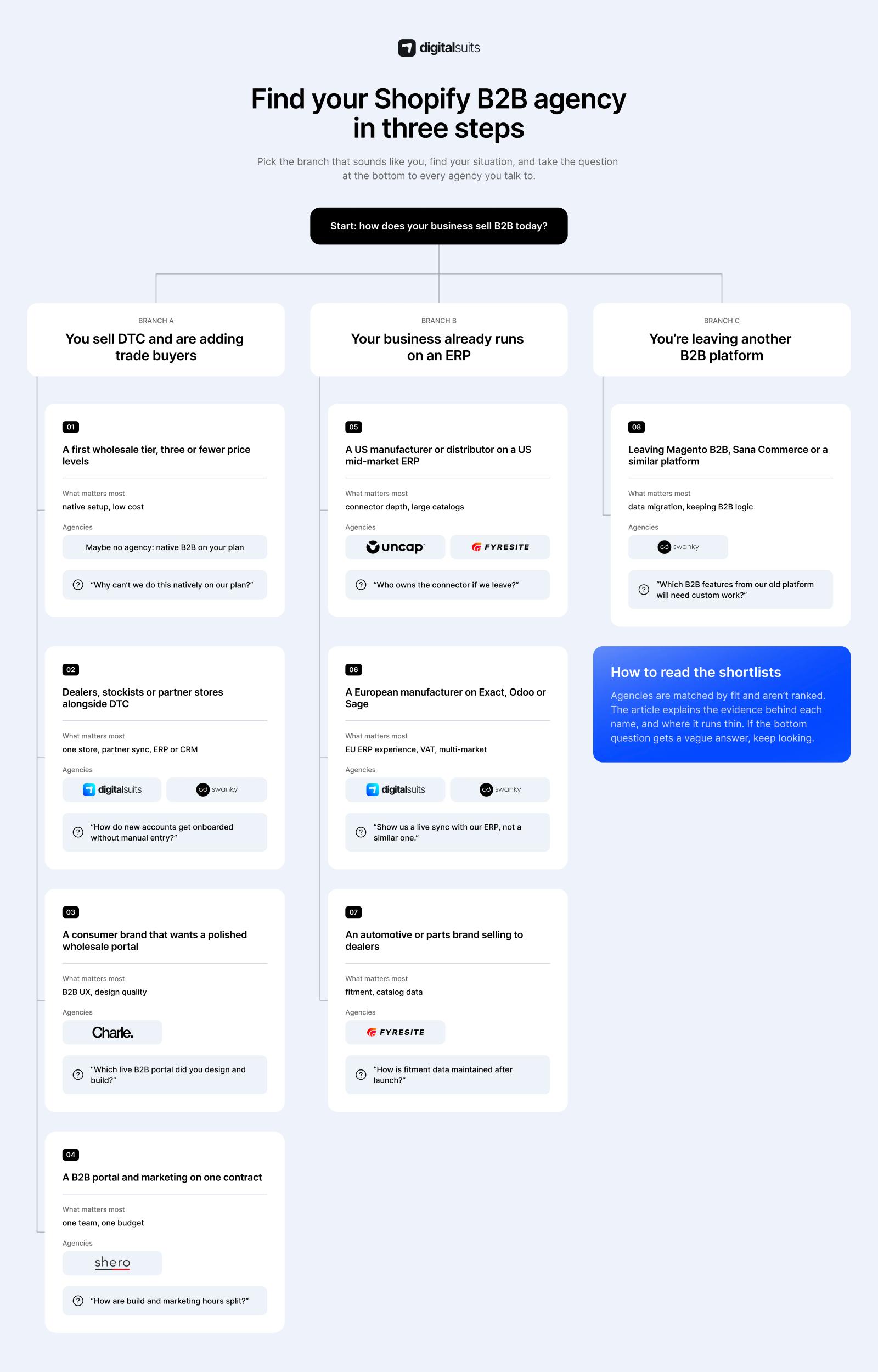
Find your situation in the chart below. Each card ends with a question in quotes. Ask it on your first call with any of the Shopify B2B development agencies you're considering, and if the answer is vague, keep looking.
Final thoughts
Choosing among the top Shopify B2B agencies comes down to your setup more than to badges or hourly rates, above all the ERP you run and the way your trade buyers place orders today.
We matched each agency to a situation instead of ranking them, and graded every case study we cite to show where the proof is solid and where it runs thin. The profiles show what each of the top-rated Shopify B2B agencies has published for your situation, and the questions in the decision framework will test the rest.
Before you commit a full build budget to any agency, DigitalSuits can review your ERP connection and pricing rules.
Written by
 Yurii ZablotskyiMarket Analyst
I explore market trends, emerging technologies, customer behavior changes, and craft stories rooted in industry data to provide practical insights for businesses.
Was this helpful?
0No comments yet