











Getting your ecommerce work done without any effort – isn't that a dream? This dream is becoming a reality with AI agents that not only think for you but also perform tasks according to your goals. It sounds great, but things are not yet as easy as they may seem.
So, how exactly can AI agents help you with your everyday ecommerce routine, and in which areas can you use them? In this article, you will find real-world AI agent use cases in ecommerce to get inspiration and find options that suit your goals.
Personalized shopping assistant
An ecommerce AI agent can help you improve customer experience, providing personalized shopping assistance 24/7. It acts like super-fast sales reps who know your product even better than you do, and assists every customer, adapting to their specific shopping behavior.
What exactly can such AI agents do?
Initiate conversations with customers to move them towards purchasing. As an example, AI agents in ecommerce can greet website visitors and engage them using contextual cues based on shopper behavior.
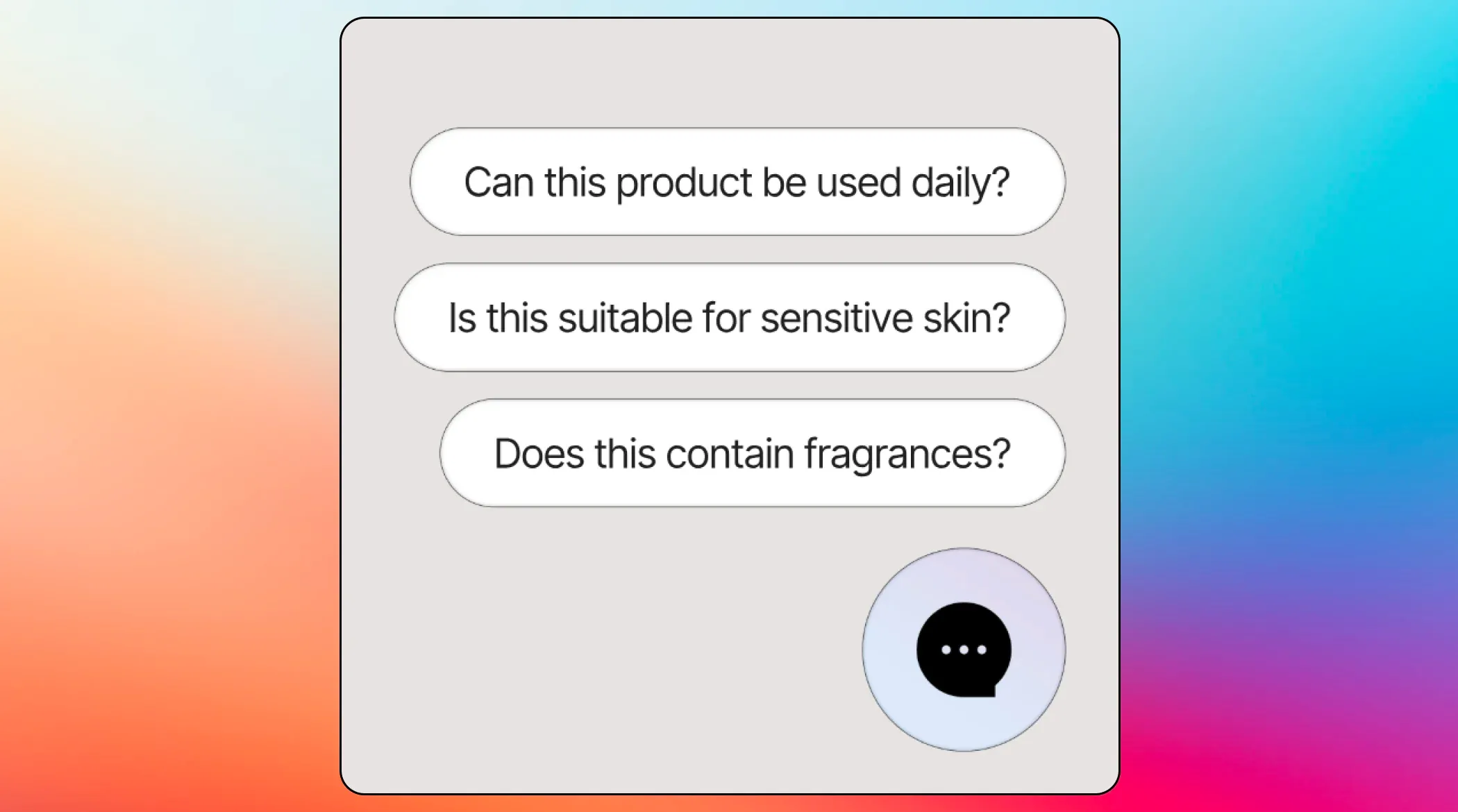
Examples of starting conversations to engage a visitor by the Gorgias AI assistant.
Provide hyperpersonalized product recommendations. An AI agent guides a customer across products and categories, analyzing session data, purchase history, and cart content, to suggest exactly what resonates with their needs.
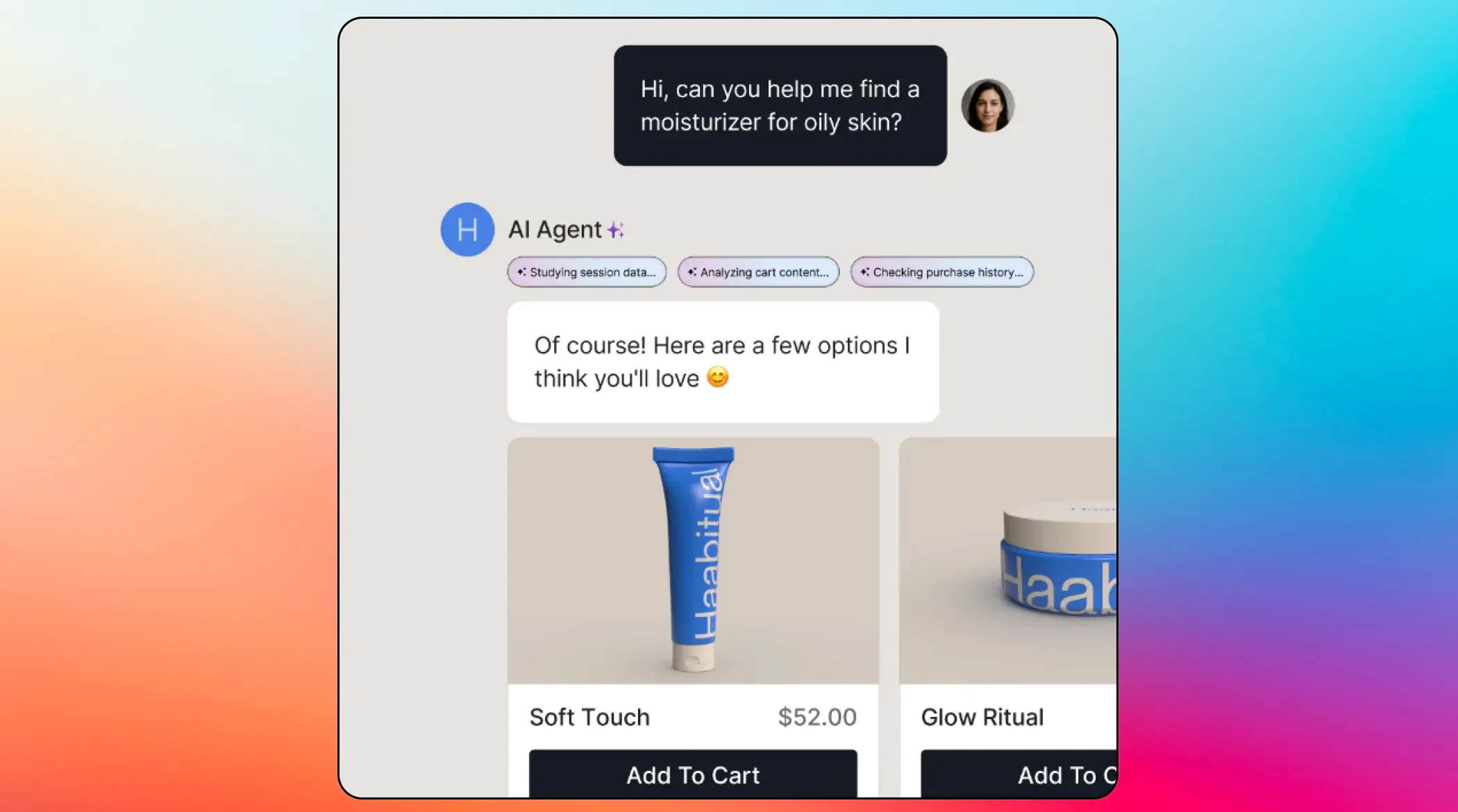
An example of a response from the shopping AI-powered assistant by Gorgias.
Analyze size and style preferences to recommend the best fit. Fashion brands often struggle with frequent product returns since customers choose the wrong clothing sizes. To eliminate such cases, you can use an AI agent like TrueFit that acts as a fitting assistant. It analyzes the customer's body shape, previous purchases and returns, and compares this data with available product information to recommend the best match.
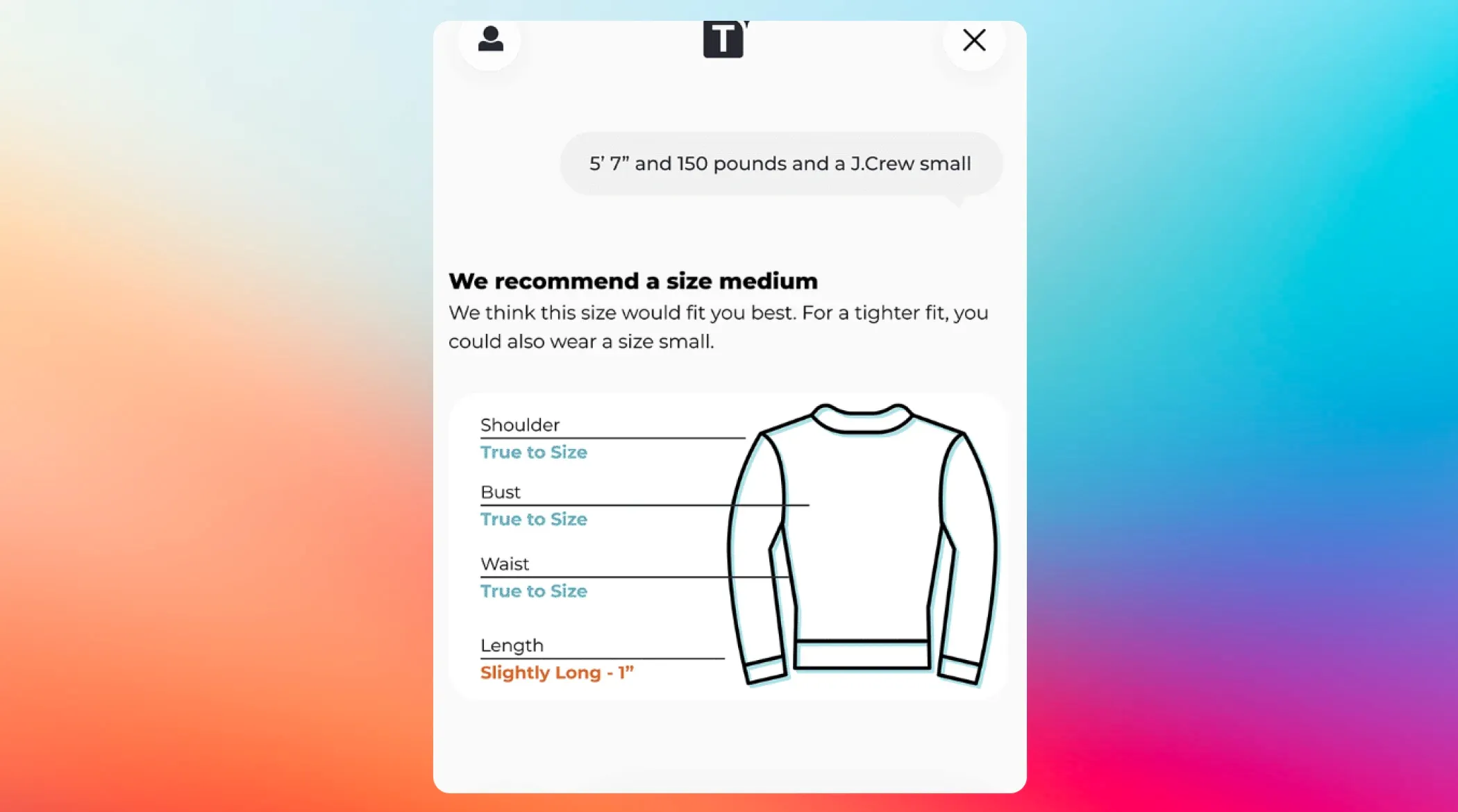
An example of size recommendation by the TrueFit AI agent.
Offer contextual upsells to increase cart size. If a customer wants to add some items to reach a free shipping threshold, an AI agent proposes upsells based on multiple factors, such as reviewed pages, products in the cart, and more. This makes upsells feel more organic, which drives higher AOV without pressure.
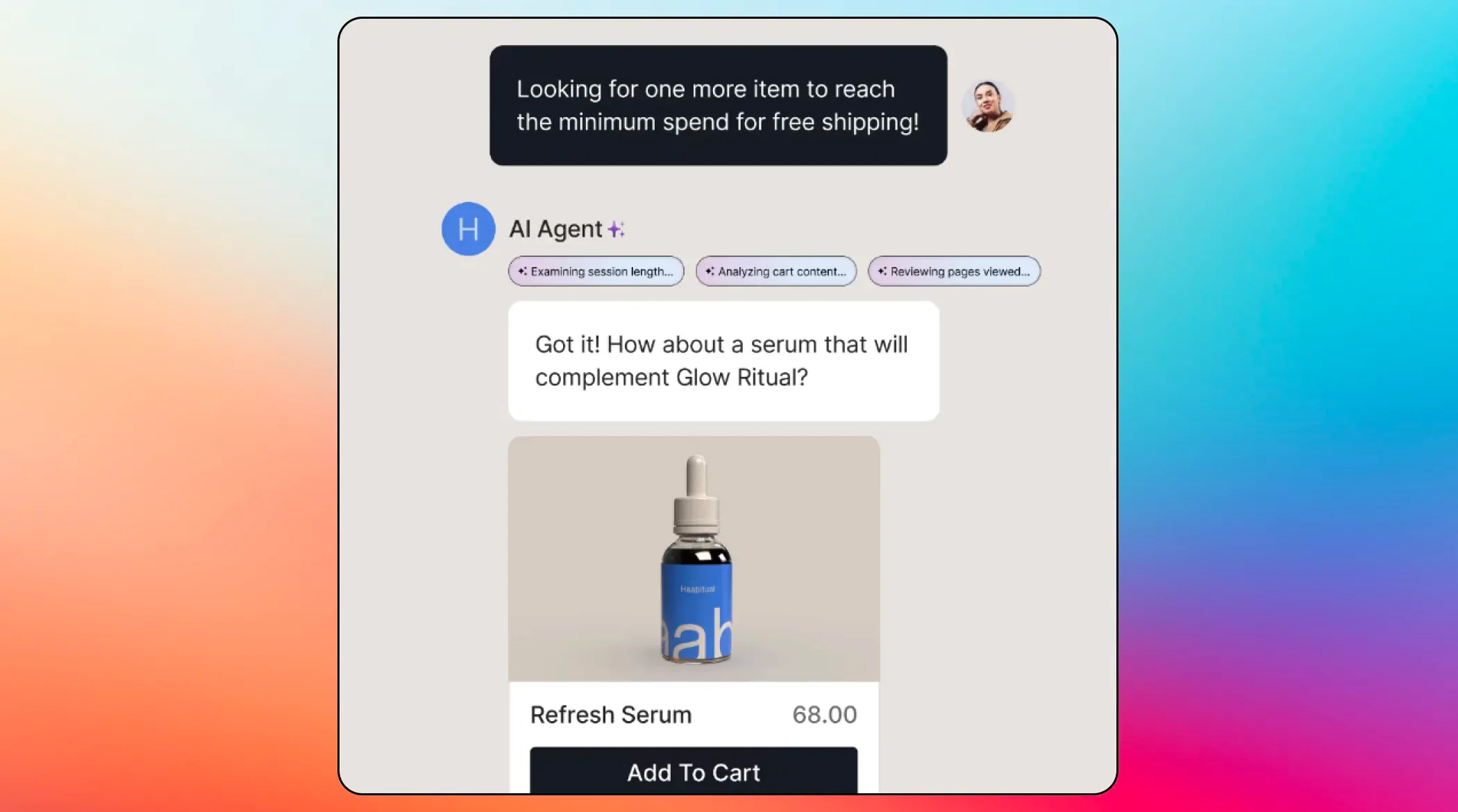
An example of a contextual upsell by the Gorgias AI agent.
Provide discounts to boost conversions, while controlling margins. AI agents can predict high-intent moments to offer a discount that nudges a customer toward the purchase. There are use cases where an AI agent notices a customer is stuck at checkout and prevents bounce by offering a time-sensitive coupon or personal discount to close the deal. You can still control the discount limits and the frequency of such offers, changing the settings based on season and demand levels.
Customer service
AI agents reshape customer service and, by 2029, they are predicted to autonomously solve 80% of all customer issues, reducing operational costs by roughly 30%.
What are the use cases of AI agents in ecommerce regarding customer service?
Ensure responsive 24/7 customer support. With AI agents, you get way more qualitative customer support than is possible with a regular chatbot. They can classify ticket intent and urgency based on real-time signals, and act autonomously, providing support on their own or escalating if a request needs manager help. On top of that, AI agents can mirror your brand voice, responding in a human-like manner to build trust.
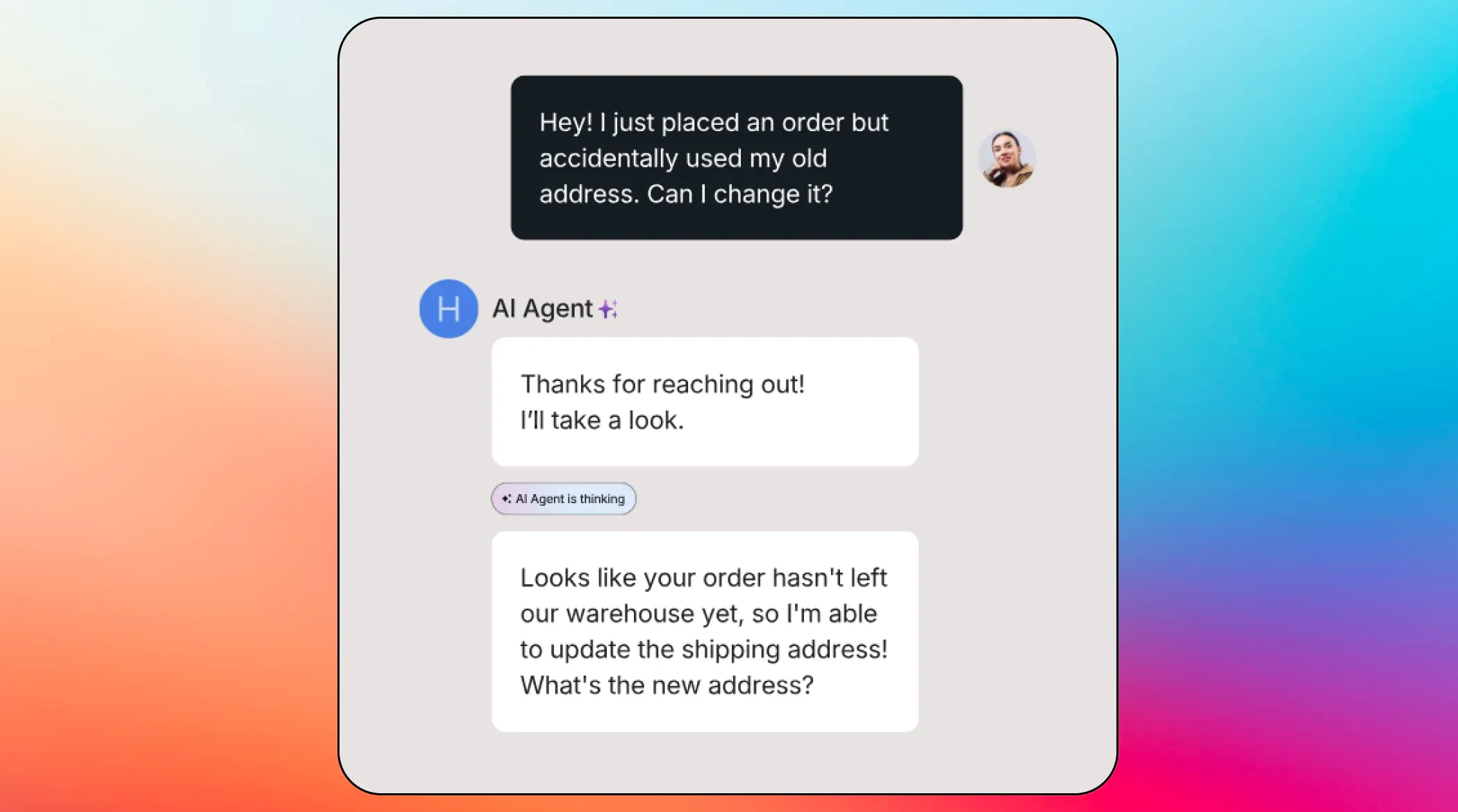
An example of an AI agent's response in customer support.
Provide multi-language support. No matter in which language a customer sends their request, an agent immediately switches to their preferred language, including specific dialects (if supported). This allows you to sell internationally and handle tickets even if you have a limited budget for the customer service team.
Resolve issues. AI agents for an ecommerce store can not only answer questions regarding order status or shipping terms, but they can also take actions on their own, such as modifying orders, editing subscriptions, and canceling returns.
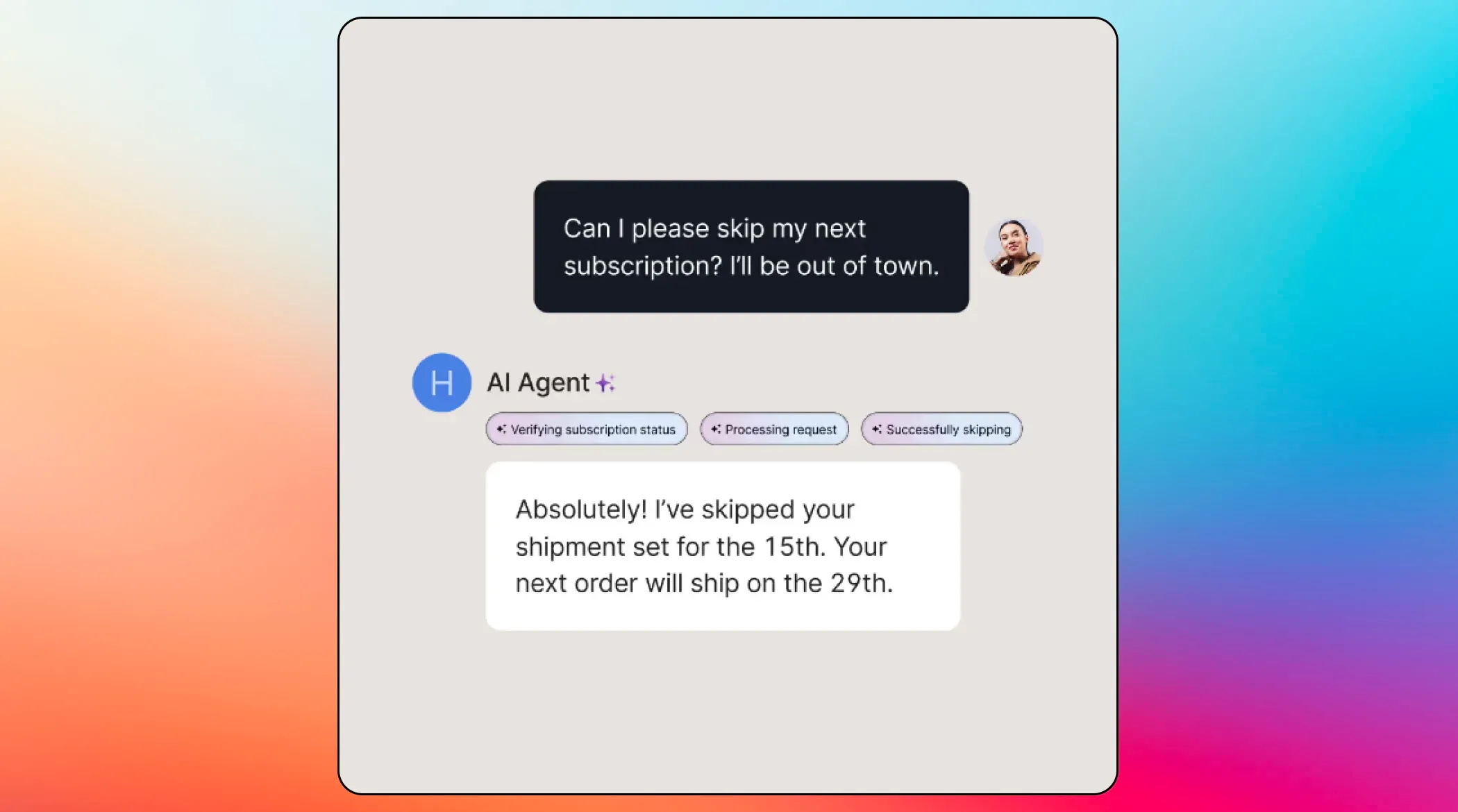
An example of handling issues by the Gorgias AI agent.
Manage calls and provide voice support. Some agents, such as Voice AI, can talk just like humans and answer questions based on customer account information and company data. Thus, instead of waiting for an operator, a customer can instantly get the information they need, edit their order, or resolve issues. If there is an issue an AI agent cannot address, it typically redirects a call to a relevant specialist.
Inventory and supply chain management
Large sellers, such as Amazon and Walmart, utilize powerful AI agents in retail to handle tons of inventory management and logistics tasks. Given the scale of their orders, it would be impossible to handle them all with the human teams.
The gap in AI agent availability for small and medium-sized businesses, though, is closing. Today, you don't need a powerful ERP with custom AI agents. Leading ecommerce platforms, such as Shopify, provide their built-in AI tools (Shopify Sidekick) to handle inventory and logistics. You can also connect third-party AI agents for stock management, such as Zoho Agents, to speed up your operations.
How do AI agents help with inventory and supply management?
Forecast demand. They can draw conclusions about future demand based on the company's historical data, current market trends, and even social media signals. With their help, merchants can quickly adjust inventory levels and production to customer behavior.
Automate restocking. AI agents not just alert you about low stocks, but autonomously create draft orders based on your historical sales trends, supplier pricing, and delivery times. They also balance inventory levels inside your network. Say, if one warehouse is overstocked while another is running low, an agent can trigger transfers between locations.
Optimize logistics. Agents coordinate between delivery services to find the most optimal path that is both cost-effective and fast. If you have your own drivers who are overwhelmed, agents can redirect orders to local driving services to ensure timely delivery.
Pricing optimization
Using static rule-based strategies for pricing optimization is an outdated approach. AI agents consider hundreds of factors, including competitors' prices, demand spikes, and even real-time customer behavior, to show the most relevant costs for thousands of items. On top of that, since AI agents learn over time, they continuously improve pricing strategies to get the highest conversions and revenue.
What do AI agents for commerce do in terms of pricing optimization?
Adjust prices in real time. Instead of manually editing prices, you can use AI agents to instantly adjust your product pricing to the market conditions and your inventory levels. Every product has its own demand and seasonality, and an agent can keep an eye on even slight changes, such as rainy weather, to boost umbrella sales.
Analyze competitor pricing strategies. AI agents monitor competitors' information to keep up with their changes and adjust prices accordingly. For example, if a competitor drops prices for some product category, an AI agent can offer to reduce pricing in your store to stay competitive.
Analyze discounts and promotions. Based on multiple metrics, such as revenue per visitor and AOV, AI agents can analyze which promotions bring the highest value and how different customer groups react to promotions. Even more, they can determine the best time to run sales, conduct A/B testing to identify the best promotion strategy, and trigger personalized discounts when they make sense (e.g., for cart abandonment).
Tailor prices to customer behavior. AI agents can recognize if a customer has a strong purchase intent and provide a personalized offer to address any hesitation. For example, if a customer has visited a particular page several times or spends a long time on a certain product page, an agent can offer a 5% discount to nudge them towards the purchase.
Visual and voice search

Optimization for voice commerce and implementation of visual search remain trendy, as they ensure greater customer convenience and satisfaction. AI agents help take these features to the next level, analyzing the context and matching customer requests with their purchase history and behavior.
How does an ecommerce AI agent help improve visual and voice search?
Enable accurate visual search and recommend relevant items. Using computer vision, AI agents analyze an uploaded image and, with high accuracy, identify the objects included to find the best match. In addition to the exact match, an agent can also recommend similar products for further discovery.
Ensure voice search and assistance. Agents leverage natural language understanding to interpret even complex voice queries, detect customer intent, and refine search results by remembering the previous questions in the dialogue.
Enhance Augmented Reality (AR) features. To improve virtual try-on functionality, merchants can use AI agents to suggest products that accurately fit customer requests and personal characteristics. For example, if a customer uploads their photo to choose the best-matching sunglasses, AI agents can analyze not only their face shape, but also their style preferences to show the best fit.
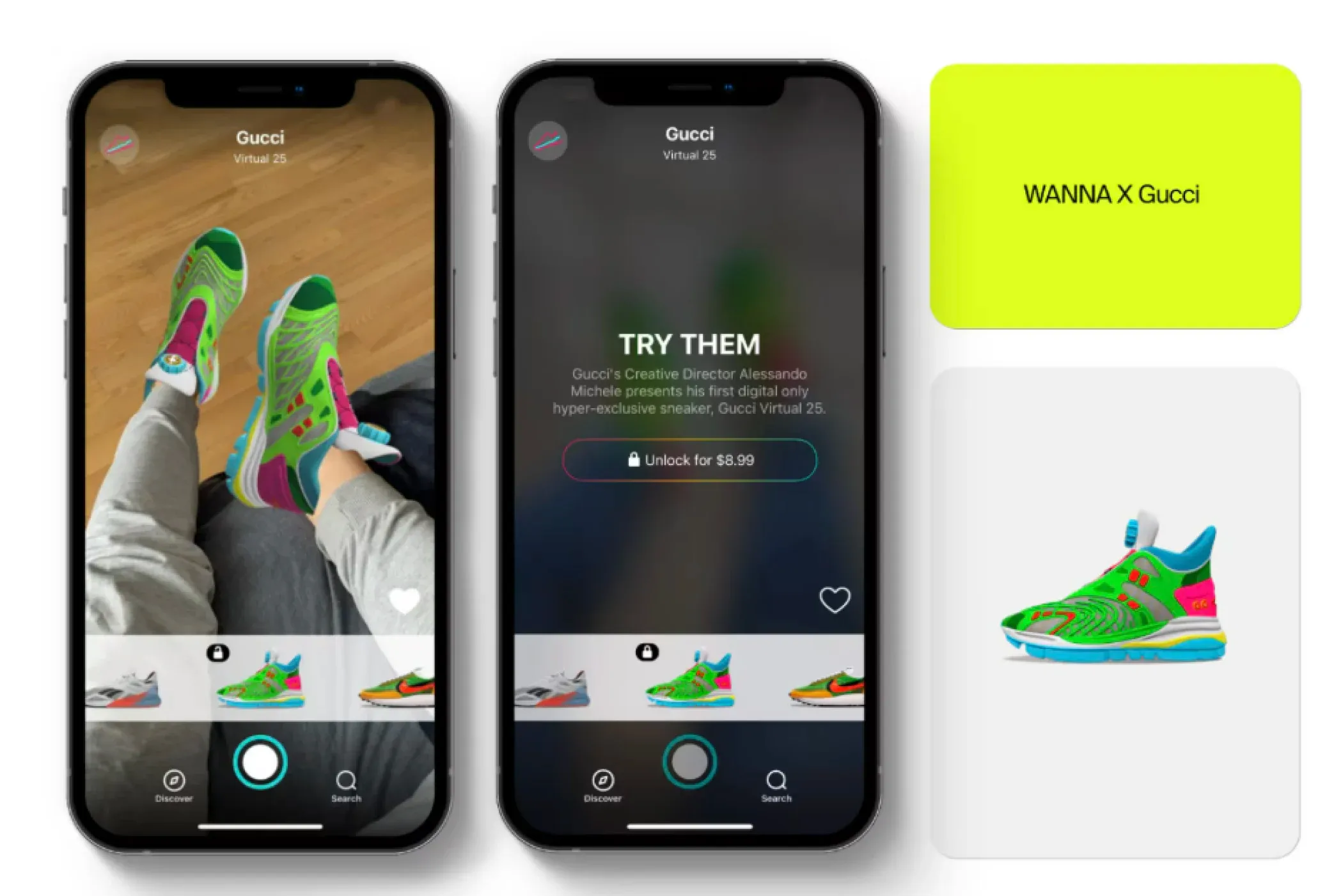
The try-on feature by Gucci.
Fraud detection and security

Fraud attacks affect both sellers and buyers. In 2025, ecommerce losses from payment fraud exceeded $56.1 billion globally.
How can AI agents help reduce financial losses?
Monitor transactions. AI agents can monitor all your transactions in real time and detect patterns that seem suspicious, such as a high-cost purchase from a new location. In such cases, an agent acts autonomously, pausing a transaction and asking for additional verification.
Protect customer accounts. It may seem unbelievable, but AI agents can create a unique customer signature based on their specific typing speed and mouse movement to identify suspicious actions that differ from this normal behavior.
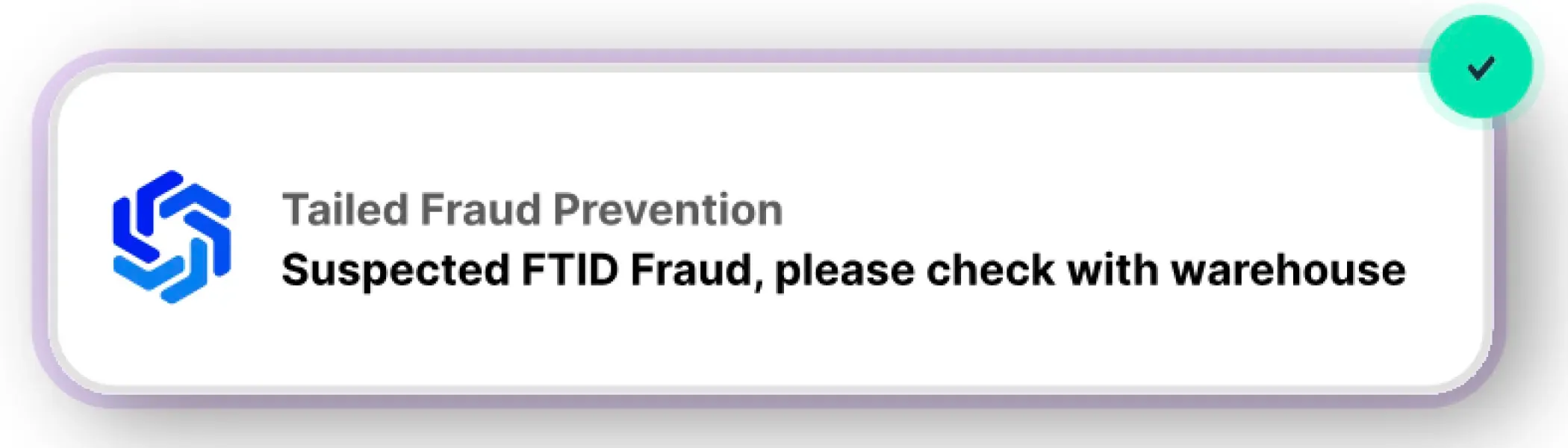
Prevent return fraud. To eliminate automatic refunds for fraudulent returns, you need a system that detects anomalies in a timely manner. AI agents like Tailed analyze your refund policy and continuously monitor customer actions associated with returns to automatically block refunds that seem suspicious.
Content generation and marketing
Creating content with LLMs is already incorporated into many business workflows. However, AI agents have something to add here.
What exactly can AI agents do in terms of content and marketing?
Create email & social media campaigns. AI agents can orchestrate marketing campaigns not only generating content but also formatting it in line with channel requirements and triggering the campaign launch.
Generate product descriptions and store content. Getting your product pages done at scale saves tons of time. And that's where AI agents come in handy, since they can create unique descriptions aligned with the best PDP practices and with your brand's tone of voice. On top of that, they can analyze customer feedback to create FAQ sections with the most relevant information. Learn about similar functionality in our article about the Shopify Sidekick AI assistant and how to use it.
Post-purchase engagement
Retaining and engaging an existing customer costs 5 to 7 times less than acquiring a new one. And with an AI agent, the post-purchase engagement could be even more effective, boosting the likelihood of another purchase.
What can AI agents do?
Remind customers about reorders. AI agents can estimate when a customer needs replenishment to alert them with a personalized email or a sequence of messages. For example, if a skin cream lasts for 30 days, a customer will be alerted within 30 days after purchasing it to reorder a new one. If a customer doesn't purchase within this timeframe, an AI agent can proceed with incentives to boost customer retention.
Manage loyalty programs. Based on your reward policy, an AI agent can trigger personalized rewards using real-time data. It can also detect signs of low engagement and trigger retention campaigns to win the customer back.
The bottom line
Unlike chatbots or automation tools that follow fixed rules, AI agents for ecommerce act like AI employees that not just provide information based on training data, but also think, choose, perform actions, and learn from new experiences.
The power of AI agents is in that they are connected to internal systems and third-party systems, and understand your specific data to meaningfully act on your behalf. Whether it's content creation or pricing optimization, they can perform a complex sequence of actions to achieve the best possible outcome. Check the top AI agents for ecommerce to start using the best tools.
If you're interested in implementing AI solutions for ecommerce to get an edge over your competitors and boost your business efficiency, don't hesitate to contact the DigitalSuits team. We're actively working on enhancing our clients' projects with AI-powered technologies. See some of our recent cases here.
Frequently asked questions
How can I implement an AI agent into my business workflows?
You can start by using an AI agent for a single, most important area, such as customer service, and scale as it brings positive results. It could be a ready-made tool, incorporated into your ecommerce platform or connected using APIs. You can also develop a custom AI agent to handle a combination of tasks within your business, but it will require a higher initial investment. If you need help with AI integration to expand your store functionality and gain a market edge, contact our team.
How can I measure the ROI of an AI agent for ecommerce?
Start by measuring KPIs specific to a certain field, such as average response time and customer satisfaction score for the customer service agent. How to make it right?
- Track metrics before agent implementation.
- Launch an agent and make it work for a month or more.
- Compare KPIs before and after the launch to calculate the ROI.
Are AI agents suitable for small and medium-sized businesses?
Yes, and AI agents in retail are especially helpful for businesses that can't hire big teams. These tools can handle heavy tasks, bringing high value even with low initial investment, such as for a ready-made agent that deals with a narrow area.

Written by
Anastasiia Moskvichova
Content Marketing Specialist
Anastasiia is an enthusiastic content writer who diligently researches and curates valuable information to craft engaging content tailored for readers with a keen interest in marketing, sales, and technology.











Was this helpful?
0
No comments yet