


De-risking the Shopify Plus migration of Europe's largest re-commerce company
Momox is Europe's largest re-commerce company with around €390M in annual revenue and ~2,100 employees. It buys used clothing, books, and media from private sellers, quality-checks each item, and resells it.
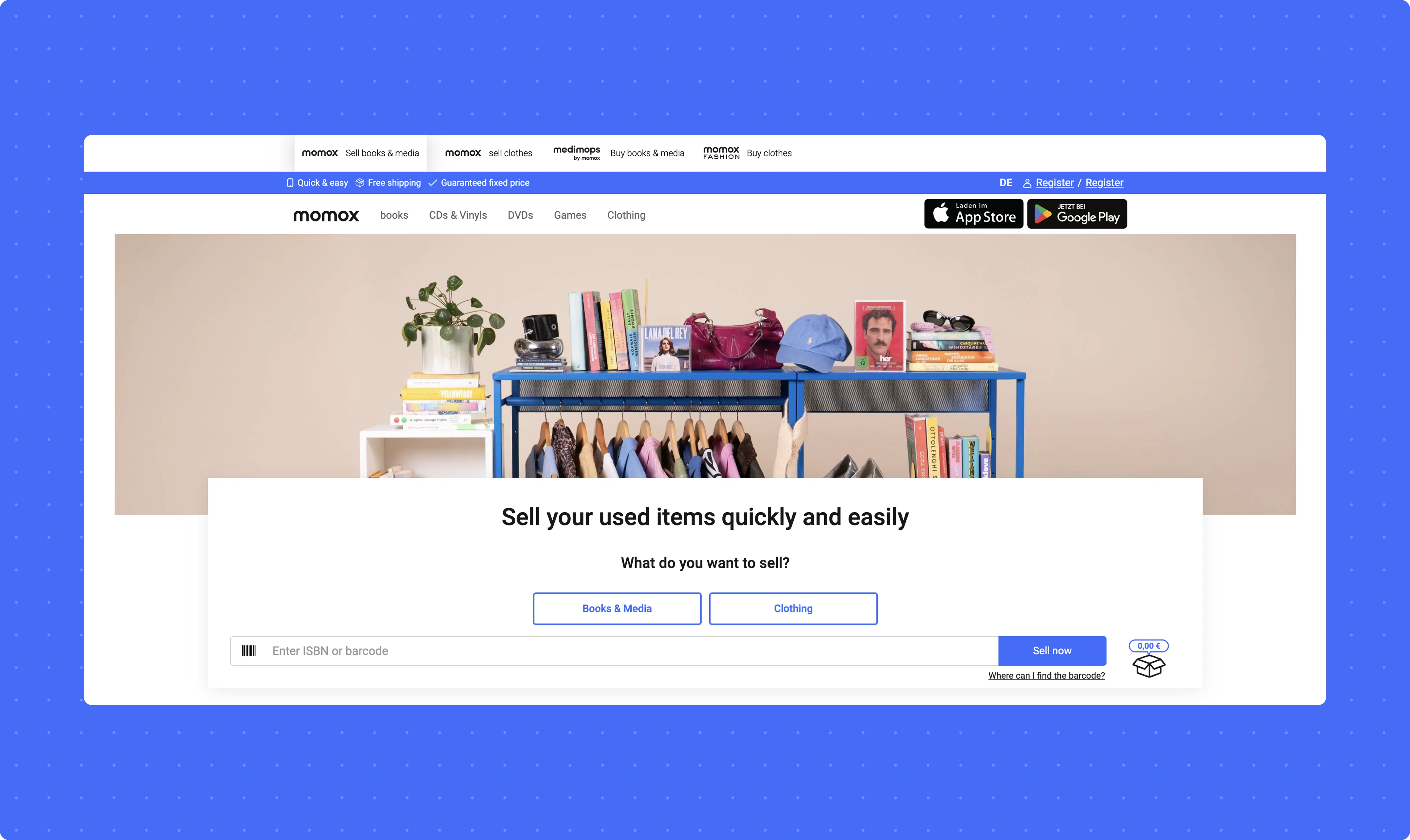
Unlike regular P2P marketplaces, Momox owns its inventory. Sellers submit used goods through the dedicated buying channels (either the Momox app or the momox.de website), get an instant price, and then ship it in for grading. Momox resells those items through several separate storefronts, such as Medimops for media and Momox Fashion for clothing, alongside sales on Amazon and eBay.
By late 2024, Momox had decided to move their storefronts off a custom .NET platform to Shopify Plus. The migration itself was handled by Momox's team and a German web agency. But the internal team had no deep Shopify expertise, which made day-to-day decision-making slow and risky.
DigitalSuits filled that gap with senior Shopify developers embedded directly in Momox's team. Their job wasn't just the everyday backlog, but also answering complex platform questions on the spot and unblocking internal engineers.
Client
Country
Germany
Partnership period
Late 2024 – ongoing
Team
2 senior Shopify developers
Technologies
Shopify Plus, Liquid, HTML, CSS, JavaScript



Shopify migration at scale with no Shopify expertise in-house
A custom .NET system had become costly to maintain and slow to change. Moving to Shopify Plus was Momox's way to reduce maintenance overhead and get the flexibility to move faster.
But first, several problems had to be solved:
- No Shopify expertise inside the team. Their internal engineers were strong full stack developers, but new to Shopify. Every platform question meant research, waiting, or blocked work.
- An organization of many teams. Each storefront is one part of a large operation where separate teams own the web store, the iOS and Android apps, CRM, marketing, and BI. A change in the store often touched several of them, so nothing could be built in isolation.
- A massive, constantly-changing catalog. The catalog holds millions of unique items, each stocked as a single unit, and, in second-hand, an item disappears the moment it is sold. Stock, prices, and listings all had to stay in sync in real time, within Shopify's platform limits. That's the core engineering problem.
- Migrating without hurting the customer. Carts, wishlists, orders, and account data all had to survive the move, so customers noticed nothing beyond a new design.
Despite Momox having a strong tech team, they needed someone to guide them through a complex Shopify migration process that touched so many teams, systems, and tools. And it had to be someone who would understand their business and be fully involved in everyday processes, not a vendor answering tickets from outside.
Senior Shopify developers inside the team for daily consulting and tasks
DigitalSuits placed an experienced Shopify developer directly into Momox's team through our IT outstaffing services. Beyond working through the backlog, he became the team's go-to expert for Shopify decisions, whether it was moving another part of the store safely or building something new, with every solution fitting Momox's entire software ecosystem.
That's how he approached the work.
De-risking the migration from planning to release
Momox Fashion, the clothing storefront, moved first. It became the template for the larger book and media stores. To compare metrics cleanly, it launched as an exact copy of the legacy store, with new features held until after go-live.
Our embedded developer carried the same sprint load as any Momox engineer and joined every meeting, including those with the app, BI, and CRM teams. That way, Shopify constraints surfaced while features were still being planned, not after they were built. The internal engineers handled anything well documented on their own and brought him the real blockers, which he solved in hours instead of days of research.
Translating the legacy store into Shopify
Momox came with a clear picture of what the new store should keep from the legacy one. Our developer's job was to turn that picture into something Shopify could actually run.
Two examples show how that worked:
- Rebuilding the gift card and discount view. The legacy account had a custom view of discounts and gift cards, showing the balance and expiry date and letting customers copy a code with one click. Momox wanted to keep it. Working with Momox's designer, our developer showed which components and behaviors Shopify could support, then built a custom page on customer account extensions. It reproduces every function of the old view in the new design.
- Carrying customer accounts across without losing history. Account migration was one of the most sensitive parts of the move: returning customers had to find their carts, wishlists and order history on the new store. Momox's own team ran the data migration. Our specialist worked on the Shopify side, keeping the flow that carries each customer's cart across running correctly as every batch landed.
“Shopify gives us the flexibility and scalability to better meet the needs of our customers and to strategically expand our offerings in the coming years. At the same time, it creates a modern technical foundation that will allow us to remain competitive in the e-commerce market in the long term and set new standards in second-hand shopping.”
 Claudia FreseCEO, momox
From launch to long-term ownership
When Fashion went live, Momox asked DigitalSuits for a second Shopify specialist to take over the Fashion store. That freed our first developer to move to the Medimops project, where his experience from the Fashion migration could shape the next storefronts.
With the store live and stable, the focus shifted from parity to progress. The team worked through the post-launch fixes and improvements, then picked up the SEO work and features that had been paused during the migration.
The Fashion team also took over all Shopify backend code and apps from a third-party vendor and brought that work fully in-house. Since then, it has built its own custom Shopify apps for wishlists, notifications, and back-in-stock alerts, and connected personalization widgets to the Shopify storefront.
At this phase, our developer acts as the team's Shopify knowledge base. Before building something like a wishlist, engineers brainstorm with him to walk through the edge cases and implementation options he has already seen on other Shopify projects.
Making Shopify knowledge stay inside Momox
An embedded consultant is most valuable when the team needs them less over time. From day one, our developers shared knowledge as part of their daily work. They reviewed approaches, paired on tricky features, and helped full-stack engineers get comfortable building on Shopify.
It's working: the Momox Fashion team now builds custom Shopify solutions on its own, without calling in the agency.
Our developer also took that knowledge beyond engineering. He gathered how the project runs into an AI knowledge base: the ecosystem, the integrations, and the settings. With it, Momox's managers and support staff can get answers about how the store works without pulling a developer away from their tasks.
Reusing the playbook for the next storefronts
Momox Fashion was the pilot. With it live, one of our developers moved to the Medimops project, which covers three market-specific storefronts: Momox Books (Europe), Momox Shop (France), and Medimops (Germany).
Momox Books is already live on Shopify. Momox Shop is planned for this year, followed by Medimops – the largest storefront and the one that brings in most of the company’s revenue. The lessons from Fashion on account migration, cross-team coordination, and working within Shopify’s limits now feed straight into planning for each one.
Shopify Plus live across two stores, with expertise built into the team
With DigitalSuits specialists embedded in the team, Momox moved two storefronts to Shopify Plus, and two more are on the way. Its internal engineers now build on Shopify with confidence, and they still turn to our developers for new insights and features.
Here's what the outcome looks like in numbers:
2 storefronts live, 2 more on the way
Momox Fashion and Momox Books are live, with Momox Shop and Medimops next in line.
0 agency dependency for new Fashion features
Backend apps and code moved in-house.