










You don't have time to test every AI agent promising to "revolutionize" your ecommerce store. So let's cut to the chase. This guide covers the top AI agents for ecommerce, breaking down what they do, who they work best for, and what you need to know before signing up.
Meet the candidates for the role of your future AI agent:
What are AI agents for ecommerce?
AI agents are software systems that can perceive what's happening in your store, make decisions based on that information, and take action without waiting for you to tell them what to do. AI agents adapt their behavior based on context. They operate autonomously within the boundaries you set, getting smarter as they handle more situations.
Ecommerce AI agents vs. AI tools vs. automation tools
People still use these terms interchangeably, but they're not the same thing.
Automation tools follow fixed rules. They're reliable but inflexible. For example, if a customer abandons their cart, send an email in two hours. It'll be the same email and time span every time.
AI tools add intelligence to specific tasks but still need human direction. A product description generator uses AI, but you still have to provide input and approve the output.
AI agents combine the capabilities of both. They use AI to make decisions and take action independently. They set their own workflows based on what they learn. An example is a customer service tool that routes tickets, answers common questions, escalates complex issues, and learns which responses work best over time.
How AI agents work
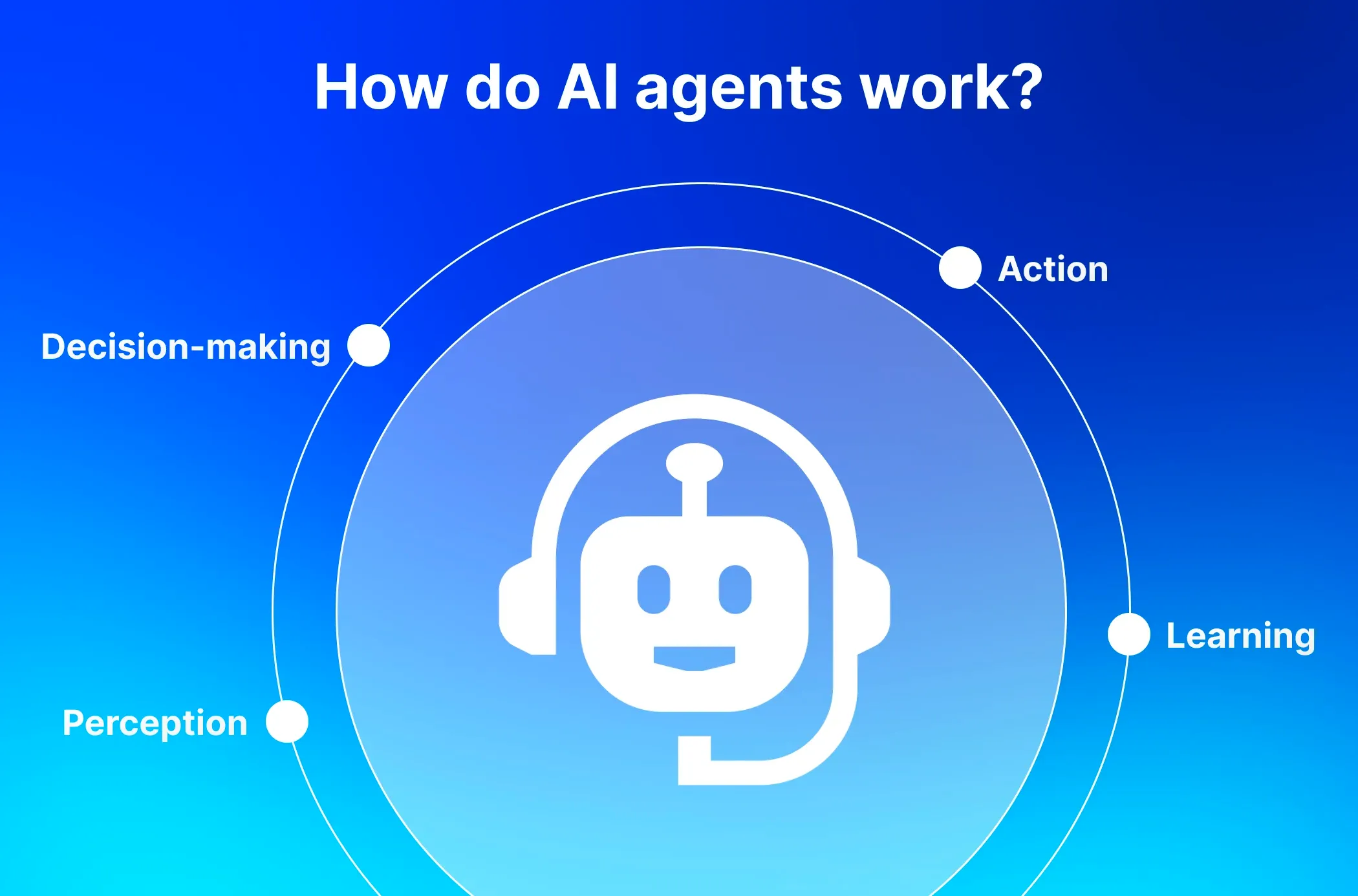
You have your answer to "What is an AI agent for ecommerce?" Now, let's move to "How does it work?" and the mechanism behind the technology reshaping online commerce. Most AI agents follow a similar pattern: perceive, decide, act, learn.
-
Perception means pulling in data. An agent monitors customer behavior on your site, reads incoming support messages, tracks inventory levels, etc. It's constantly scanning for signals relevant to its specific role.
-
Decision-making occurs when the agent interprets the data and determines the next action. A customer asks about return policies – does this need a human, or can the agent handle it? The agent uses ML models trained on past interactions to make these calls.
-
Action is where the agent does something. It can be sending a response, adjusting which products appear in a recommendation widget, creating a discount code – whatever falls within its defined role.
-
Learning closes the loop. Agents track outcomes and use that feedback to improve future decisions. This is what separates them from static automation. They get better at their job over time.
Under the hood, most agents combine large language models for text understanding, recommendation algorithms for predicting behavior, and integration APIs to execute tasks in your ecommerce platform.
Types of ecommerce AI agents
There are three main types of AI agents currently used in ecommerce.
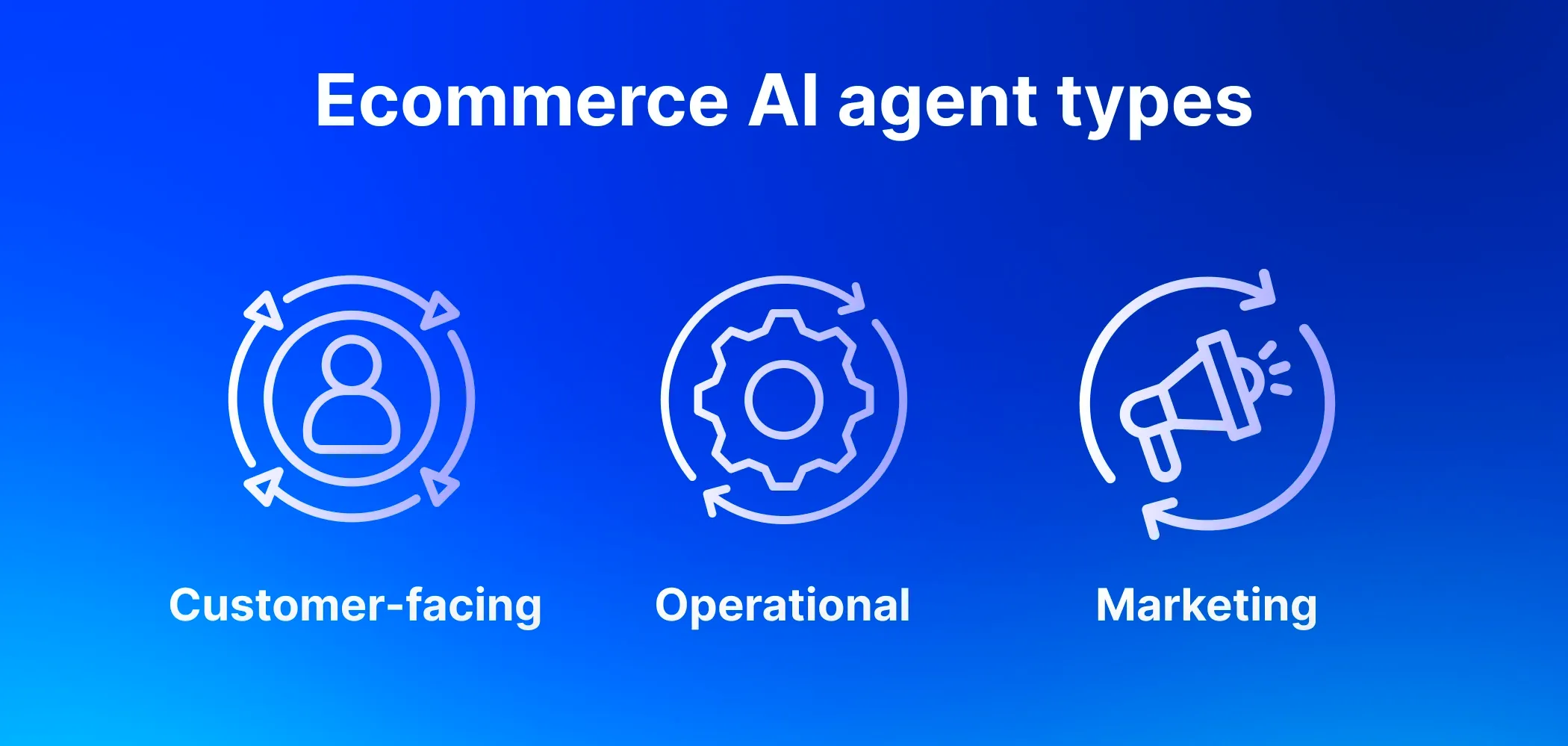
Customer-facing agents interact directly with shoppers and handle their requests. These agents need to sound natural, understand intent even when questions are vague, and know when to escalate to a human.
Operational agents work behind the scenes on store management tasks. They free up your time by helping with inventory decisions, content creation, pricing optimization, or administrative workflows.
Marketing agents focus on personalization and conversion optimization. Their job is to make every customer's experience feel tailored without you manually creating hundreds of segments.
Some tools can merge several roles. For example, an AI agent can provide customer-facing search and operational insights about what people are looking for. AI in ecommerce isn't new, but agentic AI elevates these technologies to a new level of efficiency.
Best AI agents for ecommerce
Many different tools claim to use "AI agents." The ones that made this list actually deliver on their promises and provide real feedback to prove it.
Gorgias AI Agent
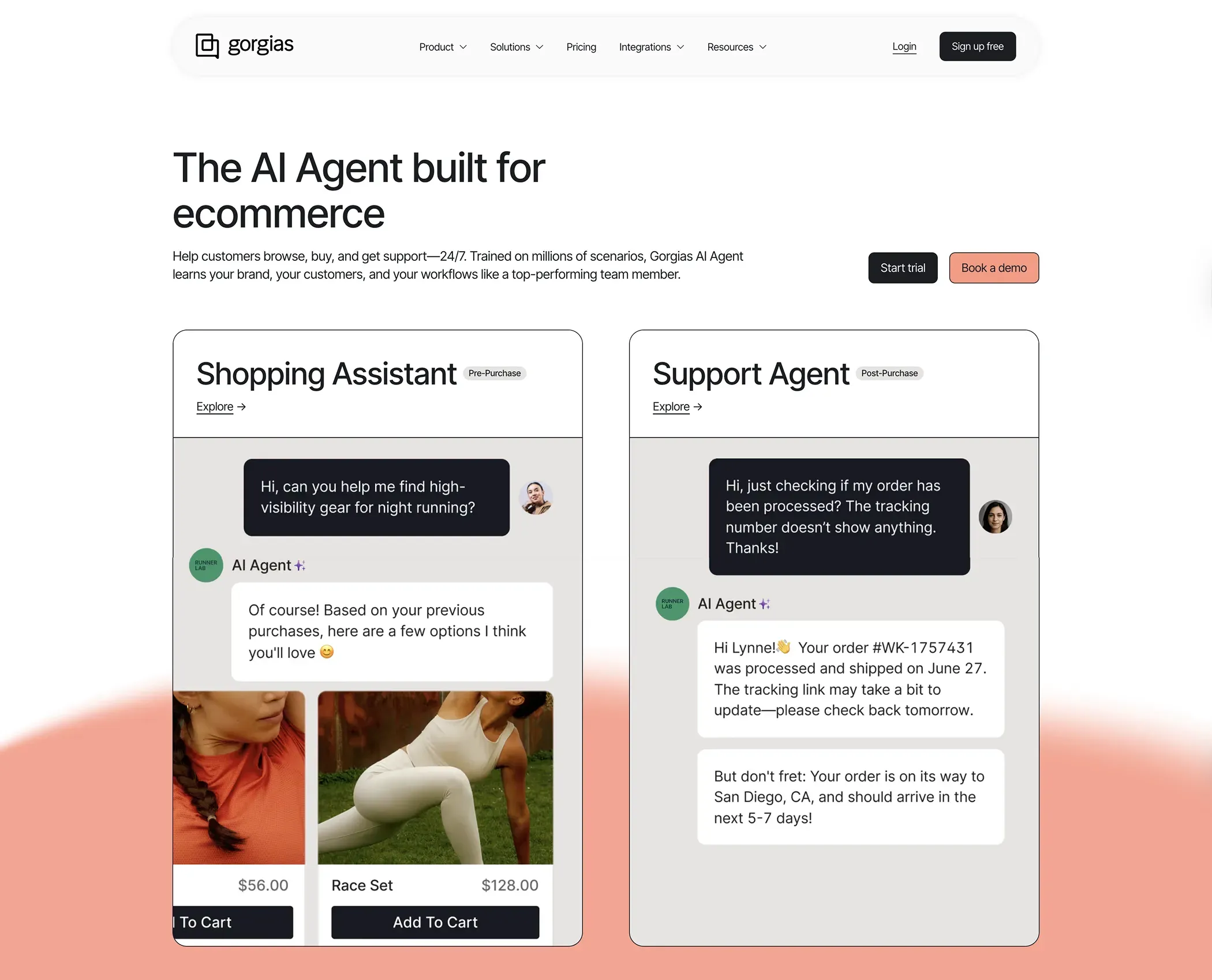
Gorgias is a customer service platform built specifically for ecommerce. Its AI Agent does much more than answer questions. It's editing orders, processing returns, issuing refunds, and handling subscription changes through direct integrations with different platforms and tools. The agent learns your brand voice, policies, and workflows during setup. Then, it operates 24/7, handling everything from order tracking to product recommendations.
Key features:
Full order management cycle: tracking, cancellations, edits, and returns
Shopping Assistant that handles product recommendations
Deep Shopify integration (inventory, order history, customer tags)
Analytics dashboard with metric tracking
Actions across 100+ third-party integrations
Multi-channel support (email, chat, social, voice, SMS)
Self-service training on help center articles and internal documentation
Best for: Mid-to-large Shopify stores with high support volume.
Pricing:
Starter – from $10/month
Basic – from $50/month
Pro – rom $300/month
Advanced – from $750/month
Enterprise – custom, volume-based
Ada CX
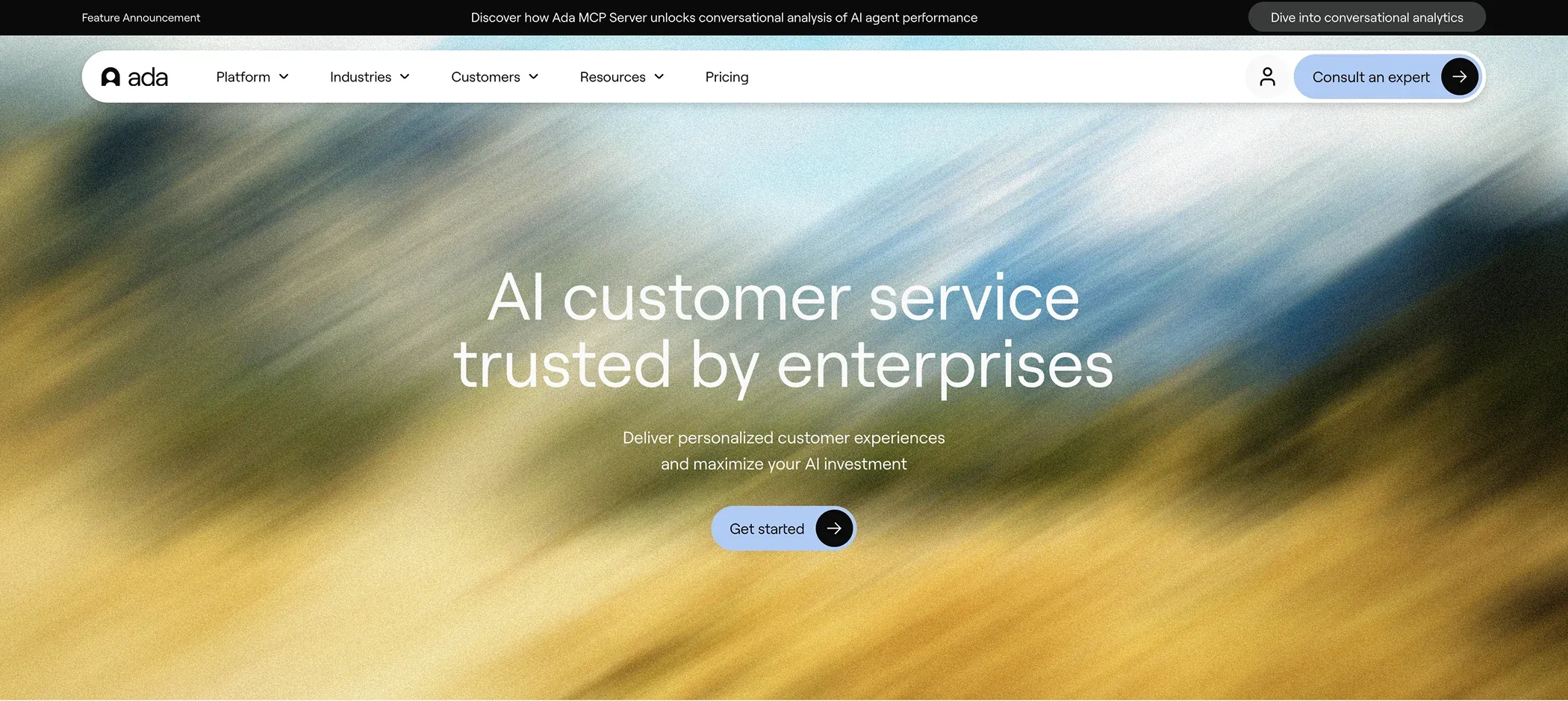
Ada is an enterprise-grade AI for customer service. It's built to handle high request volume across all channels – chat, email, voice, and social. Ada orchestrates multiple large language models to understand complex inquiries, pulls context from your entire tech stack through deep integrations, and operates in over 100 languages. This AI agent handles everything from account questions to transaction support.
Key features:
Omnichannel deployment (messaging, voice, email, social media)
Multi-model architecture combining several LLMs
Enterprise integrations for Shopify, Salesforce, Zendesk, etc.
Conversation analytics with performance tracking by channel and intent
Voice automation for call center operations
HIPAA, SOC2, GDPR, and AIUC-1 compliance
Support for 100+ languages with automatic translation
Best for: Enterprises seeking compliance and multi-channel automation.
Pricing:
Usage-based, depends on customer contact volume
Discussed individually
Zowie AI Agent
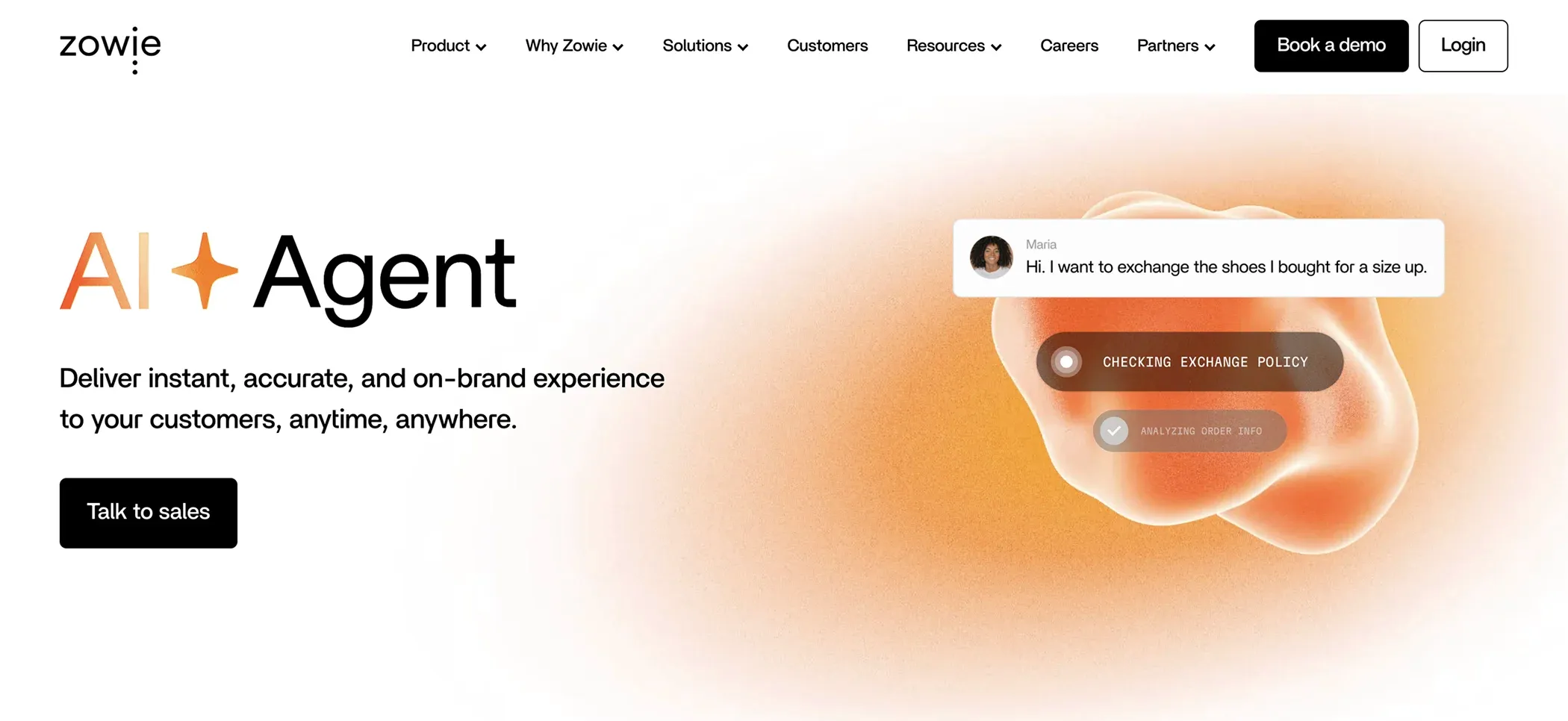
Zowie promises automation that doesn't feel robotic. The company delivers it with proprietary technology designed to eliminate the biggest problem with AI customer service – hallucinations. Their Zowie X2 solution relies on multiple popular LMMs from companies such as OpenAI, Google, Anthropic, and Meta. It enables the AI agent to produce deterministic outputs that follow your exact business logic every time.
Key features:
Proprietary technology to enforce brand consistency
Decision Engine for 100% accurate workflow execution
All workflow stages covered: refunds, returns, order modifications, etc.
Reasoning Engine that pulls company context for personalized responses
Omnichannel automation with a customized tone of voice
Support of 70+ languages and multiple integrations
SOC 2 Type II, GDPR, and CCPA compliance
Best for: Mid- to large ecommerce brands with high ticket volume, especially those operating internationally.
Pricing:
Personalized
Not publicly disclosed
DigitalGenius
DigitalGenius was built exclusively for ecommerce purposes. The platform integrates deep into your operations – logistics, warehouse, customer support, etc. One of its highlights is the integration of conversational and visual AI. With this, DigitalGenius can see product defects in customer photos and automatically trigger refunds or replacements. It also excels in understanding customer intent and emotions.
Key features:
Visual AI for processing customer photos and barcodes
Generative AI powered by OpenAI, but fine-tuned
Voice AI for multi-channel phone support
Omnichannel deployment (chat, email, voice, social, in-app)
Integrations with platforms, shipping carriers, ERPs, payment providers, etc.
Proactive automation for order monitoring and issue resolution
Purchase AI for pre-sale product recommendations
60+ pre-built ecommerce use cases
Best for: Brands with high-volume orders, especially those aiming to optimize complex post-purchase logistics.
Pricing:
Free to install
License fees start at $1,000/month
Moby Agents by Triple Whale
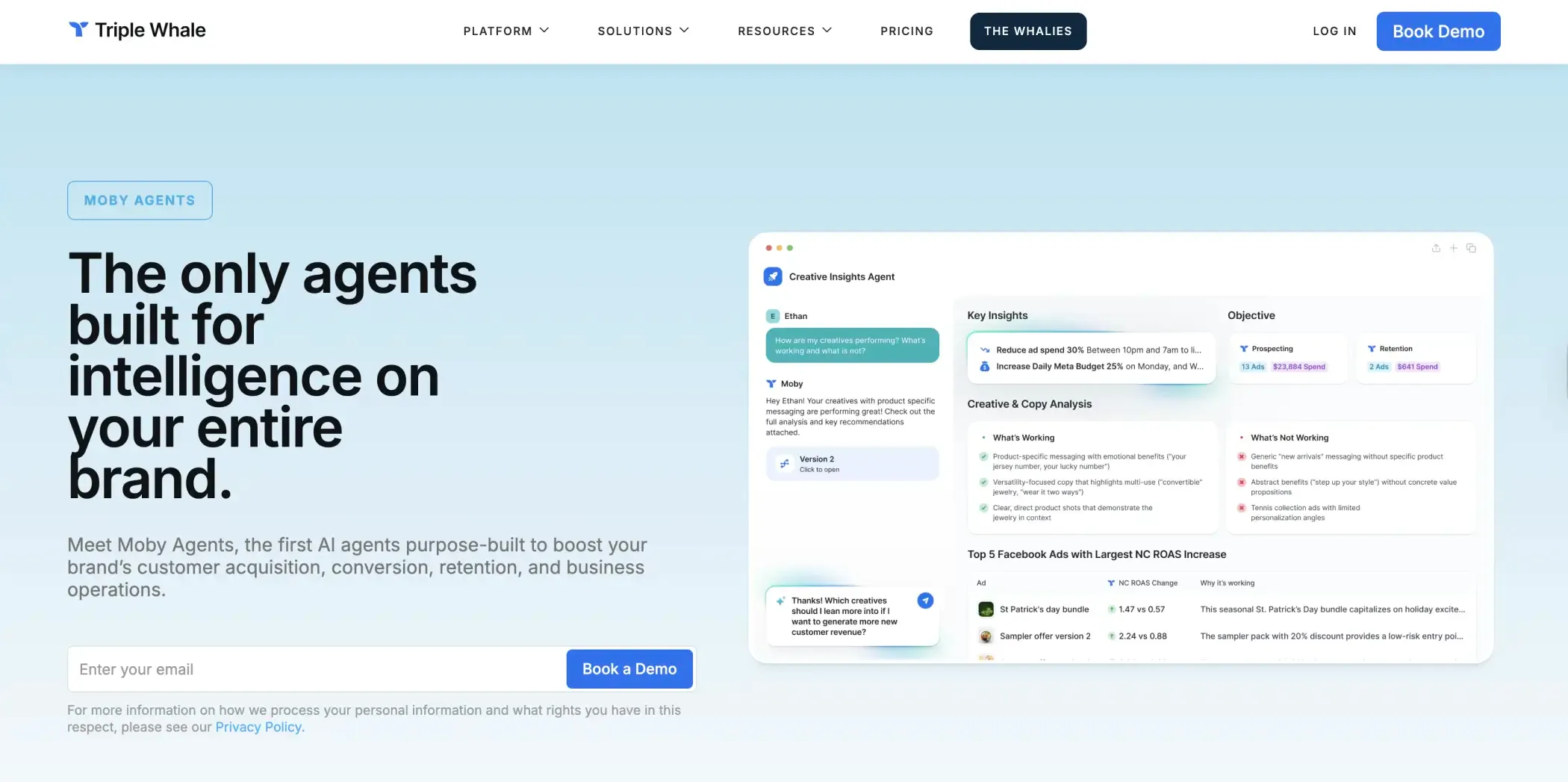
Triple is an analytics and business intelligence tool that brought AI agents to ecommerce operations. Moby Agents autonomously analyze your entire business to surface insights, detect anomalies, and make strategic recommendations. It's basically an AI analyst that monitors ad performance, forecasts revenue, flags budget waste, analyzes creative fatigue across 600+ ad variations, and catches issues – all without your constant control.
Key features:
AI agents for acquisition, conversion, retention, and operations analytics
Moby Chat for natural language queries about your business data
Multiple agents employed to tackle complex strategic questions
Unified data platform pulling from 50+ integrations (Shopify, Meta, Google, etc.)
Anomaly detection across spend, performance, and site behavior
Seasonal and linear forecasting models with confidence intervals
Action execution directly in marketing channels (pausing ads, etc.)
Best for: Data-driven brands seeking strategic intelligence and forecasting.
Pricing:
Free version with essential tools available
Starter – from $149/month.
Advanced – from $219/month.
Configurable prices for over $250K GMV
Fin by Intercom
Fin claims to be the "#1 AI agent for customer service." It was built by Intercom – a customer service platform with 25,000+ users. Fin employs a proprietary AI Engine with a multi-layer architecture specifically designed for complex support queries. You can train this AI agent on your exact workflows, test its behavior through simulated conversations before going live, then deploy it across every channel.
Key features:
Proprietary engine with six-layer optimization
Custom Procedures that teach Fin complex multi-step workflows
Testing playground to simulate full conversations before launch
Performance analysis with further suggestions for improvements
Omnichannel deployment (voice, email, live chat, social, in-app)
Works with any helpdesk or standalone
ISO 27001, ISO 27018, ISO 27701, GDPR, and CCPA compliant
Best for: Businesses with high support volume aiming for the highest resolution rates possible.
Pricing:
Free 14-day trial
With your current helpdesk – $0.99 per resolution
Fin with Intercom's Helpdesk – $0.99 per resolution + $29/month per helpdesk seat
Copilot – $35/month per user with a personal AI assistant included
Early Stage Program for startups with a 90% discount
How to choose the right AI agent for your store
Using AI agents in ecommerce requires strategic planning. You need to match the tool's capabilities to your actual needs and constraints. For this, identify where your store is losing time or money. Then, answer the following questions:
What problem are we trying to solve? It will determine what category to look in.
Does it integrate with our existing stack? It defines the ease of implementation.
What's our store size and complexity? Some agents are built for scale and seem overwhelming. The other may limit your capabilities.
How much control and automation do we want? Different use cases call for different options.
What's our technical capacity for implementation? A lot depends on whether you can involve a developer.
What does pricing actually include? Think beyond subscription – training time, scaling, etc.
How will we measure success? Without clear benchmarks, you cannot tell if there's a real result.
Make sure to be specific. Otherwise, you risk wasting time and money on a generic solution that was never supposed to help. Pick what promises to solve a specific and measurable problem you are actually facing.
AI agents for ecommerce: Challenges and ways to overcome them
Something this promising doesn't come without challenges to balance the magic. AI agents can introduce real friction points that can derail implementation if you're not ready for them.
#1 Data quality. AI agents learn from your historical data – customer interactions, product information, purchase patterns. If that data is messy, incomplete, or inconsistent, the agent will make poor decisions.
The fix: Clean your data before implementation. Keep it relevant and well-structured.
#2 Complexity. Adding an AI agent means another integration point – and sometimes several if the agent needs access to multiple systems.
The fix: Prioritize agents with native integrations for your core stack. Map out all the systems the agent needs to access. Confirm those integrations actually exist and work.
#3 Mistakes. The autonomy that makes AI agents in ecommerce valuable also creates risk. The potential mistakes can be expensive.
The fix: Set proper mechanisms – spending limits, approval for high-value actions, etc. Most platforms let you operate in a "suggest but don't execute" mode. Use it initially and scale up autonomy as you build confidence in the agent's judgment.
#4 Resistance or misuse. If your support team sees an AI agent as a threat to their jobs, they won't help it succeed. If they put too much trust in a tool, they will delegate too much. In both cases, the team refuses to use the human and AI collaboration to its full potential.
The fix: Bring your team in early and train people properly. An agent is only as good as the humans who set its parameters and interpret its outputs.
#5 Performance degradation. Customer behavior changes. Product catalogs evolve. Seasonal patterns shift. An agent trained on last year's data might underperform if it's not continuously learning from new interactions.
The fix: Even the best AI agents for eсommerce stores require occasional fine-tuning. Build maintenance into your workflow. Schedule regular reviews of agent performance metrics. Update training data quarterly. Watch for when recommendations or responses start feeling off. It marks a change in underlying patterns in your business
#6 Privacy and compliance. Depending on where you operate, you must comply with GDPR, CCPA, or other applicable privacy regulations. Customers might also just feel uncomfortable with how much an AI knows about them.
The fix: Verify that any agent you implement is compliant with regulations in your markets. Check what data it stores, where it's stored, and how long it's retained. Build transparency into the customer experience by clearly communicating that you're using AI.
As you can see, everything is manageable with good preparation. Just consider the challenges upfront, and they won't become surprises discovered mid-implementation.
The final word
AI agents that help ecommerce aren't a perfect or magic solution that will improve everything in an instant. Yet they solve operational problems and have proven to drive real results. Your task is to identify where an AI agent would be most useful to narrow the choice. And if you need guidance on putting that transformation into action – choosing the right solution, integrating it, and customizing it – reach out to DigitalSuits. Our team can help you set up the AI agent of your preference or build a custom AI solution.
Frequently asked questions
What customer data do AI agents need access to?
It depends on what the agent does. AI solutions for customer support, marketing, and operations all need different data to learn and function. If privacy is a concern, review the specifications when selecting an AI agent. Most platforms let you control data access through permission settings and suggest which data to access for optimal effectiveness.
Can I use multiple AI agents simultaneously?
Yes, and many stores do. It's common to integrate one solution for customer service, another for recommendations, and yet another for search. As long as they handle different functions, they generally coexist fine.
How often do AI agents need to be retrained or updated?
Most AI agents retrain themselves continuously in the background using real-time performance feedback. You only need to review overall performance manually once in a quarter to see whether business patterns have shifted enough to need reconfiguration.
How long does it take to see ROI from an ecommerce AI agent?
It depends. Customer service agents often see results within weeks, with reduced ticket volume and faster response times. Personalization agents take longer – typically 2-3 months as they collect behavioral data and learn what works for your audience. Some agents deliver only qualitative improvements that don't translate directly into numbers.

Written by
Kateryna Sukhova
Content Marketing Manager
Kateryna brings over 7 years of experience writing well-researched, compelling B2B content that bridges business goals with real audience needs - without losing clarity or personality.












Was this helpful?
0
No comments yet