









Bluetooth Low Energy (BLE) is what powers a lot of devices we use in our everyday routine. Unlocking a door with your phone, syncing with your fitness tracker, and finding lost keys – all of these often rely on BLE.
Even though it doesn't get the same attention as AI, BLE makes big work behind the scenes. And many companies use this technology to solve a very specific and real problem – connecting devices without draining batteries. This article breaks down what BLE is and how it works in detail.
TL;DR: Bluetooth Low Energy (BLE) essentials
- Bluetooth Low Energy (BLE) is a wireless technology intended to connect devices, especially those with tiny batteries, for data transfer with the minimal energy consumption.
- BLE differs from classic Bluetooth in that it is designed for transferring small chunks of data, such as in fitness trackers, while classic Bluetooth is a better option for larger data transfers like music streaming.
- BLE core benefits are low-power mode, fast communication, direct connection to a smartphone or other gateway devices, and low cost of implementation.
- BLE is used in wearables and smart homes, in industrial sensors and electronic shelf labels, for asset tracking and retail proximity campaigns.
What does BLE mean?
Bluetooth Low Energy (BLE) is a wireless technology that allows sending and receiving signals between devices with minimal power usage. BLE is a part of the broader Bluetooth standard, but it behaves quite differently.
What is Bluetooth Low Energy in simple terms? To answer this question, it's best to look at the problem it was intended to solve. As devices like sensors and wearables proliferated, it became clear that existing wireless technologies weren't sufficient for them. Wi-Fi consumed too much power, while classic Bluetooth required a continuous connection. BLE filled the gap – it was designed to send small packets of data within some time intervals, consuming very little energy.
The history of Bluetooth Low Energy (BLE)
The BLE story goes back to 2001, when Nokia began working on a new wireless standard under the codename Wibree. The goal was ambitious but very practical – create a radio technology efficient enough to run on something as small as a watch battery.
In 2006, due to its potential, Wibree was absorbed into the broader Bluetooth ecosystem.
In June 2010, BLE was officially introduced as part of the Bluetooth 4.0 version.
In 2016, with the release of Bluetooth 5.0, BLE doubled data transfer speed and significantly increased communication range.
In 2019, Bluetooth 5.1 improved device positioning accuracy and enabled direction-finding BLE capabilities.
In February 2023, Bluetooth 5.4 made BLE suitable for large-scale deployments with one-to-many connections and new power-saving strategies.
In 2026, the BLE team is working on the next-gen performance and AI integration.
That's how BLE has grown into a technology with many advanced features that still meets market demand. And it's especially critical for IoT applications.
The importance of BLE in IoT
IoT devices are widespread not only in the form of wearables like fitness trackers or smart building systems, but also in industrial areas in the form of sensors and tags that help monitor the state and location of the equipment. These tags may be situated in hard-to-reach places and deployed at scale, so if they require regular recharging, the cost and effort for their maintenance quickly add up. That's where BLE makes the difference.
Instead of being active all the time, BLE devices wake up to exchange pieces of data and go back to sleep. That simple shift is what allows them to operate for months and even years on a small battery without recharging. And that's the reason why manufacturers and sellers around the world, such as Amazon, utilize BLE for large-scale deployments.
BLE vs classic Bluetooth
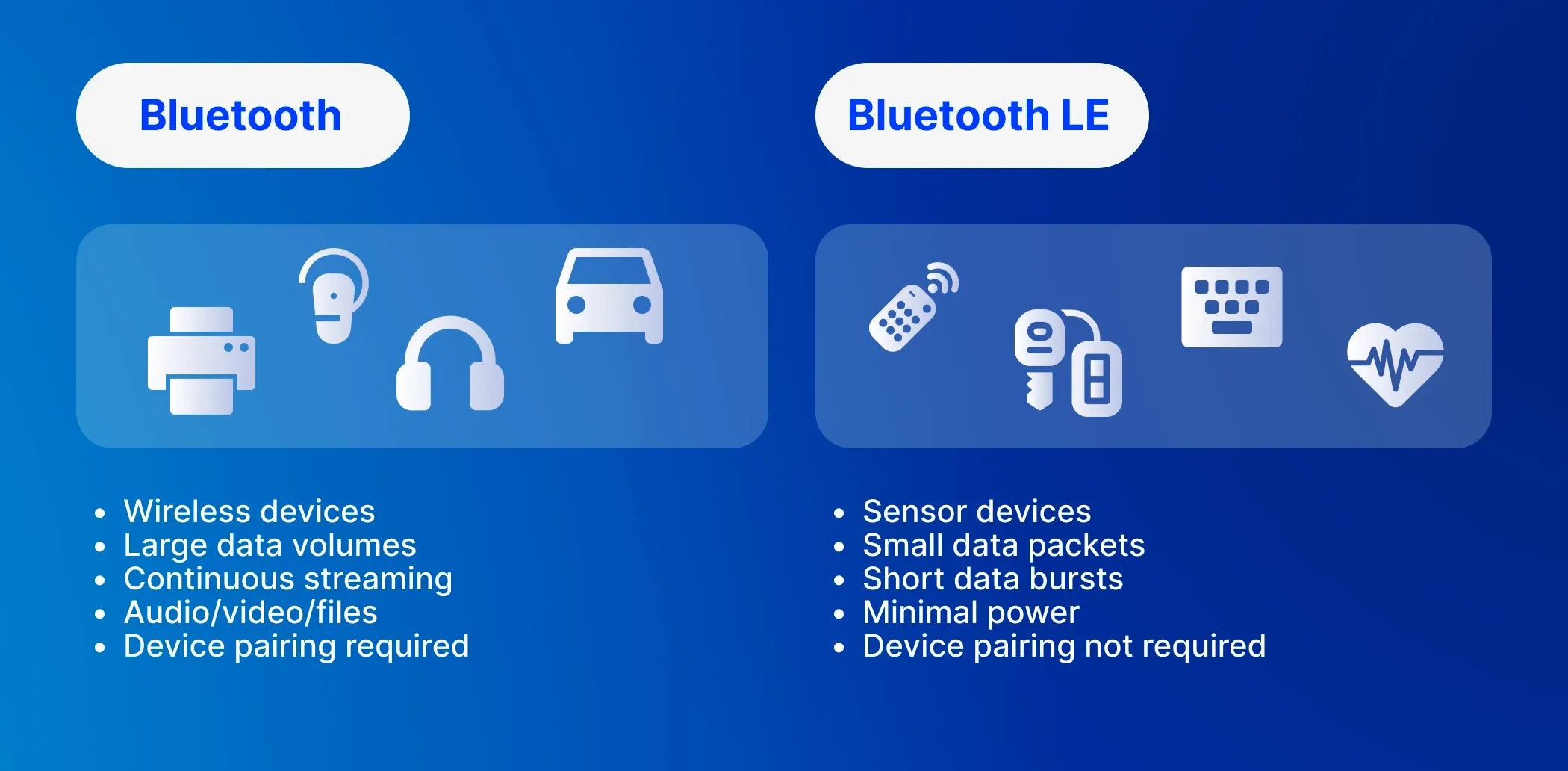
Classic Bluetooth is intended for transferring large files – for example, streaming music to headphones. So it prioritizes steady data flow and continuous connection. BLE, although it's a part of the Bluetooth ecosystem, takes a slightly different approach. It uses the same frequency (2.4 GHz) and a similar device pairing strategy, but its focus is on optimizing energy consumption. Instead of maintaining a constant connection, BLE devices spend most of their time in a low-power state, only activating to send a small chunk of data.
This slight difference in operation between BLE and classic Bluetooth leads to big differences in performance and areas of application.
| Feature | Bluetooth | BLE |
|---|---|---|
| Power consumption | Higher | Very low |
| Data throughput | Up to 3 Mbps | Up to 2 Mbps |
| Latency | ~100 ms | ~6 ms |
| Typical range | ~10–100 m | ~50–300 m |
| Battery life | Hours to days | Months to years |
| Best for | Audio streaming, file transfer | Sensors, beacons, wearables |
Bluetooth Low Energy technology vs other protocols
For a better understanding of Bluetooth Low Energy specifics, let's take a glance at other wireless connection protocols. Some of them are also known for low-power communication and could be an alternative to BLE.
Wi-Fi offers direct Internet connection and fast data throughput, but it comes at a cost of high energy consumption, which is a dealbreaker for small devices.
NFC works at a range of just a few centimeters, which is great for contactless payments, but ineffective for continuous communication at broader distances.
Z-Wave operates at a much lower frequency (sub-1 GHz) to avoid the crowded 2.4 GHz Wi-Fi band. This feature makes it a secure and reliable solution to support device networks like smart homes. However, Z-Wave devices can't connect directly to smartphones and are typically of a higher cost than BLE.
Zigbee is like Z-Wave, another mesh networking (many-to-many devices) technology for smart homes. Unlike Z-Wave, though, it operates on 2.4 GHz frequency, which makes it less secure and more affordable. Compared to BLE, Zigbee requires a dedicated hub to connect to a phone or the Internet, while BLE connects directly to smartphones.
Thread/Matter is a comparatively new mesh technology for smart homes, where every device in the network has its own IP to connect to the Internet without a bridge. Thread is typically a choice for robust systems, while BLE is considered a more affordable option for simpler architectures.
Compared to other protocols, BLE stands out due to its direct connection to smartphones that can send data to the cloud, extremely low power consumption, and affordability.
How does BLE work?
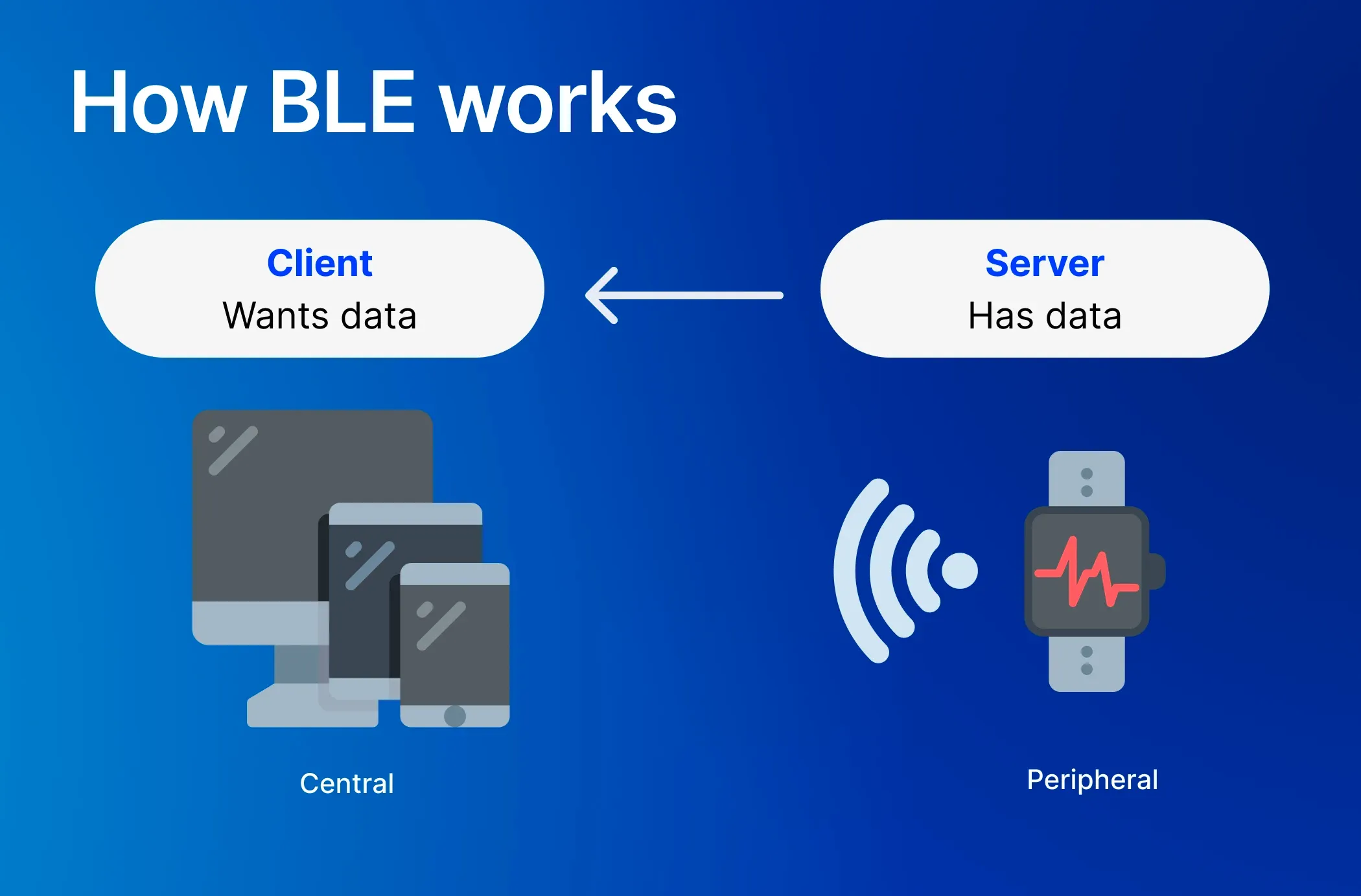
Now, let's dive into how BLE operates. Basically, the BLE technology is built around the connection between two devices – the central and the peripheral.
The central device, such as a smartphone, scans nearby devices and initiates connections. The peripheral device, such as a wearable, broadcasts small signals known as advertisements or waits for the central device to initiate a connection. For example, a fitness tracker would be a peripheral device, and a phone that gets data is the central one.
BLE operates within the 2.4 GHz frequency band using 40 separate channels. Three of them are for advertisements sent by a peripheral device. That's where the central device listens to where the peripherals are. The other 37 channels are for the central device to establish a connection and exchange information. Depending on the use case, peripheral devices transmit data at set intervals, ranging from 7.5 ms to 4 seconds.
Bluetooth Low Energy architecture
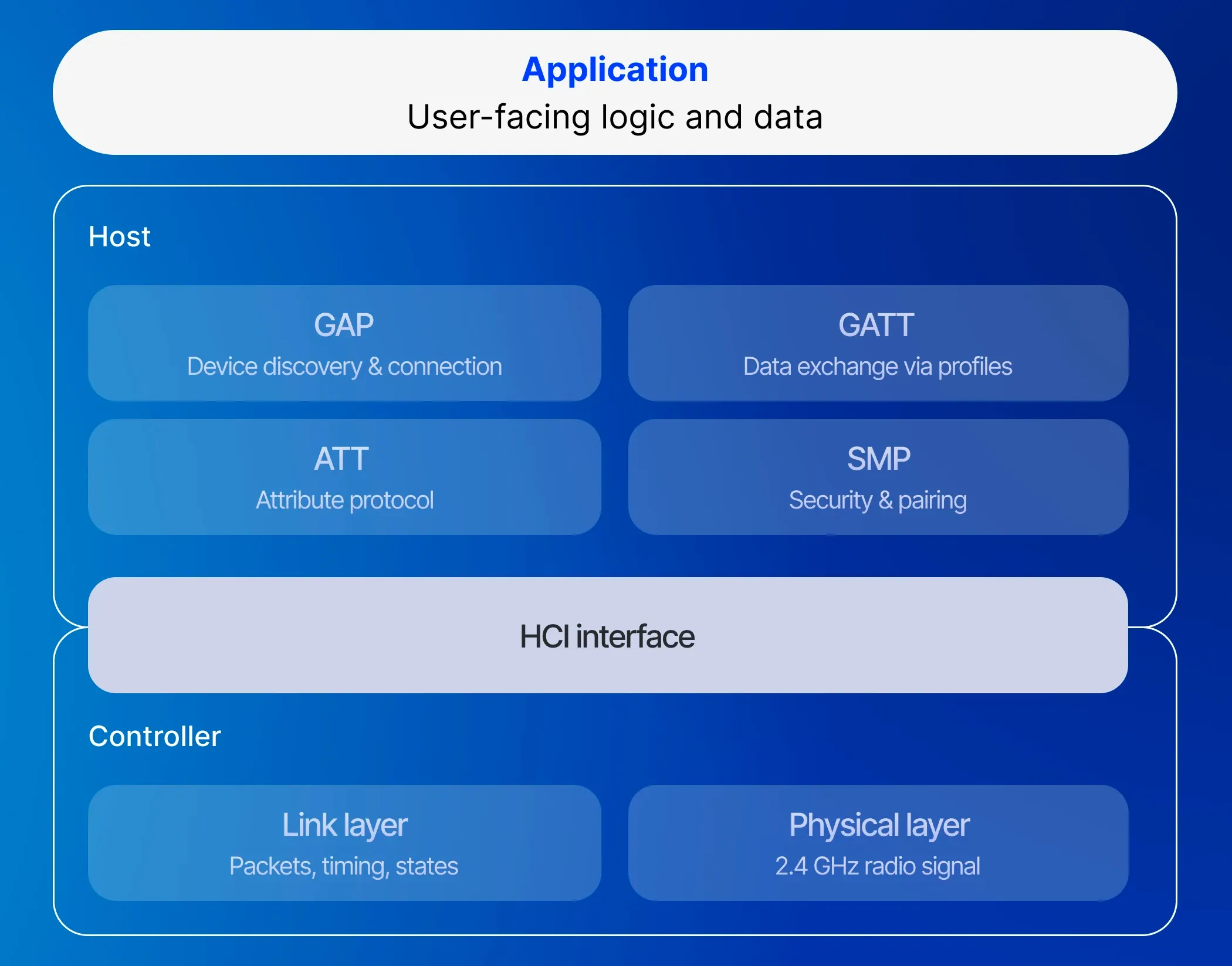
What has been discussed may picture BLE as a very simple technology, but there is a complex architecture behind the scenes. It includes multiple layers, each playing a specific role in how the data is transmitted and interpreted.
The application layer defines what kind of data is collected and how it's organized and interpreted. Simply said, it's a user interface, often produced through the BLE app development process. At this layer, the Generic Attribute Profile (GATT) framework is the most important, since it defines how a central device reads, writes, and receives information from peripherals.
The host layer handles how devices discover each other, and how they connect and exchange data. Key components of the Host are GATT for structuring and exchanging data, GAP (Generic Access Profile) for discovery and connections, and SMP (Security Manager Protocol) for pairing and encryption. Another critical part is the Attribute Protocol (ATT), which provides the underlying mechanism used by GATT to transfer data. ATT defines how data is organized into attributes and how these attributes are accessed (read, write, notify) between devices.
The controller layer is the closest one to the hardware built into the BLE chips. It manages the behavior of BLE (peripheral) devices. This layer includes the Link Layer, which is responsible for packet formatting, transmission timing, connection states, and managing communication events between devices. It also includes the Physical Layer, which handles the actual transmission and reception of data over the air using 2.4 GHz radio signals.
Host Controller Interface (HCI) is what allows the Host and the Controller to communicate with each other.
What are the key features of BLE?
BLE has a range of features that make it a choice for many applications. Some of the BLE's features we've already discussed briefly. Here, you can see them all in a single list.
Low energy consumption. BLE devices can use as little as 15 µA on average, which is extremely helpful for prolonging battery life, especially for devices with tiny coin-cell batteries.
Fast connection. It takes no more than 6 milliseconds for BLE devices to turn from broadcasting the signal to a live connection with the central device.
Adaptive Frequency Hopping (AFH). Due to 40-channel communication, BLE allows for avoiding other too crowded channels, which leads to lower interference and higher reliability.
AES-128 encryption. BLE supports encryption at the level when devices connect to each other, so you don't need to build your own security solutions from scratch.
Broadcast mode lets peripheral devices send signals to unlimited receivers without the need for pairing. This makes BLE ideal for indoor marketing campaigns, especially those based on proximity to some object.
Mesh networking, included in BLE starting from Bluetooth 5.0, lets you build a network of devices that talk to each other across a large area. That's the feature crucial for smart home infrastructures.
BLE benefits and limitations
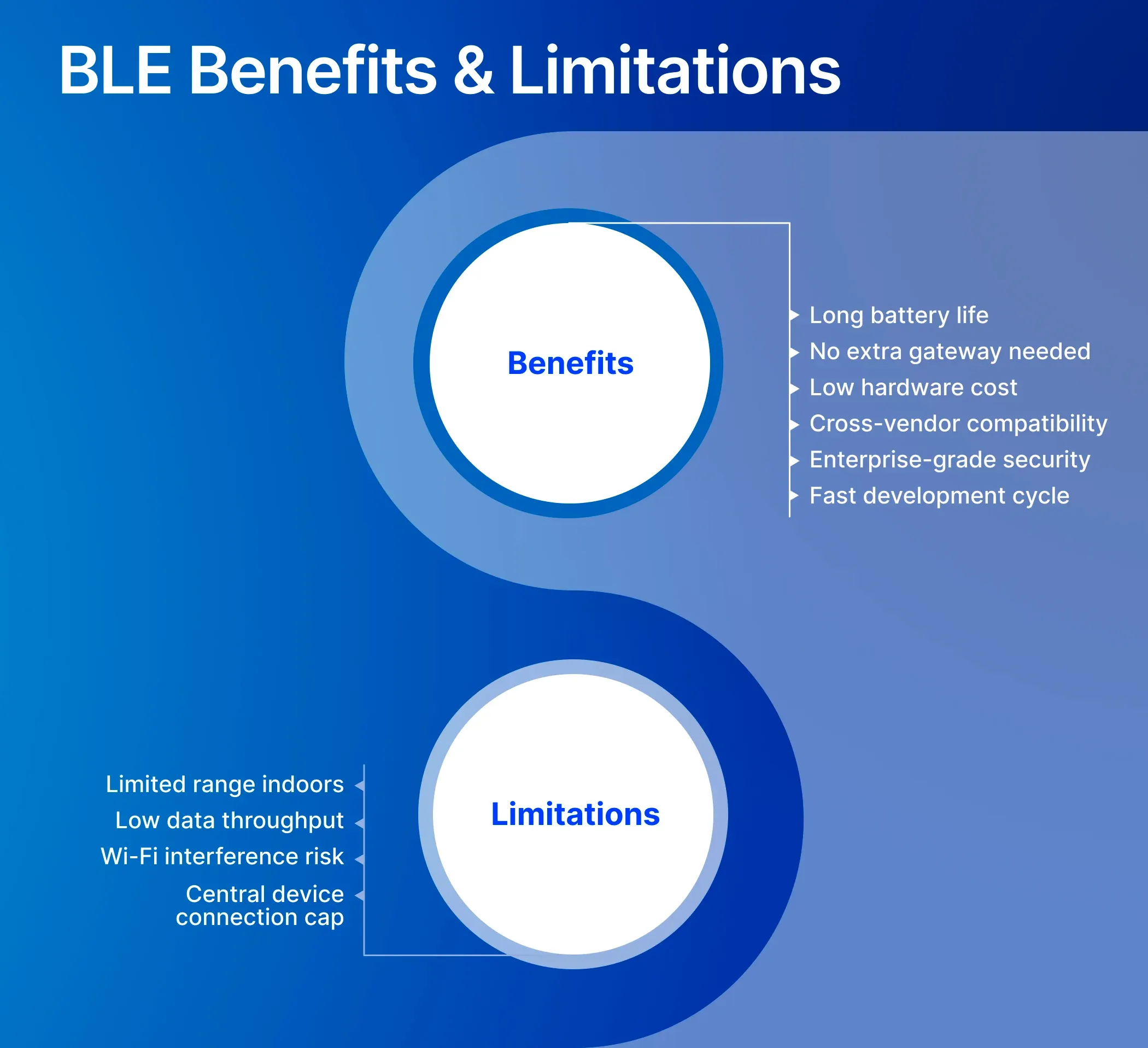
Let's take a look at what BLE does well and where it has some limitations.
Advantages of BLE
BLE is well-known for its power efficiency that lets companies use the same devices for a long period of time without changing the batteries.
Every modern smartphone or tablet supports BLE, so you don't need any costly extra gateways for data exchange.
A BLE module from companies like Nordic Semiconductor can cost up to $2, which makes it a cost-effective solution even for large-scale networks.
A BLE peripheral from one supplier can easily communicate with the central device of another manufacturer, making it easy to change if needed.
Thanks to its strong security level, BLE is considered a reliable solution even for enterprise wireless networks.
BLE app development is quite fast since many SDKs and open-source stacks are available along with extensive documentation.
BLE limitations
BLE works at about 100 metres range in an open space, while walls could be interferers.
BLE's maximum speed of transferring data is around 1–2 Mbps, which is not sufficient for files larger than sensor data.
BLE shares frequency with Wi-Fi, which may cause additional retries in crowded environments.
Peripheral BLE devices support unlimited connections, but the central device is often limited to a fixed number of connected devices.
Where is BLE used today?
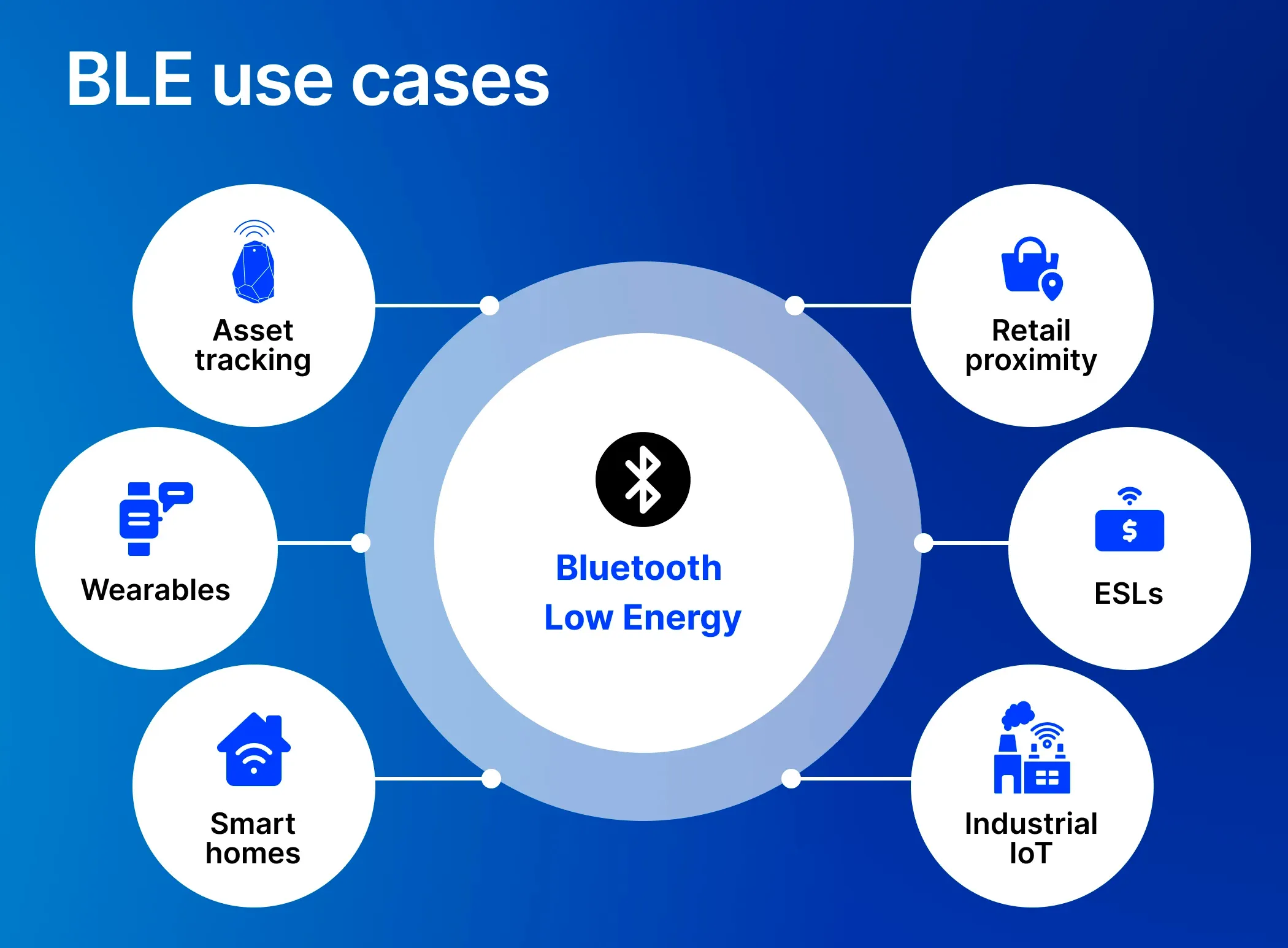
Given robust BLE capabilities, the number of its applications is growing every year. We've compiled a list of the current and the most popular BLE use cases.
Wearables. Devices like the Apple Watch and Garmin fitness trackers all rely on BLE in syncing data with smartphones. Another, more industry-specific application is a wearable glucose monitor that tracks blood sugar levels in real-time.
Asset tracking. Hospitals, airports, and warehouses use BLE beacons to track where at the moment their equipment, luggage, and even people are. Every beacon sends a signal with its ID that helps to find its location with a phone based on proximity calculation.
Smart homes. BLE powers the lighting controllers, thermostats, and door locks in a smart house, making it easy for the owner to control the system with their phone.
Electronic shelf labels (ESLs). The BLE technology allowed the replacement of traditional paper price tags with ESLs, all controlled from a central device. The Bluetooth 5.4 release made it possible to update thousands of labels per second.
Retail proximity. The BLE beacons placed on stores can interact with customer smartphones once they're close to a beaconed object. This enables personalized in-store marketing.
Industrial IoT. In manufacturing, sensors that measure temperature or pressure can send signals via BLE. This way, manufacturers can monitor the condition of their equipment and ensure timely maintenance.
Need a BLE solution for your specific case? At DigitalSuits, we help companies estimate the project feasibility, find the right solution, and build it from the ground up. See what’s possible with our BLE app development services.
What’s next for Bluetooth Low Energy?
In 2023, the global BLE market was valued at around $11.5 billion and is predicted to grow further by roughly 19% to 2035. To keep the pace and to compete with other technologies in the market, BLE makes steps towards even more advanced features. What new things are coming?
The Channel Sounding feature introduced in Bluetooth 5.4 makes it possible to measure proximity at a centimeter-level accuracy.
BLE-powered mesh networking is becoming even more solid – there is a demand for BLE in access control systems and lighting management in commercial buildings and educational organizations.
Audio streaming support for BLE is becoming a reality, allowing one device to stream to multiple receivers.
BLE tends to be an indispensable part of any smart home since it's widely used to onboard and configure devices in the network.
The bottom line
If your product or service needs to connect multiple devices, especially small ones, that scan different parameters with maximum power efficiency, and send data via a phone, Bluetooth Low Energy is the best choice you can make. On the other hand, if this technology limits you in any way, you can choose from other options. To understand precisely whether BLE is the right technology for your case, contact DigitalSuits for a consultation.
Frequently asked questions
Can Bluetooth Low Energy work without a smartphone?
Yes, a smartphone is not the only tool that can serve as a gateway for BLE devices. Among other options are laptops, tablets, or embedded systems tailored to the specifics of the business.
What is the difference between a peripheral's advertising and a connection with a central device?
In the advertising mode, a peripheral device doesn't need to pair with a central device. It just sends small packets of information within some intervals of time. Once connected, peripheral and central devices can talk, transmitting data to each other. As an example, industrial beacons operate solely in the advertising mode, while health trackers can connect to a phone to send and receive data.
How many BLE devices can be connected simultaneously?
It mostly depends on a central device. Some dedicated solutions can support even hundreds of connections, while smartphones typically handle no more than 7-10 simultaneous connections.

Written by
Anastasiia Moskvichova
Content Marketing Specialist
Anastasiia is an enthusiastic content writer who diligently researches and curates valuable information to craft engaging content tailored for readers with a keen interest in marketing, sales, and technology.








Was this helpful?
0
No comments yet